
SoldLand
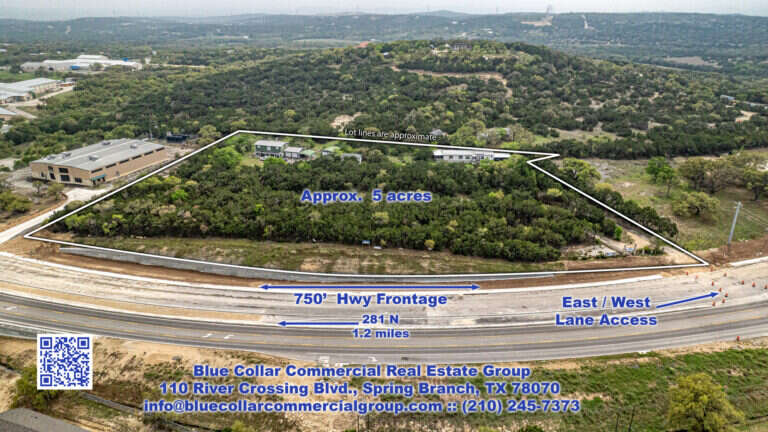
21393 TX-46, Bulverde
Asking price $1,595,000 · Closed June 2026
Guadalupe County commercial real estate entered Q3 2026 with stark sector divisions. Retail and office remain tight at 3.0% and 2.6% vacancy respectively, holding landlord-favorable pricing. Industrial vacancy climbed to 6.0% under a heavy 635,000-square-foot construction pipeline, while multifamily vacancy hit 13.2%. Investors must navigate distinct supply constraints and gluts across different asset classes.
Data through October 6, 2026 · Published October 29, 2026 · By Blue Collar Commercial Group
Source: market data through October 6, 2026.
The Guadalupe County commercial market entered Q3 2026 split by asset class, with market data current through October 2026 showing landlord-favorable conditions in retail and office, but tenant-favorable shifts in industrial and multifamily.
Retail vacancy sits at 3.0% with rents up 4.3% year-over-year, while office vacancy rests at a tight 2.6%. Conversely, industrial vacancy rose to 6.0% amid a 635,000-square-foot construction pipeline, and multifamily vacancy reached 13.2% as new supply outpaced 565 units of trailing absorption.
The headline: Supply dictates the leverage. Retail and office owners hold pricing power, but industrial and multifamily landlords must compete for tenants as significant pipelines deliver.

Rex Blackburn, Commercial Director
210-823-3721
This report covers the whole market. Rex can tell you what it means for your property.
Talk to RexVacancy rates across Guadalupe County commercial sectors diverged sharply in Q3 2026, driven by varied supply additions. Retail vacancy held at 3.0%, matching the sector’s 10-year average through 2025. With vacancy this low in retail and office, those sectors remain landlord-favorable — owners set lease terms and concessions stay minimal because tenants compete for limited available space. Industrial vacancy climbed 170 basis points year-over-year to 6.0%, doubling its 10-year average of 3.0%. The industrial and multifamily sectors have shifted to tenant-favorable conditions as new deliveries outrun demand.
The divergence in vacancy stems entirely from what developers chose to build over the past 24 months. Industrial net absorption ran negative by 174,000 square feet over the trailing year, colliding with 91,500 square feet of deliveries and pushing vacancy up. Multifamily absorbed a healthy 565 units, but 350 delivered units and a backlog of recent completions kept vacancy elevated at 13.2%. Retail absorbed 133,000 square feet against 235,000 square feet of deliveries, keeping the market tight despite the new space. Office saw almost no new supply, with just 11,600 square feet delivered against 22,700 square feet of absorption. The gap between retail and industrial absorption illustrates how differing supply pipelines dictate occupancy.
The differing vacancy rates mean participants must price leverage according to the specific asset class. A retail or office tenant seeking space faces limited options and stiff competition, making early renewal negotiations critical. An industrial tenant looking for warehouse space should view the rising vacancy as leverage for elevated tenant improvements. An owner of stabilized retail product holds genuine scarcity value, especially along the primary highway corridors. A multifamily investor must expect longer lease-up periods and higher concession packages until the current supply wave fully absorbs. The 635,587-square-foot industrial pipeline is the number that guarantees these tenant-favorable conditions will persist into next year.
The commercial landscape across Guadalupe County varies significantly by municipality and corridor. Schertz holds the bulk of the county’s 16.4 million square feet of industrial inventory, concentrated along the Interstate 35 corridor. Seguin commands a growing share of retail and manufacturing space, driven by population growth along Highway 46. Cibolo features a mix of newer retail strip centers and residential development, serving an expanding local base. The county’s demographic foundation supports this activity, with 183,642 residents and an average household income of $111,083 per the 2020-2024 ACS.
| Sector | Vacancy (Q3 2026) | Trailing Absorption | Under Construction |
|---|---|---|---|
| Retail | 3.0% | 133,000 SF | 238,917 SF |
| Industrial | 6.0% | (174,000) SF | 635,587 SF |
| Office | 2.6% | 22,700 SF | 10,800 SF |
| Multifamily | 13.2% | 565 Units | 282 Units |
These submarket concentrations reflect the county’s infrastructure and geographic positioning between San Antonio and Austin. Schertz captures the heavy logistics demand because it offers direct Interstate 35 access and proximity to San Antonio’s labor pool. Seguin draws manufacturing and retail investment due to its Interstate 10 frontage and available land parcels. Cibolo acts as a primary residential node, which pulls neighborhood retail and grocery-anchored development into its borders. The $111,083 average household income provides the spending power that keeps retail vacancy pinned at 3.0% despite recent deliveries. The 133,000 square feet of retail absorption confirms that consumer demand remains strong across these corridors.
Investors must align their acquisition strategies with these established submarket roles. A buyer targeting logistics assets should view the Interstate 35 corridor in Schertz as the primary institutional target. A retail developer should expect the strongest demographic support in Cibolo and along the Highway 46 corridor in Seguin. An owner of older industrial product in Seguin faces different tenant profiles than a landlord holding modern distribution space in Schertz. A tenant seeking retail space must recognize that the high household incomes in these corridors keep landlord pricing power firm. The submarket divisions dictate where specific commercial strategies actually work.
Rental rate trajectories in Guadalupe County split cleanly between the supply-constrained and supply-heavy sectors in Q3 2026. Retail asking rents averaged $23.00 per square foot, representing a strong 4.3% year-over-year increase. Office asking rents reached $28.00 per square foot, posting a modest 0.5% annual gain. Industrial asking rents averaged $10.70 per square foot, up 2.1% from the prior year despite rising vacancy. Multifamily asking rents fell to $1,310 per unit, a 2.8% year-over-year decline as landlords competed for renters.
The rent growth figures directly mirror the supply-and-demand dynamics playing out in each asset class. Retail landlords pushed rents up 4.3% because 133,000 square feet of tenant demand chased a limited pool of available suites. Office rents grew marginally because the 2.6% vacancy rate provides stability, even though overall leasing volume remains thin. Industrial rent growth of 2.1% reflects landlords holding the line on face rates while likely increasing hidden concessions to secure tenants for the 635,587 square feet underway. Multifamily rents dropped 2.8% because the 13.2% vacancy rate forced owners to cut face rents and offer free months to maintain occupancy. The gap between retail and multifamily rent growth illustrates how completely new construction dictates pricing.
The divergence in rent trajectories dictates how market participants should read lease negotiations. A retail tenant facing a 2027 expiration must expect landlords to hold firm on face rates. An industrial tenant should expect flat renewals or substantial tenant improvement allowances on new leases. An office user should see flexible terms as achievable, knowing landlords prioritize stable occupancy over aggressive rent hikes. A multifamily investor must expect negative near-term rent growth and elevated concession budgets until the current supply wave absorbs. The 4.3% retail rent growth is the metric that proves the resilience of neighborhood centers.
The Guadalupe County construction pipeline is heavily weighted toward industrial development as of Q3 2026. Industrial developers had 635,587 square feet under construction, with 91,500 square feet delivered over the trailing 12 months. Retail construction totaled 238,917 square feet underway, following 235,000 square feet of recent deliveries. Multifamily developers had 282 units in progress, adding to the 350 units completed over the past year. Office development remains nearly non-existent, with just 10,800 square feet under construction and 11,600 square feet delivered. The sheer volume of industrial dirt turning is the defining feature of the county’s commercial landscape.
Construction activity aligns with institutional capital preferences and the realities of replacement costs. Industrial development leads the pipeline because the Interstate 35 corridor remains a primary logistics artery, justifying the capital outlay despite a 6.0% vacancy rate. Retail construction persists at 238,917 square feet because rooftops continue to multiply across the county, demanding new neighborhood services and grocery anchors. Multifamily starts have slowed to 282 units as developers pause to let the market absorb the existing 13.2% vacancy. Office construction remains stalled because current rents of $28.00 per square foot do not support the cost of new speculative development. The 635,587 square feet of industrial space underway ensures that supply will outpace demand through the end of the year.
The composition of the construction pipeline indicates where future pricing power will settle. An industrial landlord must expect continued competition as the 635,587 square feet of new supply delivers and fights for tenants. A retail owner holds a protected position, as the 238,917 square feet underway is largely pre-leased or built-to-suit rather than speculative strip space. An office landlord should see virtually no threat from new supply, ensuring that existing Class A and medical office spaces retain their value. A developer evaluating new projects should read the heavy industrial and multifamily pipelines as a signal to pause until absorption catches up. The 10,800-square-foot office pipeline is the number that secures existing landlord leverage.
Investment sales volume and cap rates varied widely across Guadalupe County commercial sectors over the trailing 12 months. Retail sales volume reached $4.4 million, with transacted cap rates averaging 5.0% and pricing landing at $321 per square foot. Industrial sales totaled $2.9 million, trading at an average of $144 per square foot and an 8.2% cap rate. Office transaction volume was thin at $1.2 million, with closed deals averaging $111 per square foot and cap rates near 7.8%. Multifamily recorded zero institutional sales volume over the trailing year as buyers and sellers failed to bridge pricing gaps. The $4.4 million retail volume confirms that capital still flows to assets with strong fundamentals.
The disparity in transaction metrics reflects the cost of capital and sector-specific risk premiums. Retail assets commanded premium pricing at $321 per square foot because buyers trust the county’s strong demographic growth and the sector’s tight 3.0% vacancy rate. Industrial volume slowed to $2.9 million as buyers hesitated to acquire assets amid rising vacancy and a heavy construction pipeline. Office volume remained muted because lenders require significant equity for office acquisitions, limiting the buyer pool to local owner-users. The complete halt in multifamily sales indicates that sellers refuse to capitulate to the higher cap rates buyers demand in a 13.2% vacancy environment. The 5.0% retail cap rate illustrates how aggressively investors will bid for certainty.
The transacted data provides the only reliable baseline for pricing assets in this market. A retail seller should expect strong interest and aggressive pricing, provided the asset is stabilized and located on a primary corridor. An industrial buyer must view acquisitions through conservative rent growth assumptions and expect a discount for the near-term supply risk. An office owner weighing an exit should view local owner-users as the primary target, as institutional capital remains absent. A multifamily owner must expect to hold and operate through the current cycle, as the lack of sales volume means any forced exit will likely require a steep discount. The $321 per square foot retail average is the only defensible benchmark for new retail listings.
Guadalupe County’s commercial demand is anchored by sustained residential migration and expanding infrastructure. The county’s population stands at 183,642, providing a deep consumer base for retail and services. Major highway corridors, specifically Interstate 35 and Interstate 10, drive the logistics and manufacturing requirements that fill industrial parks. Local municipalities are actively expanding water and utility lines to accommodate the residential subdivisions sprawling across the county. This combination of rooftops and roads forms the baseline for all commercial absorption in the market.
The mechanics of this demand are straightforward and tied directly to the San Antonio-Austin corridor’s expansion. Families relocate to Schertz, Cibolo, and Seguin for relative affordability and school districts, which immediately generates demand for the 133,000 square feet of retail space absorbed this year. The manufacturing sector grows in Seguin because companies require large, affordable land tracts with reliable power and direct interstate access. Logistics operators target the Interstate 35 frontage to serve both major metros simultaneously, even as new supply temporarily outpaces their leasing velocity. The $111,083 average household income ensures that the retail and medical office sectors remain insulated from broader economic cooling. The 183,642 population figure is the engine pulling the retail sector forward.
Market participants must tie their investments to these specific structural drivers rather than chasing national trends. A retail investor should view grocery-anchored or service-oriented strips as the primary beneficiaries of the expanding population base. An industrial developer must recognize utility capacity and highway access as the binding constraints before committing capital, as tenants will bypass functionally obsolete sites. A landowner holding acreage near Interstate 10 or Highway 46 should view their position as controlling the path of future development. A business owner selecting a site must view established utility infrastructure as a non-negotiable requirement, as municipal expansion timelines can delay openings by years. The $111,083 household income is the metric that underwrites new neighborhood center development.
We expect retail and office vacancy to remain below 4% through late 2027, as construction pipelines are too thin to disrupt landlord pricing power. Industrial vacancy will likely peak near 7% by mid-2027 as the 635,587 square feet under construction delivers, forcing owners to increase concessions to win tenants.
The bull case: Population growth accelerates along the Highway 46 corridor, rapidly absorbing the incoming industrial and multifamily supply while pushing retail rents past $25.00 per square foot.
The bear case: High interest rates and stubborn inflation stall residential purchasing, slowing the rooftop growth that drives retail demand and leaving the 282 multifamily units underway struggling to find renters.
A forecast is not a promise.
Our read on the Guadalupe County commercial market is that the leverage depends entirely on the sector you occupy. Retail and office owners hold the cards, while industrial and multifamily landlords are fighting a supply wave. Our recommendation for retail and office owners: push face rents aggressively on 2027 renewals, as tenants have virtually nowhere else to go. For industrial buyers, we recommend underwriting acquisitions with a hard ceiling of an 8.0% going-in cap rate to account for the near-term lease-up risk tied to the 635,587-square-foot pipeline.
If you hold older industrial product in Schertz or Seguin, do not attempt to compete on price with the new deliveries. Instead, invest in functional upgrades — power, lighting, and yard space — to capture the mid-size manufacturing tenants that institutional developers ignore.
Rex Blackburn, Commercial Director
For Buyers
Target retail strips along the Highway 46 corridor, but do not bid below a 5.0% cap rate, which aligns with the trailing 12-month transacted average. Industrial buyers should demand a discount for supply risk and target an 8.0% entry yield.
For Sellers
Retail owners are in a prime exit window; price assets to the $321 per square foot transacted average. Multifamily owners should delay selling if possible, as the complete lack of institutional sales volume indicates buyers will demand steep discounts for the 13.2% vacancy rate.
For Holders
Office owners should lock in early renewals now, leveraging the tight 2.6% vacancy rate to secure long-term stability without offering heavy tenant improvements.
Retail and office tenants in Guadalupe County face a tight market in Q3 2026. With retail vacancy at 3.0% and office at 2.6%, you have virtually no negotiating leverage on face rates. Tenants should start renewal conversations 12 months early and prioritize securing renewal options rather than fighting for rent reductions.
Conversely, industrial and multifamily renters hold the advantage. Industrial tenants looking at the 635,587 square feet under construction should push for 3-5 months of free rent on five-year terms. Do not sign an industrial lease at the $10.70 per square foot average without securing substantial tenant improvement allowances to offset the rate.
Sales count only sales with a reported price.
It depends entirely on the sector. Retail and office are landlord-favorable due to tight vacancy rates of 3.0% and 2.6%. Conversely, industrial and multifamily are tenant-favorable as new supply outpaces demand, pushing industrial vacancy to 6.0% and multifamily to 13.2%.
This report covers the Q3 2026 Guadalupe County commercial market, with data current through October 2026. It draws on brokerage market data, public records, and the 2020-2024 American Community Survey. All figures reflect Q3 2026 or trailing-12-month vintages as noted beside each statistic.
Data through October 6, 2026
Data through October 6, 2026
Data through September 30, 2026
Land, buildings and businesses we sold for our clients.
Asking price $1,595,000 · Closed June 2026
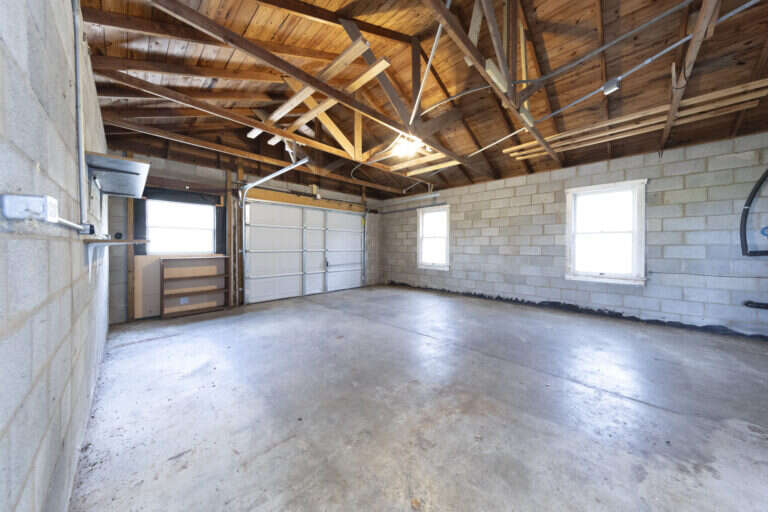
Asking price $1,700,000 · Closed June 2026
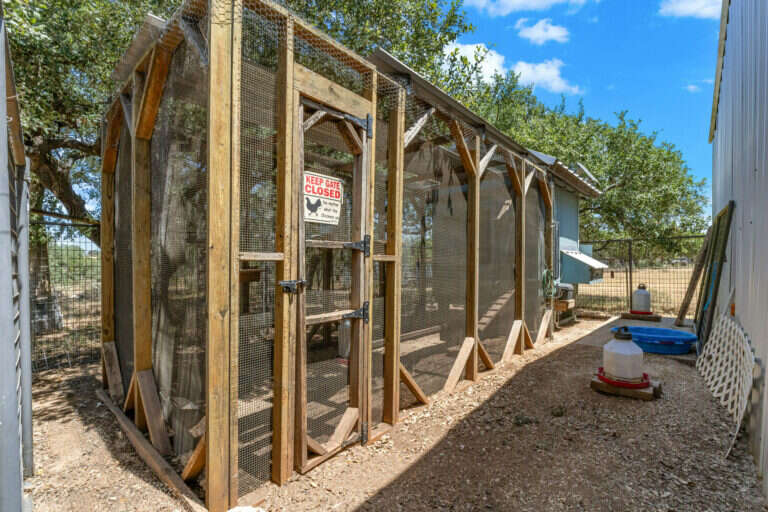
Asking price $1,095,000 · Closed April 2026
Based in New Braunfels. We work the I-35 corridor from San Antonio to Austin and out into the Hill Country. When the deal is farther out, we go there too.
New Braunfels, Bulverde, Canyon Lake, Spring Branch
Seguin, Schertz
San Marcos, Buda, Kyle, Wimberley
San Antonio, Converse, Selma, Stone Oak, Universal City
The Austin metro area
Blanco, Johnson City
Fredericksburg
Boerne
Each guide uses U.S. Census data: people, income and jobs.
What is changing in Texas land, water and growth, explained for owners, not insiders.
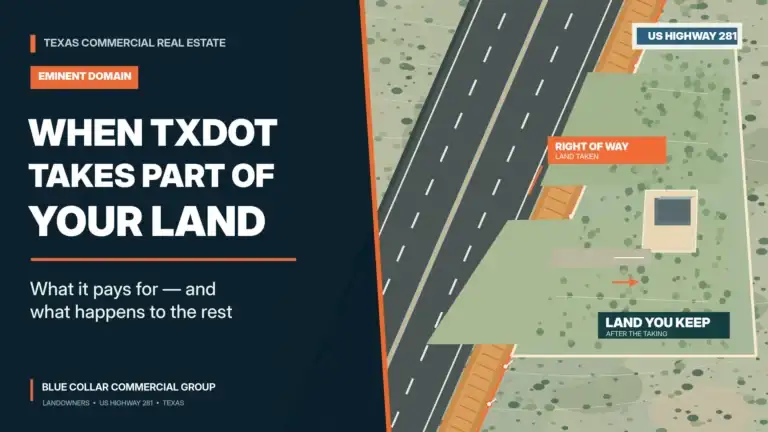
TxDOT taking part of your Texas land? See what the state pays for, which losses it doesn't count, how the process runs, and when…

Selling a Texas shopping center? See how a careful buyer rebuilds your income, which fixes can pay off, and how to handle tenant estoppels…

Buying your first Texas shopping center? See how vacancy, taxes and loan terms can turn a 7.5% return into 5%, and what to check…

A 15-minute call. Tell him what you own or what you want to buy. He will tell you what he sees, good and bad. No cost, no pressure.
Talk to Rexor call 210-823-3721
We Are Ready To Help You In Making Smart Real Estate Decisions
Whether you have questions about commercial real estate, need advice on your next investment, or are ready to take the next step, we’re here to help. At Blue Collar Commercial Group of New Braunfels, we pride ourselves on providing personalized, expert guidance at every step. Fill out the contact form, and we’ll get back to you promptly to discuss how we can work together to achieve your goals. Let’s start the conversation today!