Last checked: November 5, 2026. Contract references are to the July 2022 Texas Realtors commercial forms.
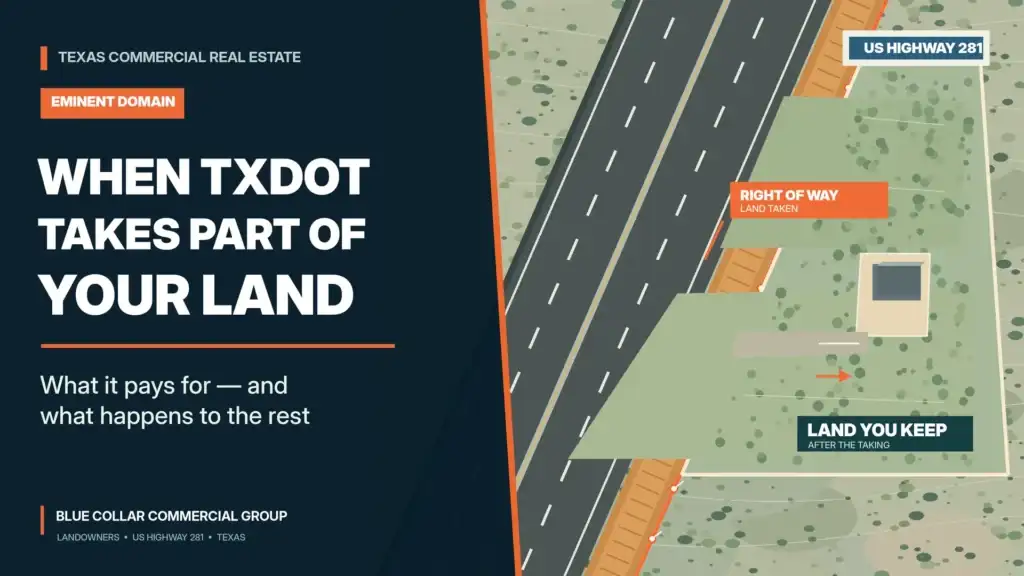
Texas is rebuilding a lot of road around here, and wider roads need more land. TxDOT’s plan for US 281 between Borgfeld Drive and Highway 46 calls for about 104.5 acres of new right of way, the strip of land the state owns for a road. Most of that land will come from the properties along the highway. The state’s power to take land for a public use is called eminent domain, and you may also hear it called condemnation.
Many owners in this spot don’t lose everything. They lose a strip along the front and keep the rest. The payment gets most of the attention, but we think the harder question comes after it: what is the land you keep worth now, and who carries the loss if it’s worth less?
Texas law pays for the land taken and for some of the damage to what’s left. TxDOT’s appraisal manual also lists losses it won’t count, and several are the things owners worry about most when a highway becomes a freeway: one-way side roads, no direct way onto the main lanes, and customers driving farther to reach you. A buyer may still pay less because of those changes. So it’s possible to have a real drop in value and no payment to cover it.
Knowing which losses count gives you a real advantage, because you can build your case around them and plan early for the ones that don’t. This guide covers what the state pays for, how to look at your remaining land the way a buyer will, how the process runs, and what to think through if you’d like to sell. We’re a commercial brokerage and not a law firm, so we’ll tell you where you need an attorney. If you’re thinking about selling only the leftover land, read the selling section before you list it or sign anything, because the timing of that sale can cost you the damages.
What the state pays for, and what it generally doesn’t
In Texas, the starting point is market value for the land taken. If the taking lowers the market value of the land you keep, you can also be owed for that drop. Lawyers and appraisers call the leftover land the remainder, and that second payment is often called damages to the remainder. On state highway projects, the special commissioners who decide the amount in a contested case have to consider those damages even if you never file a claim for them.
The line between what counts and what doesn’t comes down to one idea. A harm to your particular parcel can count. A harm you share with the whole community generally doesn’t. This table sorts the common items, using state law and TxDOT’s appraisal manual.
| Can be part of the payment | TxDOT’s manual treats as not payable |
|---|---|
| The market value of the land taken | Less traffic going past |
| Buildings and other improvements in the strip | Lost business income |
| A lower market value on the land you keep | A change in the direction of traffic |
| A material impairment of your direct access, if it lowers market value | Customers taking a longer route to reach you |
| Work needed for the remaining land to function, such as new fencing | Limits on turns, U-turns and one-way frontage roads |
| Moving costs if you’re displaced, handled separately | Noise, dust and the inconvenience of construction |
The access question
Access is where owners and the state are most likely to disagree. Texas law counts a “material impairment of direct access,” meaning a significant change in how you get on and off your land at the road your land touches. It has to lower the market value of what’s left. The same law rules out longer routes and traffic that gets sent somewhere else.
TxDOT’s manual tells its appraisers to compare the before and after on several points: how many driveways you have, where they are and how wide, whether large trucks can still get in if that’s how the property is used, how existing buildings work after the change, whether you have another public road, and whether the best use of the land changes.
The manual is also clear about the freeway case. When an existing road becomes a freeway, frontage roads are part of the first construction and you keep access to them, TxDOT treats that as access to the highway. In its view, you’ve lost no access right, and the one-way traffic and missing U-turns that follow aren’t payable. If the design leaves out frontage roads at first and you’d be cut off until they’re built, TxDOT generally treats that as taking an access right. On a brand-new road, you generally can’t claim access you never had.
Keep in mind that this is TxDOT’s reading. The manual itself says little legal authority defines “material impairment of direct access,” and whether a change in access is payable is a legal question for a court. If your driveway is the heart of your property’s value, this is a question for your attorney early on.
One rule matters a lot in the Hill Country. If your land has an agricultural or open-space tax valuation and sits outside the city limits and extraterritorial jurisdiction of any city of 5,000 or more, state law tells the commissioners to consider the loss of reasonable access in a state highway taking. Ask your attorney whether that covers your land.
When the road helps you
A road project can also raise the value of what you keep. TxDOT says highway construction often does. When we sold a 4.99-acre tract on Highway 46 in Bulverde, buyers spent years looking at a construction zone. Then the widening finished, and the new turn lane in front let cars in and out from both directions. A buyer who had seen the land before came back and saw that as a major advantage.
That cuts both ways on payment. Under TxDOT’s current legal instructions, a benefit peculiar to your parcel can reduce what you’re paid for damages to the remainder, but it can’t reduce what you’re paid for the land taken. TxDOT also says work the land needs in order to function, such as new fencing, generally isn’t offset. A general lift that the whole area gets doesn’t count against you.
The same acre, three different results
Take a made-up example, so your numbers will differ. A 10-acre commercial tract is worth $400,000 an acre, or $4,000,000. TxDOT needs one acre off the front, and the other nine acres were worth $3,600,000 of that total. The acre is worth $400,000 in all three cases. What changes is what happens to the nine.

| Rest holds its value | Shape and driveway get worse | Only the traffic changes | |
|---|---|---|---|
| Land taken | $400,000 | $400,000 | $400,000 |
| Nine acres before | $3,600,000 | $3,600,000 | $3,600,000 |
| Nine acres after | $3,600,000 | $3,150,000 | $3,200,000 |
| Drop in value | $0 | $450,000 | $400,000 |
| Payment for the drop | $0 | $450,000 | $0 on TxDOT’s reading |
| Total payment | $400,000 | $850,000 | $400,000 |
| Land plus payment | $4,000,000 | $4,000,000 | $3,600,000 |
In the middle column, the new line cuts into the only good building area and the driveway has to move somewhere worse. That’s a change to this parcel, so the drop in value can be paid. In the right-hand column, the land keeps its shape and its driveway, which now opens onto a one-way frontage road. A store buyer who wanted traffic from both directions may pay less. On TxDOT’s reading, that $400,000 loss stays with the owner.
The two owners on the right and in the middle lost about the same value. One may get paid for it and one may not, and the difference is why you need to know the cause of your loss.
The right-hand owner still has choices. As our guide to highway driveways shows, the same land can be wrong for one buyer and right for the next. A contractor with a few trucks may not care about one-way traffic, and a freeway brings visibility of its own. So the drop can be smaller than it first looks if you market to the right buyer.
Walk what’s left the way a buyer would
Ask TxDOT for the drawing that covers your property, then walk the new line. Better yet, have a surveyor mark it. On paper a strip can look small. On the ground it can hold your sign, your front row of parking, your septic field or your driveway slope.
We’d look at these first.
- Frontage and driveways. How many feet of road do you have left, and how many driveways will the state allow? TxDOT sets spacing rules, and a shorter front edge can leave less room for an entrance. Our driveway guide covers those numbers.
- Trucks. Can your biggest vehicle still get in and turn around without backing onto the road?
- Shape and depth. Is what’s left still a useful shape? Losing depth can matter more than losing acres.
- Setbacks. These rules usually measure from the property line. If the line moves, a building or a planned building may no longer fit.
- Parking. Count the spaces you’d lose, then check the count your use requires.
- Signs. Does your sign sit in the strip? Where could a new one go, and would drivers see it from the new road layout?
- Water, septic and drainage. Wells, septic fields, ditches and detention areas don’t always move easily.
- Grade. A wider road can change the height of the road at your front edge. In the Hill Country, that can change where an entrance goes and what it costs.
- Best use. Could the land still do what buyers would pay the most for? Appraisers call this its highest and best use.
Write down what changes and what each change would cost to fix. Then ask an appraiser what it does to value, and ask a broker who would buy what’s left and at about what price. TxDOT’s manual warns its reviewers about appraisals built on an owner’s preferred use, so evidence from the market will carry more weight than plans you’ve been hoping to carry out someday.
From the first letter to the final payment

It can start long before any offer. TxDOT usually holds public meetings and hearings first, and offers generally begin after the project clears environmental review. The state can also buy land years before construction money is in place, as TxDOT says about the Hamilton truck route on US 281. On US 281 South Comal, the Nov. 10 hearing doesn’t mean an offer is coming next week. It’s still a good time to see the drawings. If your land is on that stretch, the hearing runs from 5 to 7 p.m. at Bulverde Methodist Church, 28300 US 281, and TxDOT must receive comments by Nov. 25. Our Highway 281 guide covers the other projects on the road.
The first written offer. It has to come with the Landowner’s Bill of Rights, a document from the Texas Attorney General. Look first for the part in bold print. By law, the offer has to say whether the money includes damages to your remaining land, or else come with an appraisal that covers them. TxDOT says any amount for damages will be stated separately. If that line is blank or says zero, you know where the conversation starts. The state also has to share its appraisal reports on your property from the past 10 years.
Your counter offer. TxDOT allows an owner to come back with a different number, which it calls an administrative settlement. Your own evidence matters most at this stage.
The final offer. It can’t come sooner than 30 days after the first one, and it has to at least match a written appraisal from a certified appraiser. You then have at least 14 days to respond before the state can move toward a lawsuit. That window is short, so line up your help before it opens.
Condemnation, if there’s no deal. On a state project, the Texas Transportation Commission approves the step and the Attorney General’s office files the case. A judge appoints three local landowners as special commissioners. Each side can strike one from the list, on a short deadline. You must get notice of the hearing at least 20 days ahead, and the evidence exchange has its own deadlines, so this is attorney territory.
The special commissioners’ hearing. They decide money only. They can’t shrink the taking or decide what access you’ll have. If they award no more than the state offered before the case began, you may have to pay the costs of the proceeding. If they award more, the state pays those costs.
Possession. You don’t have to give up the land until you’re paid or the money is deposited with the court. Once the award is deposited, the state can take possession, even if someone objects to the amount. You can withdraw the money, but then you can only challenge the amount and not the taking itself. TxDOT sometimes also asks for early access through a Possession and Use Agreement. Have your attorney read one before you sign it.
Trial. Either side can object in writing by the first Monday after the 20th day after the commissioners file their award, so ask your attorney to calendar it. The case then becomes a regular lawsuit, with a judge or jury, and it can be appealed. Costs can land on you here too, if the verdict comes in at or below what the state originally offered.
Later. You may have the right to buy the land back at the original price if the public use is canceled before the land is put to that use, if there’s no real progress within 10 years, or if the land becomes unnecessary within 10 years. Keep your paperwork.
Who does what
The Attorney General’s statement says you can hire an appraiser or real estate professional for value and an attorney to negotiate or represent you. The right-of-way agent you’ll deal with acts for the state, so it helps to have people working for you.
- An eminent domain attorney reads the offer, negotiates and handles the case. Talk to one before you sign anything or let a deadline pass.
- A certified appraiser gives you a formal opinion of value, before and after. Your attorney may want to choose this person.
- A surveyor or civil engineer shows what the new line and new road do to your driveways, drainage and building area.
- A commercial broker tells you what buyers are paying, who would buy what’s left and how they’d look at it. That’s what we do, and it’s where a broker price opinion fits. It’s an estimated sale price and isn’t an appraisal. A broker also can’t draft your deed or tell you if it’s legally sufficient, and generally can’t act as your advocate at the commissioners’ hearing. That’s your attorney’s job.
- Your CPA looks at the tax side before the money moves.
Plan on paying your own consultants, and get any broker’s fee in a signed agreement. Ask your attorney to look at how each consultant is paid, especially anyone who may testify.
If you’re displaced, TxDOT’s relocation program is separate from the land offer. Its manual lists actual moving costs or, for an eligible business, a fixed payment between $1,000 and $53,200. A small business, farm or nonprofit can also receive up to $33,200 for the reasonable costs of getting set up at a new location, after the land money has been spent at the new site. Ask how those rules apply to you, because the conditions matter.
Selling the land you keep
You may not want to hold what’s left, and you don’t have to. Timing comes first, because it can carry the biggest cost.
Can selling the rest cost you the damages? Yes. A key Texas case is City of Austin v. Capitol Livestock, from 1970. The city was taking less than an acre for a Highway 183 widening. After the commissioners’ award, the owner signed a contract to sell the other 6.69 acres, and the buyer took possession. The trade closed the day before the city deposited the award. The jury’s numbers later showed those 6.69 acres had lost about $108,000 in value.
The Texas Supreme Court said no one could collect that money. Damages to a remainder depend on the same owner holding both the part taken and the rest on the date of the taking. The seller had already parted with the rest, and the buyer never owned the part taken. The seller was still paid for the land taken.
Notice that the buyer in that case counted as the owner before the deed was delivered, because the buyer had a contract and had taken possession. So talk to your attorney before you list the leftover land or sign a contract on it, while you can still set the timing.
Would TxDOT buy it? If the leftover piece has little use, you can raise it. TxDOT says it can buy remaining land only when the owner asks or agrees, on terms that work for both sides.
What do you have to tell a buyer? The Texas Realtors commercial contracts and listing agreement give the seller a choice of statements. One says that, to the seller’s knowledge and except as the document states, the seller isn’t aware of pending or threatened condemnation. The Commercial Property Condition Statement asks about notices of likely condemnation and planned highways that would materially hurt the property, including its access or visibility. If you’ve had a letter or you’ve seen your land on a state drawing, talk to your attorney about how to disclose it. A careful buyer is likely to find the project anyway, and it’s better for them to hear about it from you.
Who gets the state’s money if you sell the whole property first? Texas generally pays the person who owns the land at the time of the taking. In a contested case, that’s generally when the state takes possession or deposits the commissioners’ award, and your attorney can confirm the date for your case. If the whole property sells before then, the buyer is generally entitled to the payment, unless it’s expressly reserved to the seller. A sale after that date raises a different question, so ask your attorney whether any open claim stays with you and how to put that in writing.
So put your agreement in the contract. Under paragraph 16 of the Texas Realtors commercial contracts, if condemnation proceedings start before closing, the buyer can cancel within 15 days of learning about them and get the earnest money back, less any option fee. Or the buyer can stay in and take part in the case, and then the buyer chooses: you keep the award and the price drops by that amount, or the buyer takes the award and the price stays the same. That’s the buyer’s choice under the form as written, and it can be a big one. Your attorney can write something different if you and your buyer agree. Also ask what your loan documents and leases say about a condemnation payment.
Should you sell before, during or after? Each choice has a cost, and your attorney should weigh in on any of them.
| What you sell, and when | What helps | What gets in the way |
|---|---|---|
| The whole property, before any offer | You choose the timing, and you may avoid years of waiting | The line and access may be unsettled, so buyers may discount. The buyer generally gets any later payment unless you expressly keep it |
| The whole property, during the taking | A buyer can see the proposed line | The same payment rule applies, and the buyer has rights under the contract |
| Only the rest, before the taking is complete | You could be done with the leftover land sooner | The highest risk. You can lose the damages to the remainder |
| The rest, after the taking is complete | The line is settled, and you owned the whole property at the taking | You may wait longer, construction can scare off buyers, and the contract should say who keeps any open claim |
Timing can run long. When we checked for our Highway 281 guide, the state’s project database showed only a placeholder bid date of 2037 for the South Comal project. The taking can come long before construction, so you may not have to wait for the road to be finished. Ask the project contact about the land-buying schedule.
Who’s the right buyer? Sell to the buyer whose plan fits the new road. On a 10-acre sale on US 281, a store company spent months on open driveway questions while a contractor could use the entrance already there. Someone who needs only one working driveway may pay more for your remaining land than someone who needs a full turn lane and traffic from both directions. Our seller representation work starts with that list of who the land fits.
What it can mean for your taxes
Take this section to your CPA, because the rules are detailed and depend on your situation.
A condemnation can create a taxable gain, and the tax code may let you postpone it. The IRS’s Publication 544 sets a longer clock for business and investment real estate, though not for land held primarily for sale: you generally have until three years after the end of the first tax year in which you realize any of the gain to buy replacement property. This is a different rule from a 1031 exchange and has its own requirements.
Three points are easy to miss.
Get the damages amount in writing. The IRS treats money for damage to your remaining land, called severance damages, differently from money for the land taken. If the paperwork doesn’t set a specific amount, all of it is generally treated as paid for the land taken, and you’d have to show from the closing papers and the facts what both sides intended. Severance damages first reduce your basis, your tax cost, in the land you keep.
A sale under threat can count. Publication 544 says a sale to someone other than the government can also qualify if you have reasonable grounds to believe the land will be condemned. A threat generally means a government representative has told you the government has decided to acquire your land, so keep that letter.
Selling the rest may count too. A voluntary sale of your remaining land may be treated like a forced sale if the condemned land and the rest had a substantial economic relationship, meaning together they were one economic unit, and you can show the condemned property couldn’t reasonably be replaced. Read that together with the warning in our selling section, because a sale that helps your taxes can still cost you the remainder damages if it comes too early. Get your attorney and CPA talking before you sign.
What we’d do
If a letter shows up, or your land appears on a state drawing, this is the order we’d follow.
- Read the offer’s bold line on damages. Write down every deadline.
- Get the drawing and walk the new line, ideally with a surveyor.
- Talk to an eminent domain attorney before you sign anything, including an early-access agreement.
- List each change to your land and sort it into the two columns of our table. Be realistic about which column each one belongs in.
- Get your own appraisal evidence, before and after. Ask a broker who would buy what’s left and at about what price.
- Decide whether you want to keep the rest, sell it or ask TxDOT to buy it. If you lean toward selling, settle the timing with your attorney before you list it or sign a contract.
- Bring in your CPA before you settle, so the paperwork supports the tax plan.
If your land is along one of these projects, talk to Rex. A walk of the property and a look at the state’s drawing can tell you a lot.
Common questions
Can I refuse to sell to the state?
You can turn down an offer. If there’s no agreement, the state can start condemnation. You can challenge whether the taking is proper, for example whether it’s for a public use, and Texas law doesn’t allow eminent domain for tax revenue or economic development. Roadways are among the public uses the Attorney General’s statement lists. Ask an attorney about your case.
How long do I have to respond?
The final offer can’t come sooner than 30 days after the first written offer, and you get at least 14 days to respond to it. Check the dates on your own letters.
Does the state pay for my lost business?
TxDOT’s manual treats loss of business income as not payable in the land payment. If you have to move, relocation benefits are handled separately.
My driveway will open onto a frontage road. Will I be paid for that?
On TxDOT’s reading, access to a frontage road built with the first construction counts as access to the highway, so one-way traffic and missing U-turns aren’t payable. A change in your actual driveways may be a different question, so have an attorney look at the drawing.
Does the first offer include damages to my remaining land?
Look for the bold statement the law requires. It should tell you, or an appraisal should come with the offer.
Can I hire my own appraiser?
Yes. The Attorney General’s statement says you can. If the state drops the case, or a court dismisses it on your motion, you may recover reasonable fees and expenses. Ask your attorney who pays in other outcomes.
If I take the money, can I still fight?
Withdrawing an award deposited with the court ends your challenge to the taking, but you can still challenge the amount if you object on time.
Can I sell my land while this is going on?
Often you can, but the timing matters. Selling only the leftover land before the taking is complete can cost you the damages to it. If you sell the whole property first, the buyer generally gets the payment unless you expressly keep it. The Texas Realtors form also gives the buyer choices if proceedings start before closing, so read paragraph 16 with your attorney.
Does a public hearing mean the state is about to buy my land?
Not necessarily. Offers generally follow environmental clearance, and land buying can come years before construction. Ask the project contact for the tentative schedule.
Can I get my land back?
You may be able to buy it back if the public use is canceled before the land is put to that use, if no real progress happens within 10 years, or if the land becomes unnecessary within 10 years.
Terms used
- Eminent domain: The power of certain government and private entities to take private property for public use in exchange for adequate compensation.
- Condemnation: The legal process used to take property through eminent domain.
- Right of way: The strip of land, or right in land, the state holds for a road.
- Remainder: The land you keep after a partial taking.
- Damages to the remainder: Payment for the drop in market value of the land you keep.
- Severance damages: The IRS’s term for payment when the part you keep loses value.
- Direct access: Getting on and off your land at the road it touches.
- Material impairment: A significant change, in TxDOT’s words significant or important given how the property is or may be used.
- Circuity of travel: Having to take a longer route to reach a property.
- Special commissioners: Three local landowners appointed by a judge to set the amount in a condemnation case.
- Award: The amount the special commissioners decide on.
- Date of taking: The date that generally decides who gets paid. In a contested case, it’s generally when the state takes possession or deposits the award.
- Frontage road: A smaller road beside a freeway that land connects to.
- Possession and Use Agreement: An agreement that can let the state take possession before a deal closes or a case ends.
- Highest and best use: The most valuable use of a property that is legal and possible.
- Basis: Your cost in a property for tax purposes.
Sources
Contract references: Texas Realtors forms TXR-1801, Commercial Contract – Improved Property, TXR-1802, Commercial Contract – Unimproved Property, TXR-1408, Commercial Property Condition Statement, and TXR-1301, Commercial Real Estate Listing Agreement (July 2022).
- The State of Texas Landowner’s Bill of Rights, Texas Attorney General, November 2025
- Texas Property Code section 21.0113, Bona Fide Offer Required
- Texas Property Code section 21.042, Assessment of Damages
- State Purchase of Right of Way, Overview for General Public, TxDOT, July 2023
- ROW Appraisal and Review Manual, TxDOT, June 2023
- Legal Instructions: Damages and Enhancements, TxDOT
- Impairment to Access: Damages, TxDOT
- Exempt Damages (Cost to Cure), TxDOT
- Right of Way Property Acquisition Policies, TxDOT
- Non-residential moves and reestablishment expenses, TxDOT
- US 281 South Comal hearing notice, TxDOT
- City of Austin v. Capitol Livestock Auction Co., 453 S.W.2d 461 (Tex. 1970)
- 22 Texas Administrative Code section 535.17, Broker Price Opinion
- Texas Occupations Code section 1101.654
- Texas Occupations Code section 1101.806
- The 411 on Special Commissioners’ Hearings in Texas, Nossaman
- Publication 544, Sales and Other Dispositions of Assets, IRS
This guide is general information as of November 5, 2026, and it isn’t legal, tax, appraisal or investment advice. The example tract is made up, and your results will differ. Road plans and rules change. Talk to your own attorney, appraiser and CPA about any specific property.