

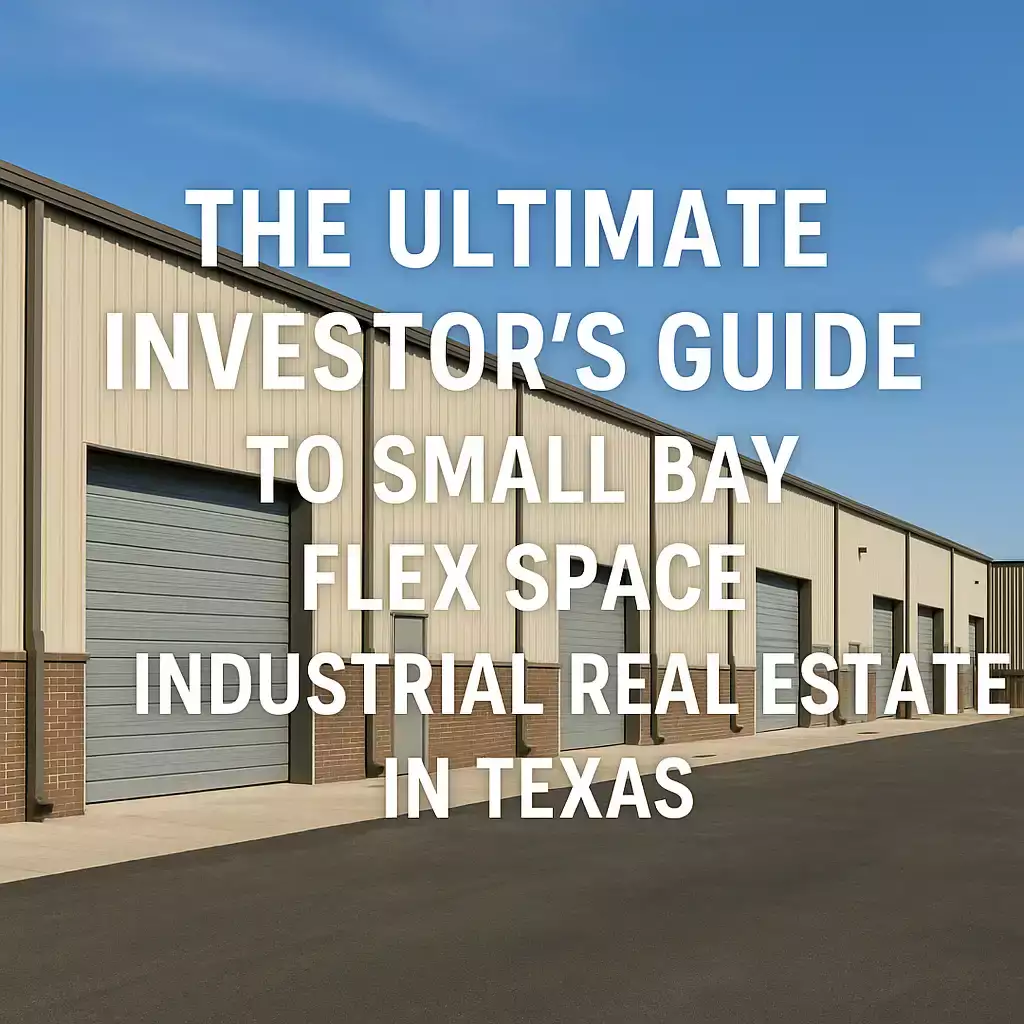
Updated October 2026. Small-bay and flex buildings are where plumbers, cabinet shops, gyms and small distributors actually work. Here is what they are, who rents them, what the local numbers say today, and what to check before you build or buy one.
The quick answers
- What is small-bay space? A building split into small units, usually 1,000 to 10,000 square feet each, with a roll-up door and some office up front.
- What is flex space? The same idea with a nicer front: an office or showroom facing the customer and a shop or warehouse in back.
- Who rents it? Local service businesses. Contractors, HVAC and plumbing companies, small manufacturers, delivery operators, gyms.
- Is it full? Fuller than big warehouses, but not as tight as it was. In Comal County about 8.5 percent of flex space was empty in September 2026, up from under 5 percent at the end of 2025.
- Is it a sure thing? No. It is a small market where one new building can change the numbers.
- What is the hardest part? Finding land with the right zoning and utilities at a cost that works with today’s rents and loan rates.
What small-bay and flex space are
When people hear “industrial real estate,” they picture a giant warehouse next to the interstate with 50 truck doors. That is one end of the business.
The other end is the row of metal or tilt-wall buildings behind the tire shop, each with a glass door, a small office and a roll-up door big enough for a work truck. That is small-bay space. When the front is finished out as a real office or showroom, it is usually called flex space, because the tenant can flex the mix of office and shop.
Typical features:
- Unit size: about 1,000 to 10,000 square feet.
- Ceiling height: often 14 to 24 feet in the shop area. Lower than a big distribution center, tall enough for racks or a vehicle lift.
- Doors: a ground-level roll-up door, commonly around 12 feet wide by 14 feet tall.
- Office: a reception area, an office or two, and an accessible restroom.
- Power: heavier electrical service (often called 3-phase power) matters to shops that run machines.
- Parking and truck room: enough for employees, customers and a delivery truck to turn around.
Who rents it, and why that matters
The tenants are the businesses that follow new rooftops.
- Home and building services. Plumbers, electricians, HVAC, roofers, landscapers, pool companies, restoration crews. Every new subdivision needs them, and they need a place to park trucks and store parts.
- Local delivery. Small operators that stage packages or inventory close to the homes they serve.
- Small manufacturers and makers. Cabinet and countertop shops, metal fabricators, sign makers, breweries, small assembly operations.
- Everything else. Gyms, sports training, auto restoration, online sellers who store their own stock.
That mix is the appeal. No single tenant makes or breaks the building. The other side of the coin: these are small businesses. They sign shorter leases, often one to three years, and some will not make it. A small-bay owner is always leasing.
What it means for you. If you own one, tenant quality is the whole game. If you rent one, a shorter lease gives you room to grow, and it gives the landlord room to raise the rent.
What the numbers say today
We checked our brokerage market data through September 30, 2026. Here is flex space, by market.
| Market | Flex space empty, Sept. 2026 | At the end of 2025 | Typical asking rent |
|---|---|---|---|
| Comal County | 8.5% | 4.6% | about $16 per square foot per year |
| Guadalupe County | 9.7% | 4.4% | about $14 |
| San Antonio area | 9.2% | 7.8% | about $16 |
| Austin area | 12.6% | 13.0% | about $19 |
| Hays County | 20.2% | 15.8% | about $18 |
Brokerage market data through September 30, 2026. Rents are asking rents, rounded.
Three things to take from that table.
Small still beats big. In Comal County, flex space was 8.5 percent empty while the big warehouse category was about 13 percent empty. In the San Antonio area, small warehouses under 50,000 square feet were roughly 8 points less empty than the largest buildings. Small spaces also rent for more per square foot.
But it loosened in 2026. Flex vacancy rose in Comal, Guadalupe, Hays and San Antonio this year. The days of “under 5 percent empty” are gone for now.
The local market is tiny. Comal County has only about 800,000 square feet of flex space in total. One new 40,000-square-foot building is 5 percent of the whole market. That is why the vacancy rate can jump four points in a year without anything being wrong with demand.
What it means for you. Do not buy or build on a county average. Look at the specific buildings that would compete with yours, what they charge, and how long their empty units have been sitting.
Why more of it does not get built
If small space rents for more and fills better than big boxes, why is there not more of it?
- Big projects are easier to justify. The permits, engineering and legal work for a 20,000-square-foot building are not much less than for a 200,000-square-foot one. Large developers and their lenders have mostly chosen the bigger payoff.
- The right sites are scarce. Small-bay works best close to homes and customers. That is also where land costs the most and zoning is tightest.
- Costs are up. Construction material prices were still rising in late 2026, and loan rates have not come down the way many expected. Small units cost more per square foot to build than one big open box.
Those barriers protect existing owners. They are also the reason a new project has to be penciled carefully. Higher rent per square foot does not help if the building costs too much to produce.
County by county
Comal County. Fast population growth feeds steady demand from service businesses, especially along Highway 46 and Highway 281. The flex market is small, so a single new project matters. Check what is under construction nearby before you commit.
Hays County. A lot of industrial space of every size was built here, and vacancy is the highest in the region. Tenants in Kyle, Buda and San Marcos have choices right now. That is good if you are renting and a caution if you are building.
Guadalupe County. A real manufacturing base around Seguin supports small suppliers and shops. Flex vacancy roughly doubled in 2026 as new space opened, so watch how quickly it leases.
North San Antonio. The biggest and steadiest pool of tenants. Most opportunities here are older buildings that can be cleaned up, rather than new construction.
If you are thinking of building
- Confirm the zoning first. Is light industrial or flex use allowed on the site today, without a special permit? Our guide to Comal County zoning is a starting point.
- Get utilities in writing. Water, sewer and power, from the actual provider. In parts of the Hill Country this is the deciding factor. See our Hill Country water guide.
- Check the road. A highway project can change how trucks reach your driveway. See what is planned on Highway 281.
- Price the building with a contractor, not a rule of thumb. Get a current bid that includes site work and utility connections.
- Run the numbers at today’s loan rates. Our guide to commercial property loans covers the options, including SBA loans for owners who will occupy part of the building.
- Design for the tenant. Roll-up doors, real power, enough parking and a clean office front. Those four things lease space.
If you are thinking of buying an existing building
- Read every lease. When does each one end? Who pays taxes, insurance and maintenance? Most small-bay leases pass those costs to the tenant, which is called a triple net lease. Our lease primer explains the types.
- Look hard at the tenants. How long have they been in business? Do they pay on time? Ask for the payment history.
- Budget for the roof, the paving and the air conditioning. Older small-bay buildings are simple, but those three items are expensive.
- Ask your CPA about depreciation. Federal tax law changed in 2025, and some building improvements may qualify for faster write-offs. The rules are specific. We covered the basics in our bonus depreciation guide, but your CPA has the final word.
- Plan for the property tax bill. A state cap on commercial appraisal increases is set to expire at the end of 2026 unless lawmakers renew it.
If you are a business looking for space
- Start three to six months before you need to move.
- Ask about power, door size and ceiling height before you tour. Those cannot be changed cheaply.
- In Hays County and parts of the Austin area, you have room to negotiate. In Comal County and north San Antonio, less so.
- Ask what the taxes, insurance and maintenance charges were last year, not just the base rent.
Common questions
What is the difference between small-bay and flex?
Small-bay describes the size: small units in a multi-tenant building. Flex describes the layout: a finished office or showroom in front with shop or warehouse space behind. Many buildings are both.
Is small-bay industrial a good investment in Texas?
It can be. It has a wide mix of tenants and less new construction than big warehouses. It also takes more hands-on management, and vacancy rose in several local markets in 2026. Judge the specific building, not the category.
How long are small-bay leases?
Often one to three years. That lets rents adjust more often. It also means more turnover.
What does flex space rent for near San Antonio and Austin?
As of September 2026, asking rents averaged roughly $14 to $19 per square foot per year across the corridor, before taxes, insurance and maintenance charges. Individual buildings vary a lot.
Can I use an SBA loan to buy a flex building?
Possibly, if your own business will occupy most of it. SBA programs are designed for owner-occupants. Talk to a lender who does them regularly.
The bottom line
Small-bay and flex space serves the businesses that keep a growing region running. That gives it a broad, practical tenant base, and it has held up better than big warehouses along the corridor.
It is not a sure thing. Vacancy is up from last year, the local markets are small enough to swing quickly, and building new space is expensive. The owners who do well are the ones who know their site, their costs and their tenants.
At Blue Collar Commercial Group, we help owners, buyers and tenants size up specific buildings and sites. Contact our team to talk it through, or see our pages for industrial property.
First published July 2025. Rewritten October 2026 with current figures. Property figures come from brokerage market data through September 30, 2026, and are rounded. This article is general information. It is not investment, legal, tax or financial advice.



