
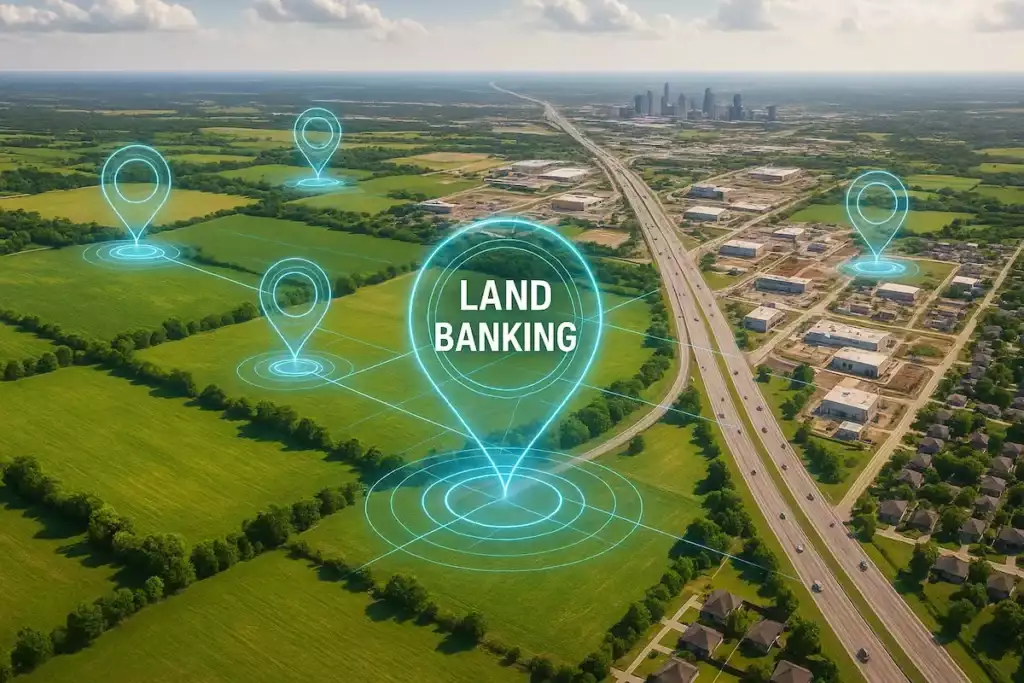
Updated October 2026. Land banking means buying undeveloped land and holding it for years before you build, sell or lease it. This article is for an investor weighing that idea along the I-35 corridor in Comal, Hays and Guadalupe counties, and it covers what the holding really costs and where it can go wrong.
The quick answers
- What is land banking? You buy raw land, pay the bills while it sits, and sell, lease or build later. You do not collect rent while you wait, unless you lease it for grazing or hay.
- Does the land have to go up in value? No. No rule of the market says land must gain. A parcel can sell for less than you paid, or not sell for a long time.
- What does holding cost? Property taxes, insurance, upkeep, and interest if you borrowed. These bills arrive every year whether or not anyone wants your land.
- Can the tax bill be lower? Sometimes. Land used for farming, ranching or wildlife can qualify for agricultural valuation. If the use changes, back taxes called rollback taxes can come due.
- What should I check before buying? Water, floodplain, road access, utilities and zoning. A parcel that cannot get water or is mostly in a floodplain is hard to build on or sell.
- How do owners get out? Sell to a builder or another investor, sell with seller financing, lease it, or develop it. Each takes time, and none is certain.
What land banking is, and what it is not
Land banking is a waiting strategy. You buy a parcel that is not ready to build on, hold it, and decide later what to do with it. Our land banking fundamentals article covers the basic mechanics. This one looks at the I-35 corridor and the costs of waiting.
Land does not produce income by itself. A shopping center collects rent. A parcel of grass collects nothing. Your return, if there is one, comes only on the day you sell or put the land to use, and what you pay to hold it comes out of that.
That makes land banking a different kind of investment from owning a building with tenants. It suits someone who can carry the costs for years without needing the money back on a schedule.
What it means for you. Ask yourself one question before anything else. If this land sat for ten years and sold for what you paid, could you live with that result?
How fast the corridor counties are growing
The area between Austin and San Antonio has been adding residents. The Census Bureau’s estimates for July 2025, released in March 2026, show Comal County at 209,166 people, up 7,680 from a year earlier, or about 3.8 percent. Hays County was at 304,390, up 10,051, or about 3.4 percent. Guadalupe County was at 201,111, up 5,437, or about 2.8 percent. For comparison, Texas grew about 1.2 percent over the same period and the United States about 0.5 percent.
Those are past counts. They do not say how much land near any one exit will be worth, or when a builder will want it. Growth also has a slower side. Census figures show Texas net domestic migration, people moving in from other states, falling from 188,667 in 2023 to 67,299 in 2025.
Roads matter to land too. Work on US 281 and SH 46 in Comal County is covered in our Highway 281 construction article. A new road can change who can reach a parcel. It does not tell you what a buyer will pay, so check the project schedule for the exact stretch near your land.
You can read more about each county on our pages for Comal County, Hays County and Guadalupe County.
What it means for you. Population growth does not tell you what any one parcel is worth, so it is not a reason to pay a particular price.
What it costs to hold land
Holding costs are the part new land investors underestimate, because nothing is coming in to cover them.
Property taxes
Every taxing unit that covers your parcel sends a share of the bill. That can include the county, a school district, a city, an emergency district and others. County rates alone do not give the total.
For 2026, the Comal County rate is $0.305015 per $100 of value, counting its road levy. Guadalupe County adopted $0.2964. Hays County adopted $0.4097. School districts and cities add their own rates on top, and not every parcel pays every one. Your tax bill also depends on the value the appraisal district sets for your land, so ask for the parcel’s last bill and the list of taxing units.
Insurance and liability
Vacant land usually needs liability coverage in case someone is hurt on it. If it has fences, a pond, a barn or a lease, the needs change. Commercial property policies commonly exclude flood damage, so anything you build or store on a low parcel may need separate flood coverage. Ask an insurance agent about the exact parcel.
Upkeep
Land needs mowing or grazing, fence repair, brush control and a locked gate if people dump trash or drive on it. These bills are small next to taxes on some parcels and large on others. Price them before you buy.
Interest, if you borrow
Lenders often want more cash down on raw land than on a building with tenants, because there is no rent to repay the loan. On September 16, 2026, the Federal Reserve set its target for the federal funds rate at 3.75 to 4.00 percent, and bank prime was 7.00 percent as of October 9, 2026. Land loan rates are set by each lender and are not published as a corridor average, so get written quotes. Our commercial loan guide explains the basics, and seller financing is another option some land sellers offer.
Interest adds up when it runs for years. Multiply the yearly interest by the number of years you expect to hold, and put that number next to the price you hope to sell at.
What it means for you. Add taxes, insurance, upkeep and interest into one yearly figure. Then multiply it by the years you might hold. That total is part of your cost of owning the land.
Agricultural valuation and rollback taxes
In Texas, land that qualifies as farm, ranch, timber or wildlife management use can be appraised on what it produces rather than what it would sell for. This is often called an ag valuation or an ag exemption. It can make the yearly tax bill much lower than it would be at full market value.
It is not automatic and it has rules. The county appraisal district decides whether you qualify. They look at what the land is used for, how long it has been used that way, and whether you apply on time. The appraisal district looks at actual use.
The catch is the rollback tax. If the land stops qualifying, for example because you sell it for a subdivision or build on it, back taxes for earlier years can come due, plus interest. State law sets how many years and what interest, and the rules have changed before. Ask the appraisal district and a real estate attorney how it applies to your parcel, and who pays it in a sale, buyer or seller.
This works in both directions. A parcel already under ag valuation may be cheaper to hold, but a buyer who wants to build will have to deal with the rollback. A parcel with no ag valuation costs more each year, but may have no back tax waiting.
What it means for you. Ask for the parcel’s current appraisal status and tax history before you make an offer. Then ask your attorney what happens to the tax when you sell, and write it into the contract.
Water and floodplain checks
Land you cannot get water to is hard to build on, and buyers know it. Check it first.
Water
Water supply differs from one system to the next, so the parcel’s own answer matters. As of October 10, 2026, the Edwards Aquifer San Antonio pool was in Stage 3, which carries a 35 percent pumping reduction. As of October 11, 2026, Canyon Lake was about 97.7 percent full. Those are different systems with different rules. Our Hill Country water guide lays out how to find out which one serves a parcel.
Ask three questions. Does a water provider serve this parcel, and will it confirm service in writing? If it relies on a well, what do neighbors’ wells produce? If it needs a sewer connection or a septic system, what does the county or city require?
Floodplain
Central Texas had serious flooding on July 4, 2025 and again on July 16, 2026. A floodplain is the low ground a flood is expected to cover. For a FEMA-mapped floodplain, that means about a 1 percent chance of flooding in any year. A floodway is the channel where water moves fastest. See our definitions of floodplain and floodway. Land in either can have limits on what you can build, higher insurance cost and fewer buyers.
Look up the parcel on the public flood maps, then walk it after a hard rain. Maps can lag behind what the ground does. Ask the county floodplain office what they require for building there.
What it means for you. Get water service and flood status in writing before the option period ends. If you cannot, treat that as a reason to walk away.
Other checks before you buy
- Access. Does the parcel touch a public road, or does it rely on an easement across someone else’s land? Landlocked land is hard to sell.
- Zoning and city limits. Land outside city limits often has few zoning rules, but a county or city may still limit what can be built. Ask who regulates the parcel today and who might later.
- Utilities. Power, sewer, gas and internet can each be far from the parcel. Extending them costs money, and it often falls on the landowner.
- Deed restrictions and easements. A title company can show what is on record, such as pipelines or power lines that cut through the land.
- Mineral rights. Check whether they come with the land.
- Survey. Know exactly what you are buying and where the lines run.
Our land investor checklist goes deeper on several of these.
What it means for you. A cheap price per acre can hide expensive problems. Total up the cost to make the land usable, not only the cost to buy it.
How owners get out
Landowners generally leave a land bank in one of a few ways.
- Sell to a builder or developer. Many land banks aim for this. Our guide to selling land to a developer covers what they ask for.
- Sell to another investor or end user. A business owner may want a few acres for their own use.
- Offer seller financing. You act as the lender and take payments over time. That can make a sale possible for some buyers, but it leaves you carrying the risk of non-payment.
- Lease it. Grazing, hay or storage can bring some income and may help the land keep its ag valuation. Check how a lease affects the appraisal and what insurance it needs.
- Develop it yourself. This turns a land investment into a development project, with permits, financing and construction costs of its own.
Time is the unknown in all of them. Buyers for raw land are fewer than buyers for finished buildings, so a sale can take longer than owners plan on.
What it means for you. Before you buy, write down who the likely buyer is, and what that buyer would need from the land. If you cannot name one, you are betting on a buyer who may not come.
The risks, stated plainly
- No income. Your costs run every year. Your return arrives, if at all, at the end.
- Long holds. A parcel that you meant to hold for five years may take ten.
- Rate costs. If you borrowed, higher rates raise the carrying cost.
- Rule changes. Tax rules, appraisal rules, water restrictions and development rules can change while you hold. The temporary 20 percent cap on appraisal growth for qualifying non-homestead property is set to expire at the end of 2026 unless lawmakers renew it. It limits growth in appraised value, not the tax bill, and it does not cover land appraised under agricultural valuation.
- Water and flood limits. A parcel that looked usable can become hard to use if supply or flood rules tighten.
- Price risk. Land can sell for less than you paid. Nobody can tell you otherwise.
What it means for you. Hold only money you will not need back on a date. Do not count on a buyer or a price when you set your plan.
Common questions
Is land banking a good investment?
It depends on the parcel, the price, your costs and how long you can wait. Nobody can promise it will pay off, and some parcels lose money.
How long do people hold land?
There is no standard time. Plan for longer than you expect, and make sure you can carry the costs for that long.
Can I lose my ag valuation if I buy land to wait for a buyer?
It can be questioned. The appraisal district looks at actual use. Ask them before you buy.
Can I borrow to buy raw land?
Often yes, with a larger down payment than a building would need. Terms vary by lender, so compare written quotes.
What if the parcel is partly in a floodplain?
The buildable part may be smaller than the acreage suggests. Ask the county what is allowed and get an insurance quote before you decide.
Should I talk to a lawyer or CPA first?
Yes. Rollback taxes, ag valuation, title issues and the tax treatment of a sale are questions for a real estate attorney and a CPA.
The bottom line
Land banking is a patient, costly strategy with no income along the way. The costs are certain and the payoff is not. Taxes, insurance, upkeep and interest come due every year, and a sale or a use for the land comes later, if it comes.
The corridor counties have been adding residents. That is a past count, not a statement about any parcel. Check water, floodplain, access and the tax picture first, know your exit, and only hold what you can afford to hold for a long time.
At Blue Collar Commercial Group, we help landowners and investors in Comal, Hays and Guadalupe counties look at land with the costs and risks in view. Contact our team to talk it through.
First published May 2025. Rewritten October 2026. Population figures are Census Bureau estimates for July 2025 released March 2026. Tax rates are 2026 county rates, interest rates are from the Federal Reserve as of September and October 2026, and water readings are from October 10 and 11, 2026. This article is general information. It is not investment, legal, tax or financial advice.