

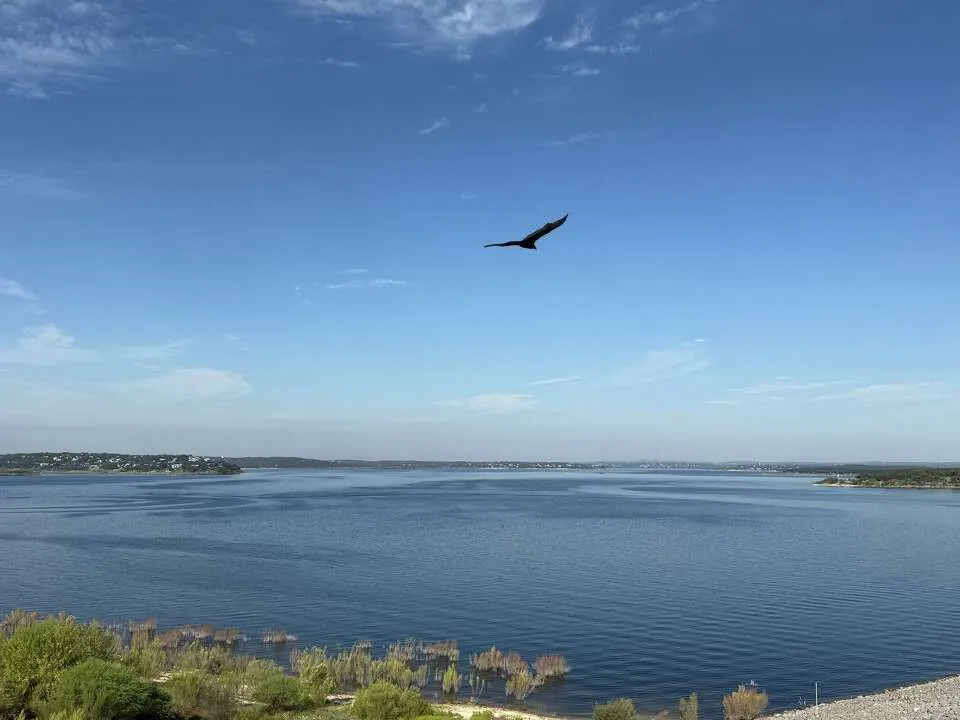
Canyon Lake is full. The aquifer isn’t. Here is where water stands between Austin and San Antonio this fall, and what it means if you own, buy, build, or lease property here.
The short version
- Is the Hill Country still in a drought? Underground, yes. The Edwards Aquifer’s San Antonio Pool returned to Stage 3 (a 35 percent pumping cut) on September 20, 2026. A flash drought spread across the I-35 corridor in September.
- Is Canyon Lake full? Yes. It was 97.9 percent full on October 5, 2026, up from 66.2 percent a year earlier.
- Are wells in trouble? In western Hays County, badly. The Hays Trinity Groundwater Conservation District has been in Emergency stage since September 2024. Jacob’s Well’s 10-day average flow was zero on October 4.
- Can you drill a new well in Hays County? Under the district’s drought rules, it is not accepting new production or non-exempt well applications right now. A federal court backed the district’s permit moratorium in August.
- Can you get water service for new development in Comal County? Not everywhere. Nine subdivisions that lost Texas Water Company service in 2025 still don’t have it.
- Did Prop 4 fix it? Not yet. The money starts flowing in September 2027.
The rest of this guide explains each answer, and what to do about it.
The photograph and the gauge
If you want to understand the water situation in the Texas Hill Country right now, you have to hold two pictures in your head at once.
The first is beautiful. Canyon Lake, the reservoir the U.S. Army Corps of Engineers built on the Guadalupe River in the 1960s, is full. Two years ago, people were walking across cracked mud to places that had been under thirty feet of water. Now the shoreline is back where the maps say it belongs.
The second picture lives underground. It is a single number recorded at a single well on the east side of San Antonio, a well hydrologists call J-17. That well is the thermometer for the Edwards Aquifer, the limestone sponge that supplies drinking water to roughly two and a half million people from Uvalde to Kyle. On September 20, 2026, its ten-day average slipped to 639.9 feet, low enough for the Edwards Aquifer Authority to put the San Antonio Pool back into Stage 3 of its drought plan.
A full lake on top. A falling aquifer underneath. Both are true on the same weekend, in the same county.
Most people only see the first picture. If you own or invest in property between Austin and San Antonio, it’s the second picture that quietly writes the terms of your next deal.
Is the Texas Hill Country still in a drought in 2026?
On the surface, no. Underground, yes. Here is the whole year in one table.
| Measure | Early Oct 2025 | Early Oct 2026 | Direction |
|---|---|---|---|
| Canyon Lake (% full) | 66.2% | 97.9% | ▲ Recovered |
| Lake Travis (% full) | 84.1% | 94.6% | ▲ Recovered |
| Medina Lake (% full) | 5.7% | 28.8% | ▲ Better, still low |
| Edwards Aquifer, San Antonio Pool | Stage 4 (40% cut) | Stage 3 (35% cut) | ► Still in drought |
| J-17 index well, 10-day average | Below 630 ft | 640.4 ft (Oct 5) | ► ~20 ft below normal |
| Comal Springs, 10-day average | — | 147 cfs | ▼ About half its long-term average |
| Hays Trinity Groundwater District | Emergency stage | Emergency stage | ■ No change |
| Jacob’s Well, 10-day average flow | — | 0 cfs (Oct 4) | ▼ Stopped |
Sources: Texas Water Development Board; Edwards Aquifer Authority; Hays Trinity Groundwater Conservation District.
Read it top to bottom and the story writes itself. The surface water, the stuff you can see from a boat, made a spectacular comeback. The groundwater, the stuff most of us drink, barely moved. The deeper you go, the less the good news reaches.
September made it worse. According to the National Weather Service office in New Braunfels, the share of South Central Texas in severe drought jumped from 1.2 percent on September 3 to 56.6 percent on October 1. Meteorologists call that a flash drought: a dry spell that goes from “a little thirsty” to “serious” in the time it takes to close on a house.
Is Canyon Lake full?
Yes, and it filled almost overnight.
For most of the past year, Canyon Lake sat in the high fifties and low sixties. Then the mid-July 2026 flood sent a rise of water down the Guadalupe. Between July 14 and July 21, the lake went from 61 percent to 100 percent full, according to Texas Water Development Board data. It has stayed at or near full ever since.
That’s good news for marinas, rentals, restaurants, and every business that lives off the lake. But here is the most important fact in this guide: a full lake did not end water restrictions for the people who live around it.
The Texas Water Company, the private utility that serves much of the Canyon Lake area, draws on the lake. But its right to that water is a fixed share of the reservoir. In its August 2026 customer newsletter, the company explained that a full lake doesn’t hand it more water to sell. A fuller lake makes the company’s share safer. It does not make the share bigger. That’s why its customers stayed under drought rules as the lake climbed toward full.
What it means for property: don’t judge a property’s water by how the lake looks. Judge it by who serves the property, where that water comes from, and what drought stage applies.
Why is the Edwards Aquifer still in Stage 3?
Because rain fills lakes fast and aquifers slowly.
The aquifer did have its moment this year. It just didn’t last. Here is the San Antonio Pool’s year in drought stages, from the Edwards Aquifer Authority’s own declarations:
| Effective date | Stage | Pumping cut | What happened |
|---|---|---|---|
| May 2025 | Stage 5 | 44% | First Stage 5 in the plan’s history |
| Aug 12, 2025 | Stage 4 | 40% | Relief after the July 2025 floods fades |
| Apr 26, 2026 | Stage 3 | 35% | Spring rains lift J-17 to 632.7 ft |
| May 30, 2026 | Stage 2 | 30% | J-17 climbs to 640.2 ft |
| Late July 2026 | Stage 1 | 20% | July floods push J-17 to a four-year high |
| Aug 6, 2026 | Stage 2 | 30% | Summer heat and pumping take it back |
| Sep 20, 2026 | Stage 3 | 35% | Ten-day average falls to 639.9 ft |
From the lightest restrictions of the year back to Stage 3 took about two months, with Canyon Lake brimming the entire time. The rain that filled the reservoirs ran off the hills and kept going. The aquifer took what it could get, and summer took it right back.
As of October 5, 2026, J-17 read 643.4 feet, with a ten-day average of 640.4 feet. That is roughly twenty feet below normal for this time of year. Comal Springs, which feeds the river through the middle of New Braunfels, was flowing at about 147 cubic feet per second, around half its long-term average.
None of this is new for this part of Texas. J-17’s record low was set in 1956, at the bottom of the drought of record, the year Comal Springs stopped flowing altogether. What has changed is everything stacked on top of the aquifer: more rooftops, more businesses, more pumping, and less room for error.
What Stage 3 means in practice: the Edwards Aquifer Authority’s stages cut how much large permit holders, including cities and utilities, may pump. The authority doesn’t set lawn-watering rules. Your water utility does, under its own drought plan.
What are the watering rules in San Antonio and New Braunfels right now?
It depends on your utility, and utilities don’t move in lockstep.
- San Antonio Water System (SAWS): back in Stage 3 watering rules since late September 2026, after a short stretch in Stage 2 over the summer.
- New Braunfels Utilities (NBU): in Stage 2 since August 10, 2026. In August, New Braunfels City Council approved changes to NBU’s drought plan, effective October 1, that add tougher Stage 4 and Stage 5 rules and drought surcharges for the heaviest users.
- Texas Water Company: stages vary by water system. Check your system’s page.
A common mistake is treating “Edwards Stage 3” and “my city is in Stage 3” as the same thing. They aren’t. A property in New Braunfels and a property in San Antonio can sit over the same aquifer and follow different rules on the same day.
What it means for property: if your business uses a lot of water, from landscaping and car washes to restaurants and manufacturing, plan around the stage you’re in now and the surcharges that kick in at the next one.
What’s happening to the Trinity Aquifer and wells in Hays County?
This is the most serious water story in the region, and it gets the least attention.
West of the Edwards lies the Trinity Aquifer, a tighter, slower rock formation that much of the Hill Country’s rural growth depends on through private and small-utility wells. Rain recharges it slowly, and floods barely touch it.
In western Hays County, the Hays Trinity Groundwater Conservation District has been in its Emergency drought stage since September 2024, imposing a 40 percent curtailment. The district says its monitor wells show declining water levels and reports “a significant increase of dry-wells and burnt-out well pumps.” In its own words, aquifer and river conditions “have not been this poor in the 20+ year history of the District.”
At Jacob’s Well, the famous spring outside Wimberley that bubbles up out of the Trinity, the district reported a 10-day average flow of zero cubic feet per second as of October 4, 2026. The district’s Emergency stage kicks in when that flow falls to 6 cfs or less.
Next door, the Cow Creek Groundwater Conservation District, covering Kendall County, remained in Stage 2, with its aquifer index running more than ten feet below the September average.
What it means for property: if a property depends on a Trinity well, the well is the asset. Know which district governs it, what stage that district is in, and how the well has performed through this drought.
Can you still drill a new well in Hays County?
Right now, in the Hays Trinity district, it is hard. Under its drought rules, the district is not accepting applications for new production wells or non-exempt wells until conditions improve.
In August, a federal court backed the district’s power to do this. In Aqua Texas, Inc. v. Hays Trinity Groundwater Conservation District (No. 1:23-cv-01576), the private utility Aqua Texas challenged the district. The district had assessed $448,710 in penalties for pumping over Aqua’s permitted limits, and a 2022 permitting moratorium had kept Aqua from getting operating permits for two new wells.
On August 24, 2026, Senior U.S. District Judge David Alan Ezra ruled on the parties’ motions for summary judgment. On the main questions he sided with the district:
- The district did not exceed its authority under its enabling law and management plan when it adopted the moratorium.
- Aqua Texas had not shown the district’s overpumping fines broke a statutory cap.
- Aqua Texas’s equal protection and takings claims tied to the moratorium were dismissed.
Aqua Texas won on two points. The court held the district could not apply its waste rules to wastewater and sewage spills, and it threw out the district’s counterclaim that Aqua’s permits were invalid. Other issues, including open-meetings claims, are headed for trial.
This is a pre-trial ruling about one district’s rules, not a final judgment, and it can still be appealed. The court also noted that exempt wells and variances remained available. Even so, the signal is clear: at least in this district, a federal court found that a permit freeze during a drought was within the district’s power.
What it means for property: “we’ll just drill a well” now needs a closer look in parts of the Hill Country. Before you buy land that depends on a new well, check the district’s rules, its current stage, and whether an exempt well or a variance fits your plans.
Can you build on land without water service in Comal County?
Not always, and that changed in 2025.
In March 2025, the Texas Water Company, formerly known as SJWTX and Canyon Lake Water Service Company, cancelled its water service agreements for nine proposed subdivisions in Comal County, about 4,182 planned homes. Blue Collar Commercial Group confirmed with the Texas Water Company on October 5, 2026, that service for those nine subdivisions has not been restored.
The company is working on new supply, including a rebuilt intake at its Park Shores plant on Canyon Lake. When those nine subdivisions get service, it will be one of the clearest signs that the water gate in Comal County is opening. Until then, it is closed.
Comal County isn’t alone. In 2026, new limits appeared across the region:
- Hays County approved a resolution on June 23, 2026, creating a 180-day emergency review period for high-water-use developments, including data centers. It runs into December 2026. A new High Water Demand Development Review Board evaluates those projects before the county considers tax abatements, development agreements, variances, or other discretionary approvals.
- Hays Trinity stopped accepting new well applications (above).
- San Marcos banned data centers citywide (below).
What it means for property: water availability is now an entitlement question, in the same category as zoning and platting. What a parcel can become depends on who will serve it, under what drought stage, and whether a groundwater district will accept a permit there at all. A parcel with a will-serve letter from a utility with real capacity faces a very different path than an identical parcel next door without one.
Are data centers banned in San Marcos and Hays County?
In San Marcos, yes. In Hays County, they face a review.
In February 2026, the San Marcos City Council rejected an annexation request for a 200-acre development by Highlander SM One LLC that would have used more than 25 million gallons of water a year, according to the Texas Tribune. On June 16, 2026, the council voted 4–3 to make data centers ineligible in every zoning district in the city. The Tribune reported it was the first outright data center ban by a Texas city.
A week later, Hays County passed its high-water-use review period, naming data centers specifically. In San Antonio, District 6 Councilman Ric Galvan has asked the city to require new data centers to use recycled water instead of drinking water.
The fight is about the next wave, not the current one. SAWS senior vice president Donovan Burton told KSAT in September that San Antonio’s existing 23 data centers use about 0.1 percent of the city’s drinking water supply, and warned that future AI data centers could use far more.
What it means for property: if you hold industrial or large-acreage land in Hays County or near San Marcos and your plan included selling to a data center user, revisit that plan with the new rules in mind. State legislators may push back on local bans when the Legislature convenes in January, so this isn’t settled. Water-heavy uses of every kind are facing more questions, more review, and longer timelines.
Did Prop 4 fix Texas water?
It will help, but not yet.
On November 4, 2025, Texas voters approved Proposition 4 with 70.42 percent of the vote. It dedicates up to $1 billion a year in state sales tax revenue to the Texas Water Fund for twenty years, roughly $20 billion in all. That’s a historic commitment.
The catch is timing. Money doesn’t start flowing into the fund until September 1, 2027, and the first project awards are expected around 2029. As of today, Prop 4 has not paid for a single pipe, plant, or well in this region.
The state’s existing programs hit limits too. In 2026, the State Water Implementation Fund for Texas (SWIFT), the state’s main low-cost loan program for big water projects, had $1.28 billion available and $4.2 billion in requests. Ten of 23 projects were funded. According to the Texas Tribune, it was the first time in SWIFT’s 11-year history that applicants were denied. Meanwhile, the draft 2027 State Water Plan puts the cost of the state’s water strategies at $174 billion, more than double the 2022 plan’s $81 billion.
What it means for property: for the next few years, local utilities will carry much of the cost of new supply, and that shows up in rates and impact fees. SAWS has proposed residential rate increases of 6.9 percent in January 2027 and 6.5 percent in 2028, with more after that. City Council could vote as soon as October 8, according to KSAT. If you own or underwrite an income property here, factor in the possibility of rising water and wastewater costs, and read your leases to see who pays.
What did the July 2026 floods change?
We want to write about this carefully. Behind every number below are families who will never forget these summers.
On July 4, 2025, a storm stalled over the Hill Country and dropped torrential rain on the Guadalupe headwaters in the middle of the night. More than 130 people died, many of them children at summer camps along the river in Kerr County.
A year later, it happened again, but differently. In mid-July 2026, a slower, multi-day storm dropped more than twenty inches on parts of Uvalde, Kerr, and Real counties. Near Comfort, the Guadalupe crested at about thirty-seven feet, higher than in 2025. This time, two people died.
According to the Texas Tribune, the 2026 rain fell over several days and more of it in daylight, with lower hourly rates than the 2025 cloudburst. The response had also changed. After 2025, the Legislature passed laws on camp safety and flood warnings and funded sirens, gauges, and early-warning systems. By July 2026, Kerr County had new sirens on the river, the Upper Guadalupe River Authority had a real-time river dashboard running, and emergency crews were staged early. Kerrville Mayor Joe Herring told the Texas Tribune on July 17, 2026, that the new dashboard and early warnings “saved lives yesterday, without a doubt.” Comal County accepted up to $1.25 million in state funds for sirens and flood gauges.
What it means for property: two floods in two years have made flood risk a second gate, next to water supply. Owners along the Guadalupe and its tributaries should expect more questions about floodplain maps and flood history, and should be ready with answers.
Will El Niño end the drought?
It might help. It is not a promise.
NOAA has issued an El Niño Advisory and gives better than a 90 percent chance of a very strong El Niño this fall and winter. For South Central Texas, El Niño winters tend to be wetter, and the Climate Prediction Center favors above-normal precipitation. That’s the best hope on the board for real aquifer recharge.
But it’s a forecast. And as the last two Julys showed, a lot of rain in a short time doesn’t always mean a lot of water in the aquifer. Slow, soaking winter rain is what the Edwards and Trinity need most.
A water due-diligence checklist for Hill Country property
We’re a commercial real estate firm, not a water utility. What follows is general information, not legal, financial, or investment advice for your situation. These are the questions the 2026 water picture raises.
If you own property:
– Know where your water comes from: the Edwards, a Trinity well, surface water, or a mix through your utility.
– Know your utility’s current drought stage and what triggers the next one.
– If you depend on a private well, talk to your groundwater district before planning any expansion.
If you’re buying land or an investment property:
– Ask for a will-serve letter, and find out how much spare capacity the utility has.
– Identify the utility and its current drought stage.
– Identify the groundwater district, its stage, and whether it’s accepting new permit applications.
– Pull the current floodplain map, and ask about pending map changes.
– Get current water and wastewater impact fees in writing.
If you’re a developer:
– Plan on longer timelines for water-heavy projects, especially in Hays County.
– Start the water conversation before the zoning conversation. In 2026, water became the harder question in a lot of places.
– Treat conservation design, like rainwater harvesting, reuse, and drought-tolerant landscaping, as a permitting asset, not just a marketing line.
If you run a business:
– Budget for higher water and wastewater costs in 2027 and beyond.
– Check your lease to see who carries rising utility costs and drought surcharges.
– If water is central to your operation, write a drought plan now, while the lakes are full.
None of this is a reason to walk away from the Hill Country. It’s a reason to do your homework with your eyes open.
What to watch in the next 12 months
- This winter: NOAA’s El Niño updates and real rainfall totals over the recharge zone.
- October 8, 2026: possible San Antonio City Council vote on SAWS rates.
- December 2026: Hays County’s 180-day review period ends. Watch for an extension or permanent rules.
- January 12, 2027: the 90th Texas Legislature convenes. Expect bills on water funding, groundwater district authority, flood warnings, and local data center bans.
- Early 2027: the final 2027 State Water Plan.
- January 2027: SAWS rate increases take effect, if adopted as proposed.
- September 1, 2027: the first Prop 4 dollars flow into the Texas Water Fund.
- Date unknown: water service for the nine Comal County subdivisions, and a trial date in Aqua Texas v. Hays Trinity.
We’ve been tracking this since 2023. Our earlier reports covered the 2025 water crisis in Comal County, what the June 2025 rains did and didn’t fix, the July 2025 floods, Canyon Lake’s recovery, data centers and water, and Texas’s long-term water future. Most of what we flagged then held up: the flood was a reprieve, not a resolution; growth became water-gated; the Trinity proved the weak link; and data centers became a land-use fight. What we didn’t see coming was a full Canyon Lake by July 2026.
Frequently asked questions
What stage is the Edwards Aquifer in right now?
The San Antonio Pool has been in Stage 3 since September 20, 2026. Stage 3 cuts large permit holders’ pumping by 35 percent. It is triggered when the J-17 well’s ten-day average falls below 640 feet or Comal Springs falls below 150 cfs.
What is the Canyon Lake water level in 2026?
On October 5, 2026, Canyon Lake was 97.9 percent full at about 908 feet. It reached 100 percent on July 21, 2026, after the mid-July floods.
Why are there still water restrictions if Canyon Lake is full?
Most of the region’s drinking water comes from aquifers, not the lake, and the Edwards Aquifer is in Stage 3. Utilities that draw on Canyon Lake, like the Texas Water Company, hold a fixed share of the reservoir, so a full lake doesn’t give them more water.
Can I drill a new well in Hays County?
The Hays Trinity Groundwater Conservation District is in Emergency stage and, under its drought rules, is not accepting new production or non-exempt well applications. Exempt wells and variances may be possible. Contact the district before you buy or build.
Is Comal County under a development moratorium?
There is no countywide moratorium. But in March 2025, the Texas Water Company cancelled service agreements for nine Comal County subdivisions, and as of October 5, 2026, service for them has not been restored. Always confirm water service before buying land to develop.
Did San Marcos ban data centers?
Yes. On June 16, 2026, the San Marcos City Council voted 4–3 to make data centers ineligible in every zoning district in the city.
When will Prop 4 water money arrive?
Deposits into the Texas Water Fund begin September 1, 2027. The first project awards are expected around 2029.
Will El Niño end the Central Texas drought?
NOAA gives better than a 90 percent chance of a very strong El Niño this winter, which tends to bring wetter weather to South Central Texas. It is a forecast, and recharging the aquifers takes steady rain over time.
The lake isn’t the whole story
Stand on the dam at Canyon Lake this fall and it’s hard not to feel relieved. The water is back, and it really does look like the drought is over.
Underneath, it isn’t. A full lake is good news. But in the Hill Country the most important water is the slow-moving water in the rock below us, and right now that water is telling us to stay careful.
At Blue Collar Commercial Group, we check the water first. Before you buy, sell, lease, or build anywhere between Austin and San Antonio, let’s look at the whole picture together: the lake, the aquifer, the utility, the district, and the floodplain. Contact our team to start that conversation.
Data in this guide is current as of October 5, 2026, unless noted otherwise. Sources include the Edwards Aquifer Authority, the Texas Water Development Board, the Hays Trinity and Cow Creek Groundwater Conservation Districts, the National Weather Service Austin/San Antonio office, NOAA’s Climate Prediction Center, the Texas Water Company, San Antonio Water System, New Braunfels Utilities, Hays County, the City of San Marcos, the Texas Tribune, KSAT, Community Impact, and the U.S. District Court for the Western District of Texas (Case No. 1:23-cv-01576-DAE). This article is for general information only and is not investment, legal, or financial advice.



