

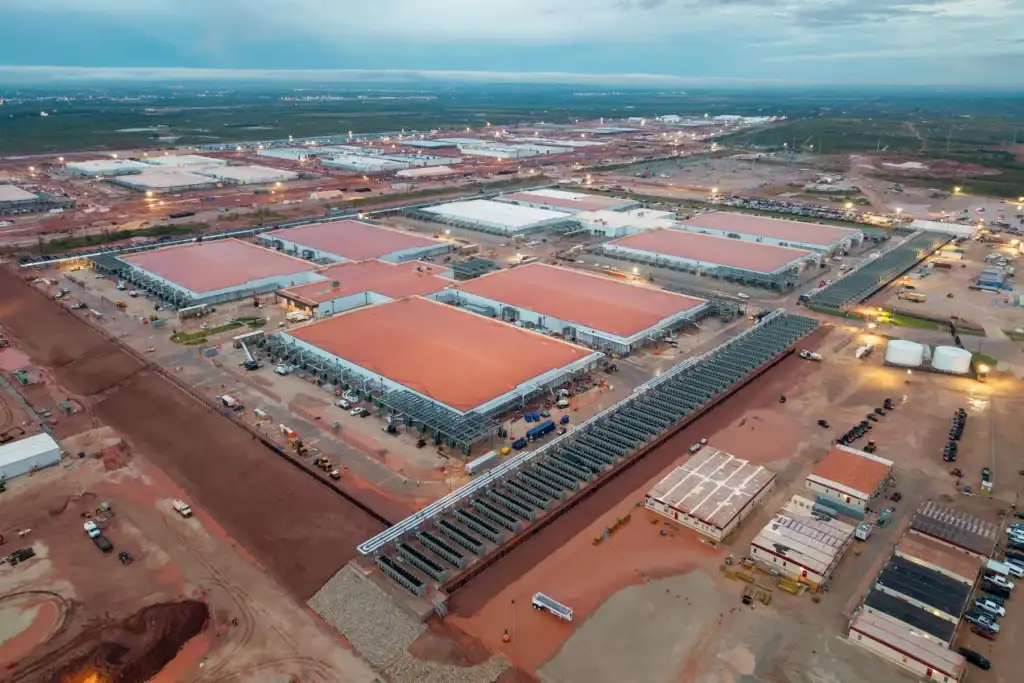
Everybody has an opinion about data centers. Here’s what’s actually true, what isn’t, and what it means if you own land, a business, or a building in Texas.
The quick answers
- Are data centers taking over Texas? A lot are coming. Texas has about 335 running today and at least 248 more planned.
- Did the state stop them? For now, it slowed them down. The governor ordered a review of every big data center trying to plug into the state’s power grid, and froze their state environmental permits until the review is done in December.
- Will they raise my electric bill? Nobody can show that they have yet. It’s too early to know.
- Will they use up our water? The buildings themselves use little today. But building them takes water, and so do the power plants that run them, and that adds up.
- Do they bring jobs? Lots of construction jobs. Not many permanent ones.
- Do they drive up rents? In some small towns during construction, yes. Childress and Abilene have seen rents jump.
- Can a town say no? A city can, using zoning. A county mostly can’t.
First, what is a data center?
Picture a giant warehouse with almost nobody inside. Instead of boxes on shelves, it’s packed with rows of computers that run the things we use every day: email, phone apps, online banking, streaming, and now artificial intelligence tools like ChatGPT.
Those computers need three things:
- A lot of electricity. The biggest new campuses use as much power as a city.
- A way to stay cool. Some use water to cool the building. Others use systems that recycle the same water over and over, or use air.
- Not many people. Once it’s built, a huge data center can run with a small crew.
Keep those three things in mind, and most of the arguments about data centers start to make sense.
Why Texas, and why now?
Artificial intelligence changed everything. AI takes far more computing power than a regular website, so tech companies are racing to build bigger data centers, faster.
Texas has what they want: lots of land, its own power grid, plenty of natural gas, wind and solar, and a state that has welcomed big projects for years. The biggest example is “Stargate,” a massive AI campus near Abilene backed by OpenAI and Oracle. Microsoft is planning another giant campus in Pecos, in far West Texas.
By one major real estate firm’s count, Texas now has more data center capacity built or under construction than any other state, about twice as much as Virginia, which used to be the clear national leader.
The number everyone quotes, and why it’s misleading
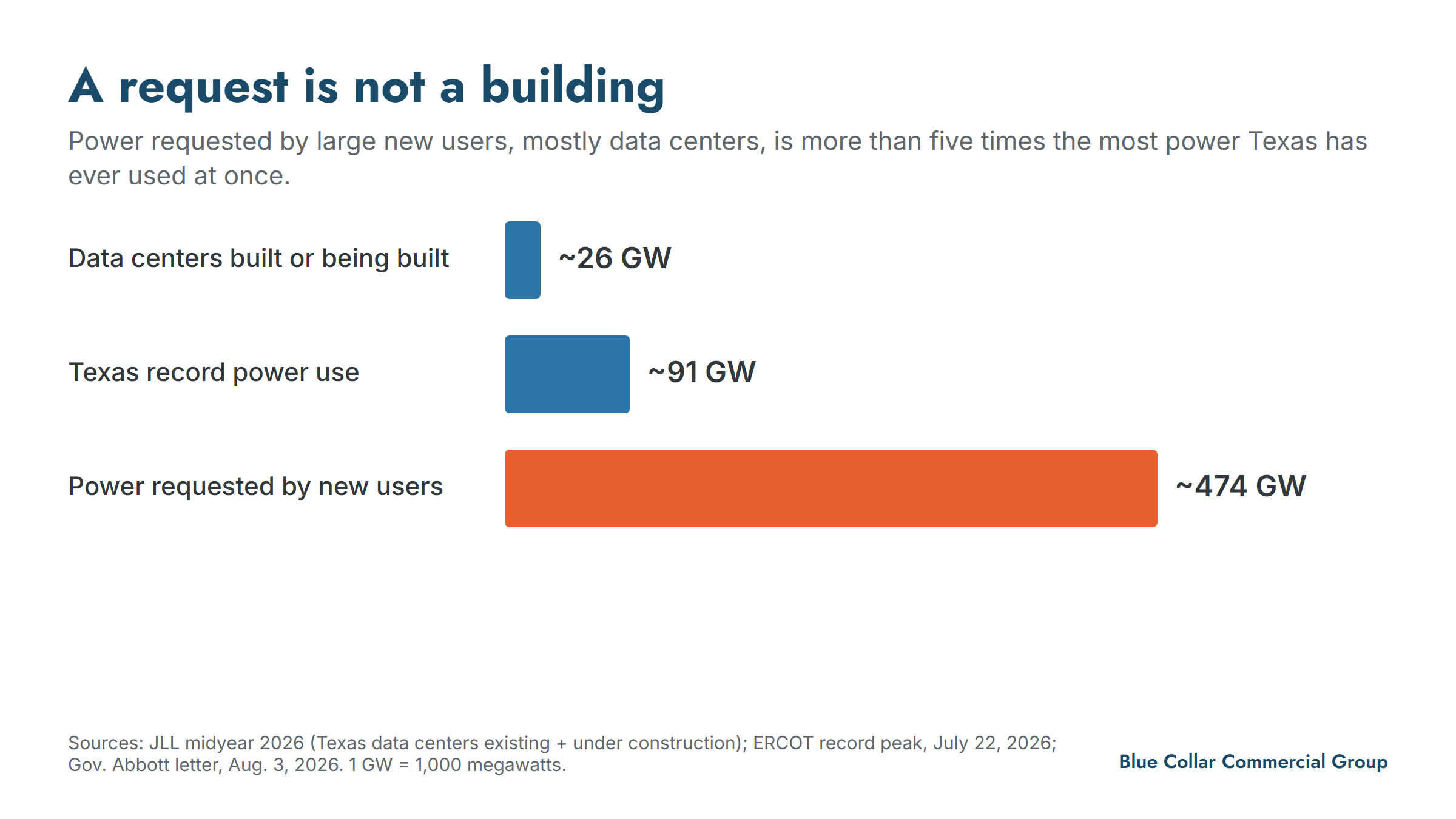
You may have seen headlines saying data centers want more than five times the electricity Texas has ever used at one time.
That’s true, but it’s a list of requests, not a list of buildings.
Here’s why. A company looking for a site will often ask for power at five or six places at once, then build at one. Every one of those requests goes on the list. So the list looks enormous, even though most of those projects will never get built.
Even the people who run the Texas power grid have said their own long-term forecast is probably too high. That’s a good rule of thumb for any headline about data center “demand”: a request is not a building.
Why did the governor hit pause?
In 2026, Gov. Greg Abbott, who has spent years recruiting big business to Texas, decided the state needed to slow down and check the math. Here’s what happened, in plain English:
- June: He said data centers should pay the full cost of the power lines and equipment they need, so regular customers don’t get stuck with the bill.
- August: He ordered a review of every data center trying to connect to the state’s power grid before any more get approved. He warned the sheer size of the requests “could endanger the reliability and stability” of the grid.
- September: State utility regulators passed a new rule requiring big projects to put up a large deposit just to get in line for power. That’s meant to weed out the “maybe” projects.
- Also September: The governor told the state’s environmental agency to stop issuing permits for new data centers until the review is finished, even for projects that make their own power.
The review is expected to wrap up in December. Until then, a lot of projects are on hold.
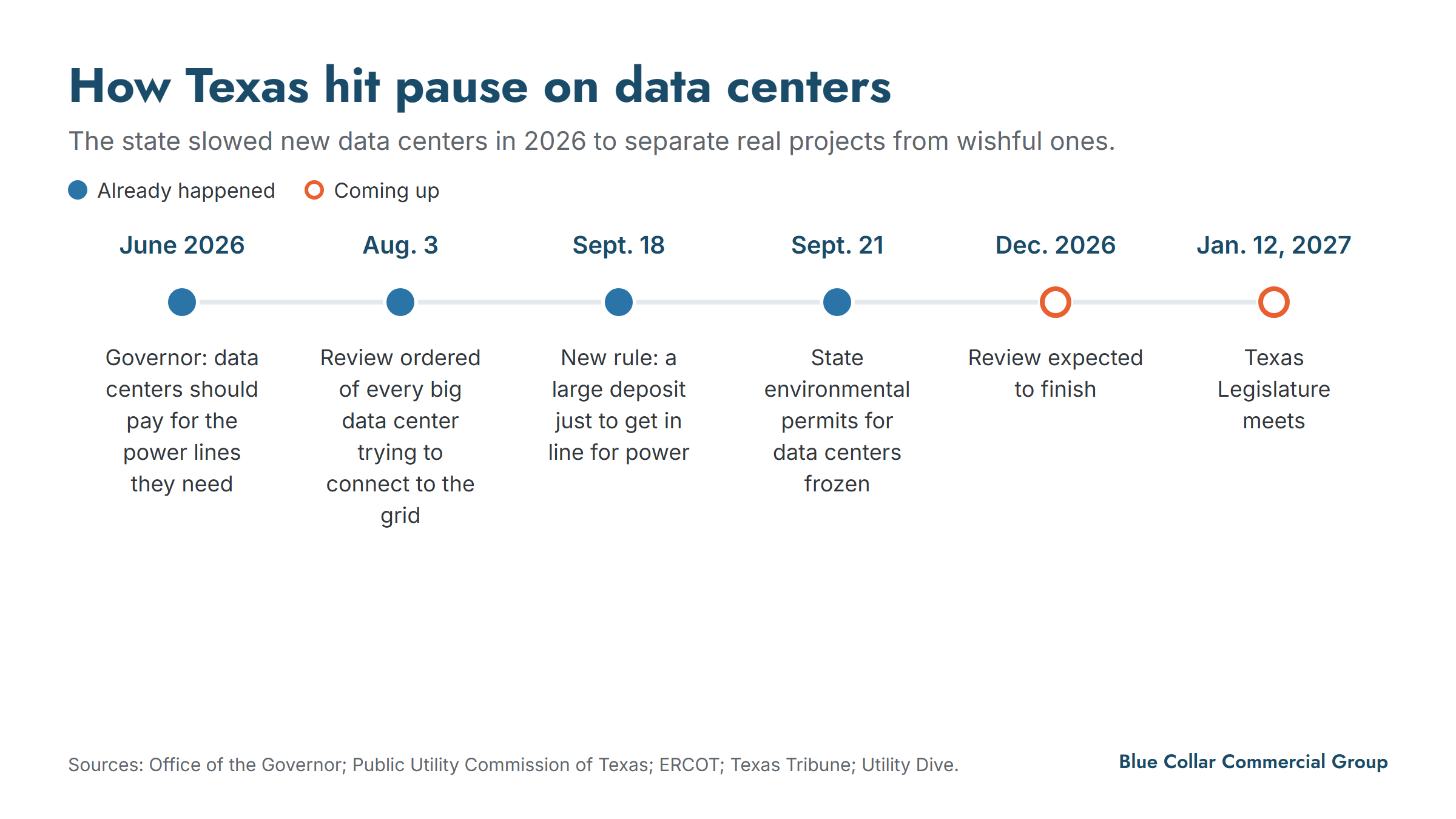
That doesn’t mean Texas has turned against data centers. It means the state wants to separate the real projects from the wishful ones before it commits more of the power grid to them.
Fact vs. fiction: 12 things people say about data centers
1. “Data centers use up all our water.”
The short answer: Not today. Maybe later. It depends on how they’re built.
Right now, data centers use less than 1 percent of the water used in Texas. In San Antonio, the city’s water utility says the 23 data centers already running there use about one-tenth of 1 percent of the city’s drinking water, and most of the water they use is recycled water, not drinking water.
The future is less certain. A University of Texas study estimates data centers could account for 3 to 9 percent of all Texas water use by 2040, if they keep growing and keep using water-hungry cooling. The key is how a building is cooled. Some systems evaporate a lot of water. Others fill up once and recycle the same water for years.
What it means for you: In dry areas like the Hill Country, water will be one of the first questions any data center has to answer. If one is proposed near you, ask where the water will come from and what kind of cooling it will use.
2. “The cooling water is only part of the story.”
The short answer: True. Construction and the power plants behind data centers use water too, and the power plants use much more.
When people argue about data center water, they usually mean the water used to cool the building. But there are two other big uses that don’t show up on the data center’s own water bill.
1. Water to build it. Building a campus takes a lot of water for mixing concrete, keeping dust down and preparing the site. Texas doesn’t track this. For a sense of scale, look at Georgia: county records showed one large data center campus still under construction there, run by a company called QTS, was billed for about 109 million gallons of water since early 2024. The company said that during construction, water goes to “concrete work, dust control and site preparation,” and that use will drop sharply once the campus is running. Construction water is temporary, but it often lands during the same dry years when towns are already asking residents to cut back.
2. Water to make the power. This is the big one. Most Texas electricity comes from natural gas, coal and nuclear plants, and those plants use large amounts of water to cool down. An analysis by the Sierra Club, an environmental group, found that Texas gas, coal and nuclear plants consumed more than 100 billion gallons of water in 2024. Nationally, it estimated gas plants use about 238 gallons of water for every unit of electricity they make (a megawatt-hour), and coal plants about 409, compared with about 95 gallons a data center uses directly for the same amount of power. Wind and solar farms use almost no water to make electricity.
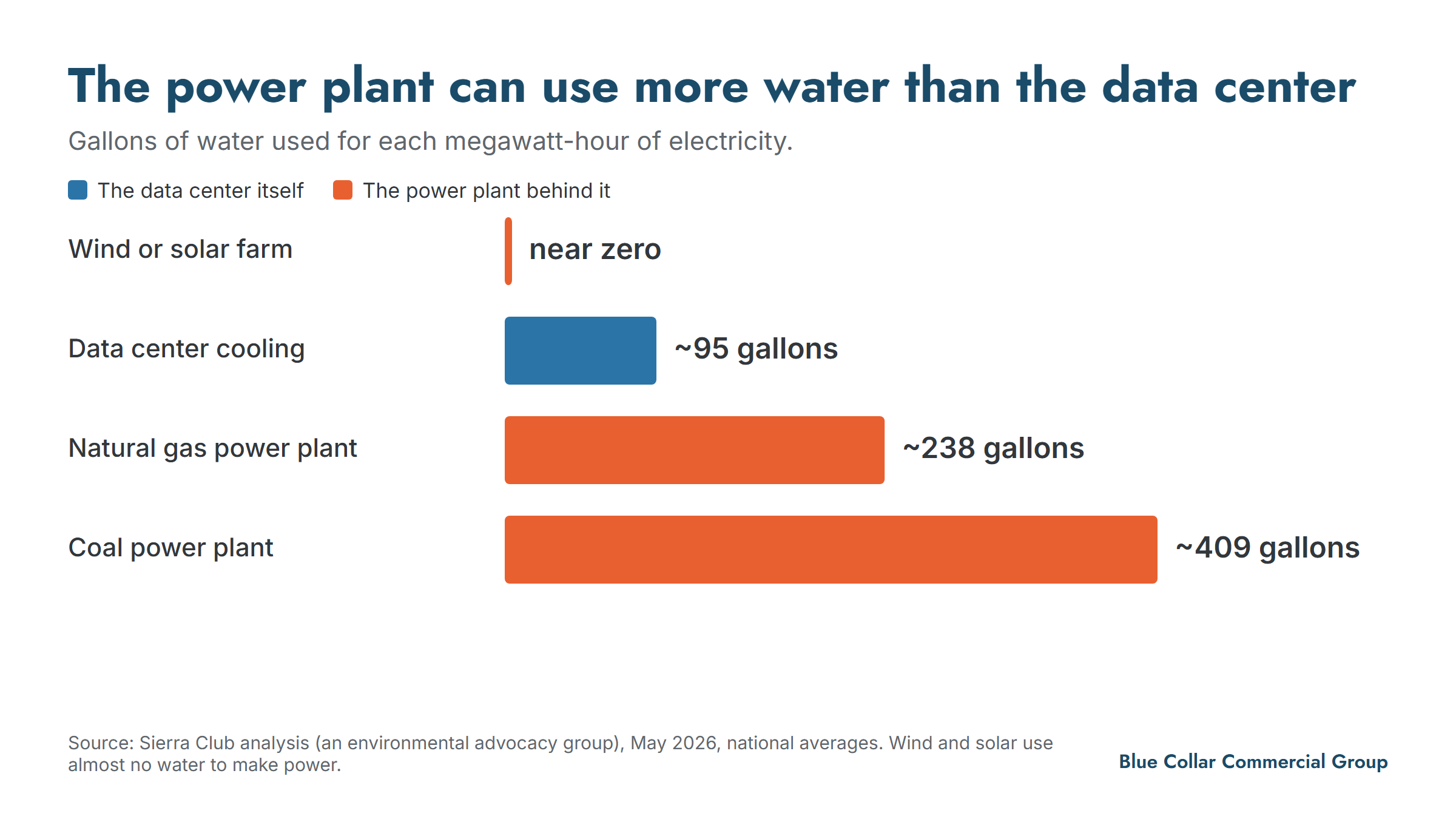
Put those together and the picture changes. The Houston Advanced Research Center estimates Texas data centers used about 25 billion gallons of water in 2025 when you count both their own cooling and the water used to make their electricity, and that could reach 29 to 161 billion gallons a year by 2030. Its researchers say a data center’s source of electricity can matter more to its water footprint than how it cools the building.
What it means for you: When a data center says it uses “almost no water,” ask two follow-up questions: how much water will construction take, and where will its power come from? A data center running on a gas plant has a much bigger water footprint than one running on wind or solar.
3. “Data centers will make my electric bill go up.”
The short answer: Too early to tell.
This is the one people worry about most, and the honest answer is that nobody has shown it’s happened in Texas yet.
Here’s what we know. A Federal Reserve Bank of Dallas study found that data centers have already pushed up wholesale electricity prices, the prices power companies pay, by a few percent nationwide, and warned prices could rise a lot more if all the proposed projects get built. On the other hand, a Rutgers University study of household bills found the effect is “mostly not yet” showing up. And a consulting firm’s review found that Texas, which has added the most new demand, has seen some of the smallest rate increases in the country.
Texas is also changing the rules so big data centers pay more of their own costs.
What it means for you: There’s no data center surcharge on your bill today. Whether one shows up depends on rules the state is still writing.
4. “Data centers will crash the power grid.”
The short answer: A real concern for the future. It hasn’t happened.
The worry is understandable after the 2021 winter storm. But this summer, Texas set a new all-time record for electricity use, and the grid handled it without an emergency.
The bigger question is the future. If even a fraction of the requested data centers get built, the state will need a lot more power plants and power lines. That’s exactly why the governor ordered the review. Texas law now also requires the biggest new data centers to shut down or cut back when the grid is in trouble, so homes keep their lights on. And many new campuses, like Microsoft’s in Pecos, are building their own power plants.
What it means for you: The grid is a planning challenge, not a crisis today. Watch what the December review finds.
5. “Data centers bring lots of jobs.”
The short answer: True while they’re being built. Not after.
Building a data center takes an army. Microsoft says its Pecos campus will employ more than 6,000 construction workers at its peak. In Abilene, thousands of workers came to town for Stargate.
But once a data center is finished, it runs with a small crew. Microsoft expects “hundreds” of permanent jobs at Pecos. To get the state’s tax break, a data center only has to show it created 20 permanent jobs, and the state’s own tax official told lawmakers this summer that “clearly some of them have difficulty achieving the 20.”
The industry’s trade group says data centers support more than 100,000 direct jobs in Texas. Keep in mind that number comes from a study the industry paid for.
What it means for you: Expect a hiring and spending wave during construction, then a much smaller steady workforce.
6. “Data centers don’t pay their fair share of taxes.”
The short answer: Partly true, depending on how you look at it.
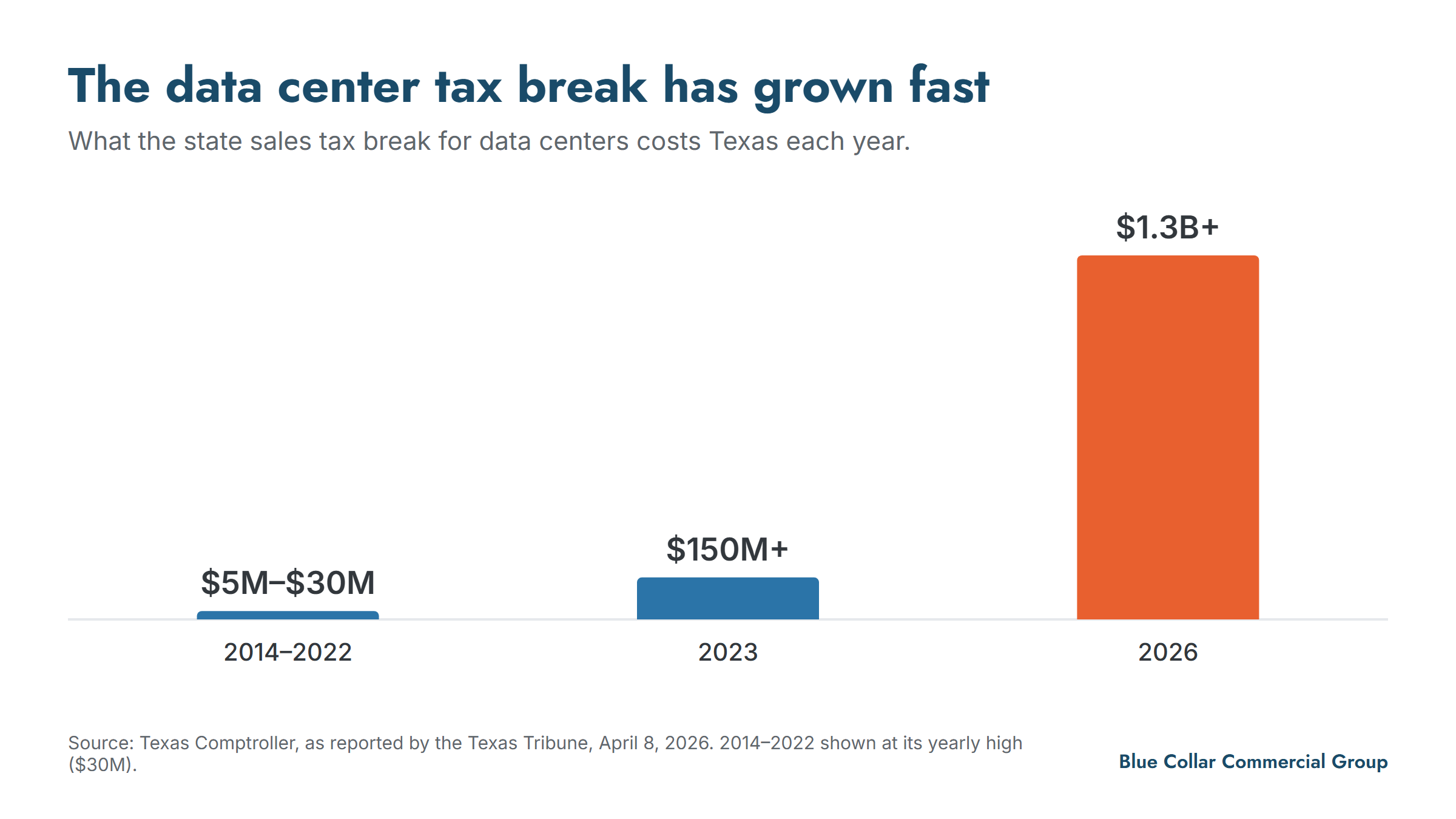
Texas gives data centers a big break on state sales tax for their equipment and electricity. It used to be small. Between 2014 and 2022 it cost the state $5 million to $30 million a year. This year it’s costing at least $1.3 billion, according to the state Comptroller, and the number is climbing fast. Many projects also get local property tax breaks. In Abilene, the city and county agreed to cut Stargate’s property taxes by 85 percent for ten years.
On the other side, data centers still bring in money. Abilene’s sales tax collections are forecast to top $67 million this year, far above the $48.5 million it budgeted, and city staff credit the data center construction upswing. And once tax breaks expire, a finished data center can add a lot of value to the local tax rolls.
Lawmakers from both parties are now talking about limiting or ending the state tax break when the Legislature meets in January.
What it means for you: The tax break is likely to be one of the big fights of the 2027 legislative session.
7. “Data centers make land prices go up.”
The short answer: Yes, for a specific kind of land. Not across the board.
What data centers want most isn’t land. It’s power. A tract next to a big power substation, with power already promised to it, is worth something special to a data center company.
Here’s a real example. This summer, a company sold a site in Graham, Texas, to a data center developer for up to $76.5 million. The sale included the land and the right to a large amount of electricity from the grid. Part of the price depended on how much power the utility confirms.
We haven’t seen evidence that data centers raise land prices across a whole county. The value is concentrated on the few parcels with access to serious power.
What it means for you: If you own land near major power lines, that location may matter more than your acreage. Before you sign any offer or option, get professional advice. The new state rules can change what a “spot in line” for power is really worth.
8. “Data centers are loud and hurt property values next door.”
The short answer: The noise complaints are real. The damage to home values hasn’t been proven either way.
The best-known Texas noise fight is near Granbury, where neighbors have sued over a bitcoin mining operation, a different kind of computer facility, saying the constant hum has harmed their health. The company disputes their claims.
As for property values, there isn’t a Texas study that answers the question. The National Association of Realtors, a real estate trade group, has said it found no single data center effect on home values. But no study is not the same as no effect.
What it means for you: If a data center is proposed near your property, ask about noise limits, setbacks and screening. New Braunfels is now writing those kinds of rules (more below).
9. “Data centers are great for the local economy.”
The short answer: During construction, yes. After that, we’ll see.
Abilene is the best Texas example of the upswing. Beyond the sales tax jump, the city led Texas in hotel revenue growth in mid-2025 as construction workers filled hotel rooms.
But upswings have a downside. Texas Public Radio and KUT reported this summer that the Stargate build has also contributed to a housing crunch in Abilene. And construction spending fades when the buildings are done.
What it means for you: Hotels, RV parks, restaurants, rentals and contractors near a big build can see a real rise. The question is how much of it lasts.
10. “Data centers drive up rents and push locals out.”
The short answer: In some small towns during construction, yes. It’s one of the clearest costs of the upswing so far.
When thousands of construction workers arrive in a small town at once, they need somewhere to live. Rents go up, and the people who already lived there can get squeezed out.
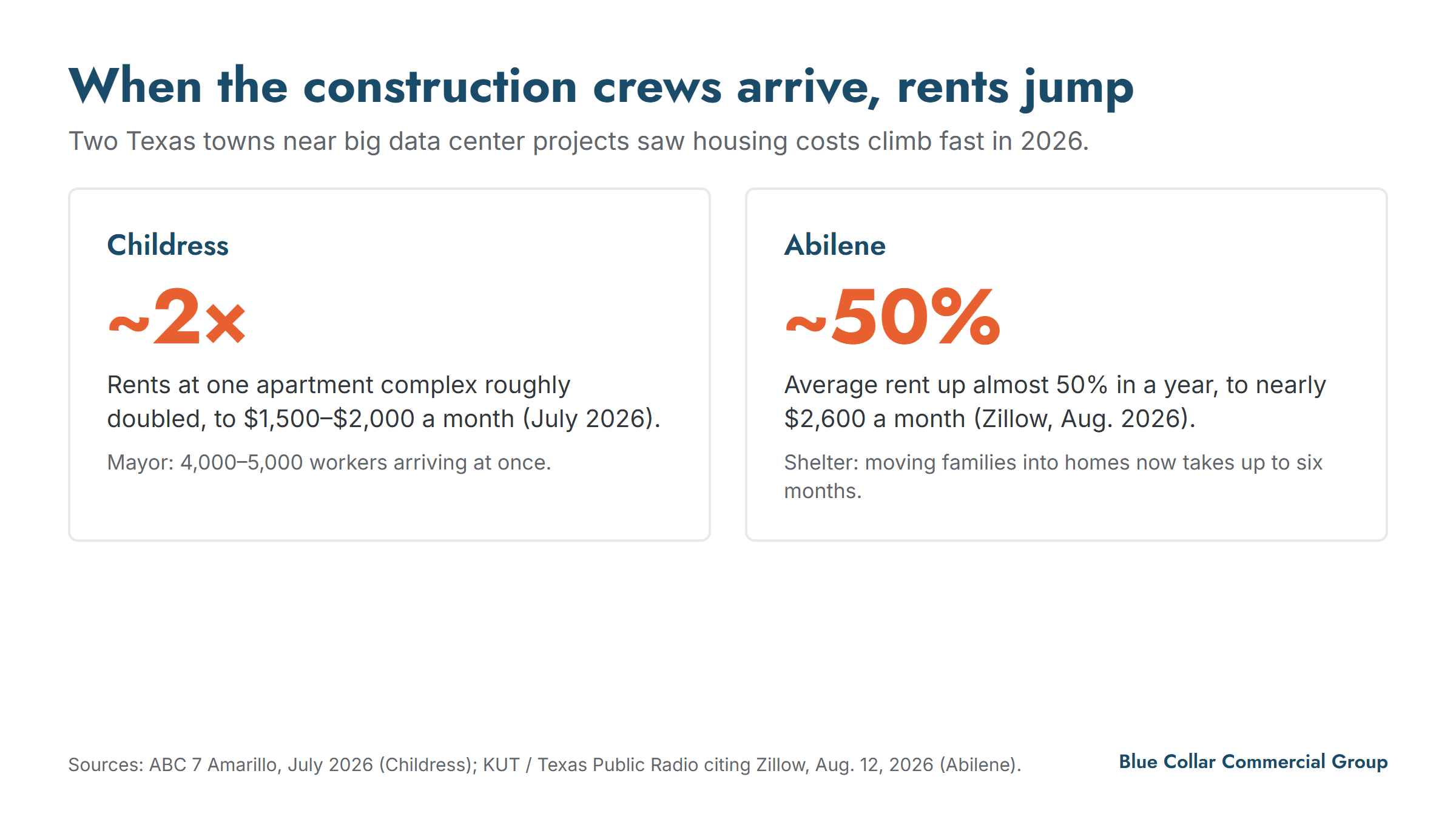
Childress is a good example. It’s a small town in the Texas Panhandle, near where a company called Iren is building a data center south of town on Highway 287. This July, residents of the Madison Chase Apartments got letters showing their rents roughly doubling, to $1,500 to $2,000 a month, according to ABC 7 Amarillo. Some tenants were told their leases wouldn’t be renewed. More than 20 people turned out to protest. Mayor Cary Preston said, “When you’re having 4 to 5,000 workers coming into our area, all at once,” it’s hard to keep up. He also said most of the development is outside city limits and “basically out of our hands,” and that the city was talking with landlords and trying to bring in more housing. He noted that business and property owners benefit from more sales tax, while working families feel the squeeze.
Abilene has seen the same thing on a bigger scale. KUT and Texas Public Radio reported in August 2026 that average rent in Abilene had climbed to nearly $2,600 a month, up almost 50 percent in a year. A local shelter worker said moving families into permanent housing now takes up to six months instead of about one. Abilene Christian University said more than 100 incoming students lacked housing for the fall. Some landlords have turned long-term rentals into short-term rentals for workers.
This isn’t a red or blue issue. Childress sits in one of the most conservative parts of Texas, and its residents are raising the same concerns as people in Austin and San Marcos.
What it means for you: If you own rental property near a big data center project, demand and rents can jump fast during construction. If you rent, or you run a business that depends on local workers, the same jump can be painful. Either way, the rise tends to follow the construction crews, so it’s worth asking what happens when they leave.
11. “It’s an AI bubble. Most of these will never get built.”
The short answer: Many of the proposals won’t get built. The ones under construction are real.
We’ve already seen deals fall apart. In March 2026, OpenAI and Oracle dropped plans to expand their Abilene campus. But within about three weeks, Microsoft stepped in and took over the expansion. That’s the pattern right now: some projects fall through, and others step in.
The state’s new rules, including the big deposit just to get in line for power, are designed to clear out the projects that were never serious.
What it means for you: Treat any announced project near you as a “maybe” until you see financing, power and permits lined up.
12. “A town can just ban data centers.”
The short answer: A city can try. A county mostly can’t.
In June 2026, San Marcos became the first Texas city to ban data centers everywhere in town, using its zoning power. A state senator has questioned whether the city has that authority, but as of early October, no one had sued.
Counties are a different story. In Texas, most counties don’t have zoning power at all. Hill County, north of Waco, passed a ban on new data centers this spring, then dropped it about two weeks later after a developer sued for $100 million. Comal County put it plainly in its own resolution this May: the state has the power to regulate data centers, and “counties do not.”
What it means for you: Inside city limits, local rules matter. Outside city limits, there are far fewer rules, which is one reason nearly half of the planned Texas data centers are headed for unincorporated areas.
What this means for commercial real estate
Here’s how we see it from the real estate side.
If you own land near big power lines, you may own something data center companies want. But that value depends on whether power is actually available, not just requested, and the state is now tightening the rules around that. Don’t assume a phone call from a developer means a done deal.
If you own a hotel, RV park, restaurant or rental property near a big construction site, expect an upswing while it’s being built, as Childress and Abilene show. Keep in mind the construction crews eventually leave, and a town under housing strain can turn on new projects fast.
If you own industrial or flex space, contractors and suppliers working on these projects need places to work and store equipment. That demand follows the construction.
If you’re a neighbor, the most important question is whether the land next to you is inside city limits. Cities can set rules on where data centers go and how loud they can be. Counties mostly can’t.
If you’re buying or investing, add a few questions to your checklist: Is there a data center proposed nearby? Is it inside a city? Where will it get its power and water? Is it caught up in the state’s review or the permit freeze?
This is general information, not legal, financial or investment advice for your situation.
What it means for the Texas economy
Data centers are bringing billions of dollars of construction, equipment and new power plants to Texas. That’s real money and real work.
They’re also costing the state real money. The sales tax break alone is now one of the most expensive incentive programs Texas has, according to the Texas Tribune.
The big economic impact numbers you’ll see, like 100,000-plus jobs, come mostly from studies the industry paid for. They may be right. But we couldn’t find a neutral, independent study of the whole state’s economic impact.
The honest summary: data centers are a big bet for Texas. The state is now trying to make sure the payoff is worth the cost.
What’s happening in our backyard
San Antonio: The 23 data centers already running in San Antonio use about one-tenth of 1 percent of the city’s drinking water, mostly using recycled water. The city’s water utility has warned that future AI data centers could use much more. A city councilman wants new data centers to be required to use recycled water instead of drinking water.
San Marcos: Banned data centers citywide in June 2026, after turning down a proposed 200-acre data center project in February.
Hays County: In June 2026, started a six-month review of big water-using projects, including data centers, before it grants things like tax breaks.
Comal County: In May 2026, the county passed a resolution. It isn’t a ban. The county says it supports well-planned data centers that use low-water cooling. But it wants strong water protections in areas where groundwater is already stressed, and it asked the state to require water-use reporting, study the impact, and review or repeal the state tax break.
New Braunfels: In August 2026, the City Council decided not to pass a temporary ban. Instead, it told city staff to write new rules. Today, data centers aren’t even defined in the city’s code. The new rules would only allow them in industrial areas, require a special permit for each one, and set standards for water use, noise and buffers from neighbors. Mayor Michael French said, “Data centers are growing fast at a record rate along the I-35 corridor.” The new rules haven’t been adopted yet. They still need two votes from the council.
Guadalupe County (near Seguin): In April 2026, the county approved a tax break of about $500 million and a development agreement for a 706-acre data center project by a company called CloudBurst. In July, a group of residents sued the county over that approval and another data center project. The case hasn’t been decided.
What to watch next
- December 2026: The state’s review of data centers is expected to finish. This will show how many projects are real.
- December 2026: Hays County’s six-month review ends.
- January 12, 2027: The Texas Legislature meets. Expect fights over the tax break and whether cities can ban data centers.
- Coming months: New Braunfels votes on its new data center rules.
More from our team: Read Texas’ AI Frontier: Why Abilene Is Ground Zero and Texas’ AI Upswing vs. The Water Crisis.
Frequently asked questions
How many data centers are in Texas?
About 335 are running, and at least 248 more are planned, according to the Texas Tribune (June 2026).
Did Texas ban data centers?
No. The governor ordered a review of big data centers trying to connect to the power grid, and paused their state environmental permits until the review is done, expected in December 2026.
Do data centers raise electric bills in Texas?
No one has shown that they have so far. A Dallas Fed study found they’ve pushed up wholesale power prices nationally, but the effect on household bills hasn’t clearly shown up. Texas is changing its rules so big data centers pay more of their own costs.
How much water do Texas data centers use?
Less than 1 percent of Texas water today. Counting the water used to make their electricity, the Houston Advanced Research Center estimates about 25 billion gallons in 2025. A University of Texas study says data centers could reach 3 to 9 percent of Texas water use by 2040, depending on how many get built, how they’re cooled and where their power comes from.
Do the power plants behind data centers use water?
Yes, often more than the data center itself. Gas, coal and nuclear plants use water to cool down. Wind and solar use almost none. That’s why a data center’s power source can matter as much as its cooling system.
Do data centers create jobs?
Thousands of construction jobs on big projects, but far fewer permanent jobs once they’re running.
What is the Texas data center tax break?
A state sales tax exemption on data center equipment and electricity. It’s costing the state at least $1.3 billion this year.
Do data centers raise rents?
In some small towns during construction, yes. In Childress, apartment rents roughly doubled this summer as thousands of workers arrived, and Abilene’s average rent rose almost 50 percent in a year, according to local reporting.
Can a Texas city ban data centers?
San Marcos did, using zoning, though a state senator has questioned its authority. Most Texas counties don’t have zoning power.
Is New Braunfels banning data centers?
No. The city is writing rules that would limit data centers to industrial areas and require a special permit for each one. As of October 2026, those rules haven’t been adopted.
The bottom line
Data centers aren’t good or bad by default. A well-planned one in the right place can bring investment and tax dollars. A poorly planned one in the wrong place can strain water, power and patience. Most of the claims you hear are a little bit true and a little bit exaggerated.
What’s changing fast are the rules: a state review, a permit freeze, new grid rules, a legislative session in January, and local ordinances still being written.
At Blue Collar Commercial Group, we help property owners, buyers and investors figure out what a nearby project, or a new rule, means for their land and buildings. Contact our team to talk it through.
Information is current as of October 5, 2026. Sources include the Office of the Governor, the Electric Reliability Council of Texas (ERCOT), the Houston Advanced Research Center, the Sierra Club (advocacy group), the Public Utility Commission of Texas, the Texas Comptroller (as reported by the Texas Tribune), the University of Texas at Austin, the Federal Reserve Bank of Dallas, Rutgers University, E3, the San Antonio Water System, Comal County Resolution 2026-12, City of New Braunfels File #26-979, the Texas Tribune, Utility Dive, KSAT, KTAB, Texas Public Radio, KUT, ABC 7 Amarillo, WRDW, the Herald-Zeitung, Community Impact, and company announcements from Microsoft, Crusoe and Plug Power. Industry-funded studies are labeled. This article is for general information only and is not investment, legal or financial advice.



