

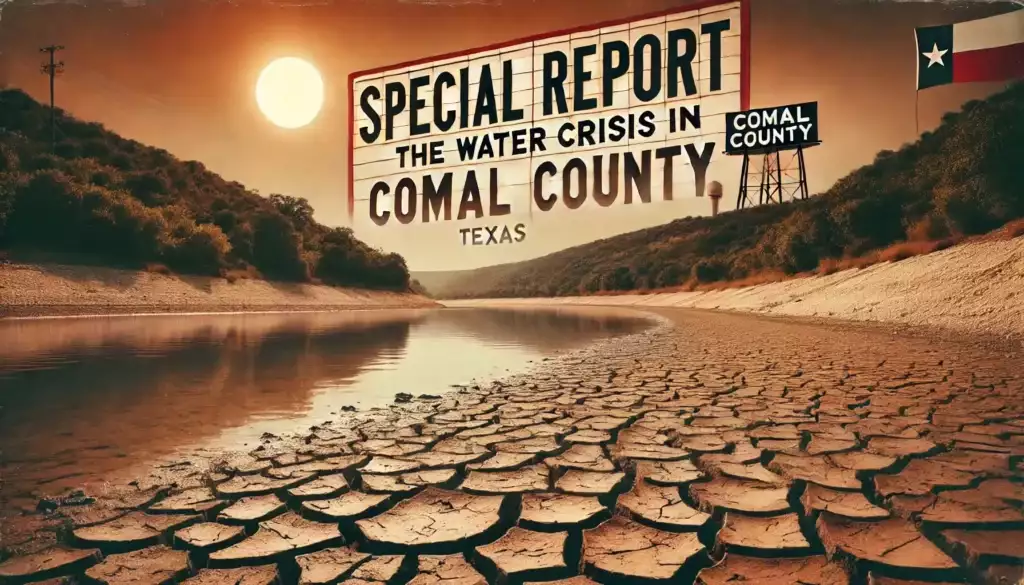
Updated October 2026. This article explains where Comal County gets its water, how the region has handled dry years, and what a property owner or buyer should ask a water provider before relying on service. For current conditions and the latest rules, read our newer guide, Texas Hill Country Water in 2026.
The quick answers
- Where does Comal County’s water come from? From four main places: the Edwards Aquifer, the Trinity Aquifer, Canyon Lake and the Guadalupe River. Which one serves a property depends on the provider.
- What is the Edwards Aquifer Authority? It is the agency created by the Texas Legislature to manage pumping from the Edwards Aquifer. It sets pumping cuts in stages when the aquifer is low.
- Where do things stand this fall? The Edwards San Antonio pool was in Stage 3, a 35 percent pumping cut, on October 10, 2026. Canyon Lake was about 97.7 percent full on October 11, 2026.
- Can a full lake and a low aquifer both be true? Yes. They are different systems with different rules. One reading does not describe the others.
- Does a property in Comal County have water service? Only the provider can answer that, in writing, for that parcel.
- Where is the current rulebook? In our 2026 Hill Country water guide. This article gives the background behind it.
Why water is a property question in Comal County
Water is a property question here because it decides what can be built, where, and when. A commercial building needs drinking water, fire protection and a way to get rid of wastewater. If any of the three is missing, the building does not work.
Comal County sits where the Texas Hill Country meets the Blackland Prairie. The county includes New Braunfels, Bulverde, Spring Branch, Garden Ridge and the communities around Canyon Lake. These places do not share one water system. A shop in the middle of New Braunfels and a lot near a ranch road west of Canyon Lake may rely on different sources, different companies and different rules.
That is the main point of this article. When someone says “the water situation in Comal County,” ask which water and which provider. You will get a different answer for each.
What it means for you. Never treat a news headline about “Comal County water” as information about your parcel. Treat it as a reason to ask your provider a specific question.
How Comal County gets its water
The Edwards Aquifer
An aquifer is underground rock that holds water, much like a very large, very hard sponge. The Edwards Aquifer runs in a long arc through the Hill Country and the San Antonio area. Rain that falls on its recharge zone, the part where water soaks in, refills it. Wells pump water out, and springs let water flow out naturally.
The Edwards matters in Comal County mostly because of New Braunfels. The city sits on the edge of the Hill Country, and its springs are fed by the aquifer. A low aquifer shows up as weaker spring flow, and it also shows up in pumping rules for those who hold permits to draw from it.
The Trinity Aquifer
The Trinity Aquifer lies under much of the western and northern part of the county. Many rural homes and small businesses use Trinity wells. Wells can differ from one another, even on nearby tracts. No single reading describes the whole Trinity Aquifer. Conditions depend on the groundwater district, the layer of rock and the individual well.
Canyon Lake
Canyon Lake is a reservoir on the Guadalupe River in Comal County. A reservoir is a lake built by a dam to store water. The Texas Water Development Board publishes daily readings for it. As of October 11, 2026, it was about 97.7 percent full. Several providers draw their supply from the lake, and the lake also matters to the local economy through recreation and the communities around its shoreline. You can read more about the area on our Canyon Lake page.
A full lake says something about the lake. It does not say whether a given provider has extra capacity, pipes in the ground or a permit to serve a new building.
The Guadalupe River
The Guadalupe flows out of the dam at Canyon Lake and runs through New Braunfels. River water is used for supply and also shapes the town’s look and its tourism. The same river that people tube on in summer also carries floodwater in a storm. Both are part of owning property near it.
Comal Springs
Comal Springs, in New Braunfels, is a major group of springs fed by the Edwards Aquifer. The Edwards Aquifer Authority posts daily spring-flow readings. They are one more gauge to read alongside the aquifer well and the lake level. They are not a verdict on any one property.
What it means for you. Find out which of these sources your property depends on. If the answer is “I don’t know,” that is the first thing to learn.
The Edwards Aquifer Authority and its stages
The Texas Legislature created the Edwards Aquifer Authority to manage the Edwards Aquifer. Its job includes limiting how much water can be pumped, so that people, farms, businesses and the springs that depend on the aquifer share a finite supply.
The authority splits the aquifer into pools. The San Antonio pool rule applies to much of Comal County. When water levels drop, the authority moves the pool into a higher stage, and permit holders must cut pumping by a set share. When levels recover, the stage can come down.
As of October 10, 2026, the San Antonio pool was in Stage 3, with a 35 percent pumping reduction. The authority also tracks an index well, called J-17, as one of its measures. Two points are easy to miss.
- These are the authority’s pumping rules for aquifer permit holders. They are not the same as a city’s or a utility’s watering schedule. A city may adopt its own stages, tied to its own supply.
- A stage reflects the aquifer’s condition at a point in time. It can change as rain and demand change. This article does not predict where it goes next.
What it means for you. If a business uses Edwards water under a permit, ask the permit holder how a pumping cut affects the property’s supply. If it buys water from a utility, ask the utility how aquifer stages show up in its own rules.
A short history of dry years
Texas has always cycled between drought and flood, and the Hill Country is known for it. Long dry stretches pull lakes and aquifers down. Then a heavy storm fills creeks and the river in a few hours. Both extremes have shaped how local officials manage water.
A few points of background help a buyer understand why water rules look the way they do.
Why the aquifer is managed
For many years, Texas treated groundwater as belonging to the landowner above it. Pumping on one tract could affect springs and wells miles away. Over time, the state created regional bodies to manage the Edwards Aquifer, and local groundwater districts for other aquifers. The Edwards Aquifer Authority is the one for the Edwards. Groundwater conservation districts handle many of the Trinity wells. Each has its own rules, and they are not the same.
Why the springs matter
The Edwards Aquifer Authority works with others on a habitat conservation plan that protects federally listed species living in the aquifer and at Comal and San Marcos springs. This is one reason aquifer management is not only about people. Spring flow itself is something the rules try to protect.
Why the lake is part of the story
Canyon Lake holds water through dry years and releases it down the Guadalupe. When the lake is low, lake-edge businesses feel it. When the lake is near full, as it is this fall, those pressures ease for the lake. They do not disappear for every provider.
Why 2025 and 2026 looked mixed
Recent years included both extremes. Deadly Hill Country floods hit on July 4, 2025 and July 16, 2026, centered on the Guadalupe River in Kerr County (Kerrville) and downstream areas such as Comfort. In the autumn of 2026, Canyon Lake was nearly full while the Edwards San Antonio pool sat in Stage 3. A reader who sees only the lake gets one story, and a reader who sees only the aquifer gets the other. Both are accurate. They describe different parts of the system.
If you want exact figures for earlier droughts, the Texas Water Development Board and the Edwards Aquifer Authority publish historical records.
What it means for you. Read the history as a reminder that conditions swing. A property decision should hold up in a dry year and in a wet one.
What 2025 and 2026 looked like
This is what we can state from official readings and dated events.
- Edwards Aquifer, San Antonio pool. Stage 3, with a 35 percent pumping reduction, on October 10, 2026 (Edwards Aquifer Authority).
- Canyon Lake. About 97.7 percent full on October 11, 2026 (Texas Water Development Board).
- Floods. Deadly Hill Country floods hit on July 4, 2025 and July 16, 2026, centered on the Guadalupe River in Kerr County (Kerrville) and downstream areas such as Comfort.
Those items do not fit one tidy story, and we do not try to make them fit. A reservoir reading cannot show whether groundwater is available, and an aquifer stage cannot show whether a utility can connect a particular building.
Federal drought maps have shown improvement across part of Central Texas after heavy rain. An improving map does not mean every aquifer or county has recovered.
Floods and drought are not opposites for a buyer
Many buyers think of water risk as one thing. It is two. One is too little: no service, a restricted well, or a pumping cut. The other is too much: floodwater in a building. A property can have a secure water connection and still sit in a floodplain, which is land that floodwater can reach. Our floodplain glossary entry explains the term. Most commercial property insurance policies exclude flood damage, so flood coverage is usually a separate policy.
For a view of how flooding affects one type of Hill Country property, see our article on buying an RV park after the flood.
What it means for you. Check both sides. Ask whether water will arrive, and ask whether water can reach the building.
Different providers, different answers
This is the part most buyers miss. Inside Comal County, the water you get depends on who delivers it.
City and utility service
A city utility, such as the one that serves New Braunfels, has its own sources, contracts and rules. It may buy water from more than one source. It can adopt watering stages for its customers on its own schedule. If a utility’s lines run to your property line, you still need to confirm that it will serve a new or larger building and what it will charge to connect.
Private water companies and districts
Outside city limits, a private company or a special district may supply water. These providers set their own limits. A provider can decline to serve a proposed development if it decides it cannot supply it, and it can change its stage of restrictions based on its source. A provider cannot promise service it does not have the supply or pipes to deliver. A letter that says “water is available” should say what, where, how much and on what conditions.
Wells
Many rural properties use their own wells. A well needs a legal right to pump, a groundwater district’s permission where one applies, and a water source that holds up. Rules for new wells can change, and a district can limit new permits during a drought. Ask the district, not only the seller.
Wastewater
Water in is only half of it. Wastewater out is the other half. A property may connect to a city sewer, a private plant or a septic system. Treatment plants have capacity limits, and cities have plans to expand some of them. An expansion in one part of New Braunfels says nothing about capacity in Bulverde, Spring Branch or around the lake. Verify the system that serves the specific parcel.
What it means for you. Get the provider’s name, the source of the water, the sewer or septic arrangement and the district that covers the land. Then get each one in writing.
What a property owner or buyer should ask a water provider
Use this as a working list. It fits a lot, a building, or a business you are thinking about leasing.
Supply questions
- Who is the retail water provider for this exact parcel, and where is the nearest line?
- What is the source of the water: aquifer, lake, river or a mix?
- Is the provider willing to serve a new or larger use at this address? Will it say so in a letter?
- What conditions come with that letter, and when does it expire?
- Is the provider in a restriction stage now, and what triggers the next one?
- Does the provider have any pending limits on new connections?
Cost and timing questions
- What are the tap, meter and impact fees, and who pays them?
- Who pays to extend a line to the property, and who owns it afterward?
- How long does a new connection usually take?
Wastewater questions
- Is the property on a sewer, a private plant or a septic system?
- If sewer, does the plant have capacity for the planned use?
- If septic, what does the permitting authority require for this use and this soil?
Well and groundwater questions
- Is there an existing well, and is it registered or permitted?
- Which groundwater district covers the land, and what are its current rules for new wells?
- Is the pumping right transferable if the property sells?
Risk questions
- Is any part of the site in a mapped floodplain?
- Does the insurance quote include flood coverage, or is that separate?
- What does the lender or insurer require for water, sewer and flood?
Put the answers in your due diligence file. If a provider will not answer in writing, treat that as an answer.
What it means for you. Ask before you make the offer, or put the questions in the contract as conditions. Your attorney can tell you how to write them in.
What a full lake does not tell you
People see a near-full lake and conclude the water question is over. That conclusion is not supported, for three reasons.
- The lake supplies the providers that draw from it. It does not supply the Trinity wells.
- The Edwards Aquifer responds to its own rain and its own pumping. It can be in a restriction stage while the lake is high.
- A utility’s ability to serve a new building also depends on pipes, treatment plants and contracts.
The reverse also holds. A pumping stage on the Edwards does not mean the whole county is out of water. It means one pool of one aquifer has pumping cuts. Providers that rely on other sources may have no change at all.
Our 2026 Hill Country water guide goes through the current conditions, the watering rules and the due diligence list in detail. Read it alongside this article.
What it means for you. Do not trade one headline for another. Match the headline to your provider.
Water and the kinds of property we see in Comal County
Vacant land
Raw land without service carries the most water risk. The land may be cheap for a reason. Before you buy, learn whether a provider will serve it, whether a well is allowed and whether sewer or septic is possible. The cost of getting service to the land can matter more than the price of the land.
Retail and small commercial buildings
A shop, restaurant or office needs a steady connection, and a restaurant or a car wash uses far more water than a quiet office. Ask whether the provider’s capacity covers your use, not just the building’s past use. A change of use can trigger new requirements.
Industrial and flex space
Many light industrial users need little water, and some need a lot. Your tenant’s process decides it. Ask the tenant for its expected needs before you sign a lease or a purchase contract.
Hospitality and lake-edge property
Properties that depend on the lake and the river, such as campgrounds and rental cabins, depend on water in two ways. They need supply for guests, and they rely on a visitor economy built around the rivers. They are also the most exposed to floodwater. Flood insurance and an evacuation plan are part of the discussion.
What it means for you. The right water questions change with the use. Start with what the building will do, then ask what that needs.
Where to look for current information
These sources publish the readings referenced in this article, and they update them often. Check them directly rather than trusting a summary, including ours.
- The Edwards Aquifer Authority posts the current pool stage, pumping reductions, the J-17 index well and the Comal Springs flow.
- The Texas Water Development Board’s water data site posts daily lake readings, including Canyon Lake.
- Your groundwater district posts its own stage and well rules.
- Your water provider posts its watering stage and its service rules.
For local context, our Comal County page and our Canyon Lake page cover the places mentioned here.
What it means for you. Write down the date of any reading you rely on. Water numbers change.
Common questions
Is Comal County running out of water?
No single answer covers the whole county. As of October 2026, Canyon Lake was nearly full and the Edwards San Antonio pool was in Stage 3. Conditions differ by source and by provider.
What does Stage 3 on the Edwards Aquifer mean?
It means permit holders who pump from the San Antonio pool must cut their pumping by 35 percent. These are the Edwards Aquifer Authority’s rules, not a city’s watering schedule.
Does a full Canyon Lake mean my property has water?
No. The lake serves some providers. Whether your parcel has service depends on your provider, its pipes and its permission to serve your use.
Can a water provider promise service?
Not in a way you should rely on without a written letter that states the terms. Supply, pipes and rules can change.
Is flooding a water supply problem?
It is a separate problem. A property can have reliable supply and still sit where floodwater can reach. Check the floodplain and your insurance.
Where do I find current rules?
Start with our 2026 Hill Country water guide, then confirm with your provider and your groundwater district.
The bottom line
Comal County’s water comes from more than one place, and each place has its own rules and its own readings. In October 2026, the lake was nearly full and the Edwards pool was in a pumping cut. Both are true at once.
For a property owner or buyer, the useful step is the same in a wet year and a dry one. Learn who serves the parcel, where the water comes from, what the sewer arrangement is, and whether floodwater can reach the site. Get the answers in writing and note the date.
At Blue Collar Commercial Group, we help owners, buyers and tenants ask the right questions about land and buildings in the Hill Country. Contact our team to talk it through.
This article was first published in 2025 and rewritten in October 2026. Readings come from the Edwards Aquifer Authority (October 10, 2026) and the Texas Water Development Board (October 11, 2026). This article is general information. It is not investment, legal, tax or financial advice.



