

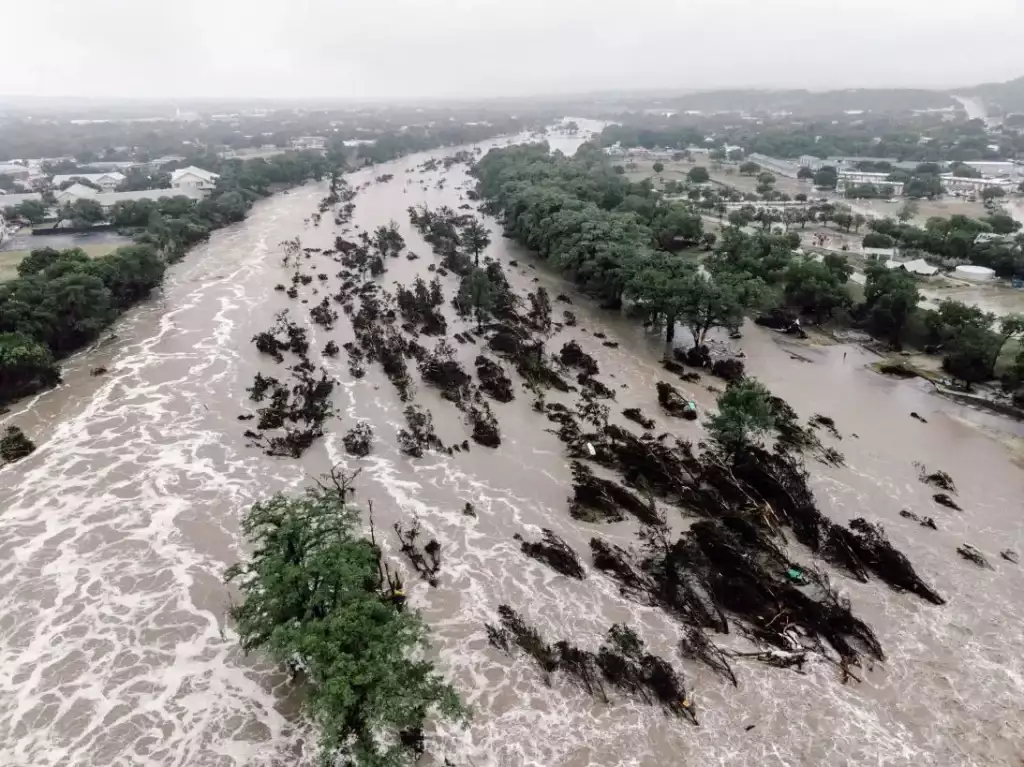
Updated October 2026. This article explains why the Texas Hill Country can swing from drought to flood in the same place, and how an owner, buyer or tenant of a commercial building can plan for both. It is written for business owners, small investors and landlords who are not real estate people.
The quick answers
- Why does the same ground go from drought to flood? Hill Country weather swings between long dry spells and short, heavy rain. When a lot of rain lands in a few hours, a river can rise fast, even if the lakes and the aquifer were low before it.
- Did the rain end the water shortage? Not everywhere. As of October 10, 2026, the Edwards Aquifer San Antonio pool was in Stage 3, with a 35 percent pumping reduction. On October 11, 2026, Canyon Lake was about 97.7 percent full. Different water systems tell different stories.
- Does a normal commercial property policy cover flood? Usually not. The Texas Department of Insurance says most commercial property policies exclude flood damage, so flood cover is bought separately.
- What is the first thing to check on a building? Where the building sits compared with the nearest creek, river or drainage path, and who your water provider is. Ask for both in writing.
- What should a lease say? Who pays for repairs, who carries which insurance, and what happens to rent if the building cannot open after a flood or a water outage.
- Is there a plan that makes a property safe? No. A plan lowers the odds of a bad outcome and shortens the recovery. It does not remove the risk.
Why the Hill Country swings between drought and flood
Dry years and wet days both happen in this region. Heavy rain over a few hours can raise rivers quickly, as the deadly floods of July 4, 2025 and July 16, 2026 showed. Both were centered on the Guadalupe River in Kerr County and in towns downstream, such as Comfort.
A building can face a water shortage in one season and rising water in another. One plan has to cover both.
What it means for you. Do not judge a property by the weather of the last six months. Ask what it has been through over many years, and ask what the property would do in each extreme.
Where the water stands now
A lake, an aquifer and a river can each be in a different condition at the same time. As of October 10, 2026, the Edwards Aquifer San Antonio pool was in Stage 3, with a 35 percent pumping reduction. That is the aquifer authority’s pumping rule, not a city’s watering schedule. On October 11, 2026, Canyon Lake was about 97.7 percent full, according to the Texas Water Development Board. The U.S. Drought Monitor summary for October 6, 2026, showed conditions improving across part of Central Texas after substantial rain, which does not describe any single aquifer, county or well.
What it means for you. Read the numbers for the system that supplies your property. Our guide to Hill Country water in 2026 walks through who supplies what.
Water supply: a backup and a letter
A building that cannot get water cannot run a restaurant, a car wash, a clinic or most offices. Water limits vary by provider. One Hays County city’s official page, for example, warns that its wastewater plant is full. The history of one county is in our report on the Comal County water crisis.
Ask the provider for a service letter
For any property you plan to buy, lease or build on, ask the water and sewer provider for a written statement. It should say whether the property is inside the service area, whether service is available today, and whether any limits or pauses apply. A seller’s or landlord’s word is not a substitute. The provider is the only party that can confirm service for a specific parcel.
Think about a backup
Some businesses need water to open. If yours does, ask what a backup would take. Options can include a storage tank, a second source, or a plan to reduce use during a restriction. Cost, permits and space all depend on the site, so get a quote from a licensed contractor before you count on any of them.
Write down the minimum water your business needs to open for a day. A restaurant, a medical office and a warehouse with two restrooms have very different numbers. Once you have the figure, you can ask a contractor what a tank or a second connection would cost, and ask the provider what happens to your account during a restriction. Also ask who owns and maintains the line from the street to the building, since a break on your side of the meter is your repair.
What it means for you. Get the service letter before you commit money. If you cannot get one, treat that as a finding about the property.
Drainage and site grading
Water follows slope. A site that looks fine on a dry day can look very different during a heavy storm. Drainage is how the lot sheds water, and grading is the shape of the ground that directs it.
What to look at on the lot
- Which way the ground slopes around the building, and whether the slope leads water toward the doors or away from them.
- Where the water from the roof goes, and whether the downspouts empty near the foundation.
- Whether parking areas hold water, and whether storm drains and ditches are clear.
- Whether neighboring lots send water onto yours, or take yours.
- Marks on walls, fences or poles that could show where water has stood before.
Ask for records
Ask the seller or landlord about past water in the building, past insurance claims and any repairs. Ask the city or county what drainage rules apply to the site. If you plan to add pavement or a building, a civil engineer can tell you what drainage work the change could require.
What it means for you. Walk the lot after a hard rain if you can. What you see in an hour of rain tells you more than a brochure.
Building on higher ground
Higher ground does not make a site safe, but site elevation is one thing you can check. Local conditions decide what it means for a given lot. A floodplain is low land next to a creek or river that water can cover when the stream rises. Treat a map as a starting point and not as a verdict. Our guide on flood risk and what to check covers maps, permits and questions for the city or county in depth.
Floor height and equipment
If a building must sit in a low area, ask how high the floor is above the ground, where the electrical panel, the air conditioning units and the server or inventory rooms are, and whether any of it could be raised. Equipment placed up high is easier to protect than equipment placed low.
What it means for you. Ask for the building’s floor height compared with the nearest flood line and keep the answer in your files.
Insurance: flood is usually separate
The Texas Department of Insurance says in its commercial property guide, updated December 9, 2025, that most commercial property policies exclude flood damage, so flood cover is bought separately. On July 10, 2025, the department asked insurers to work with affected policyholders; its bulletin says it creates no new requirements.
Questions for your insurance agent
- Does my policy exclude flood, and does it exclude surface water or runoff?
- What are the limits and deductibles on flood cover for the building and for the contents?
- Is there a waiting period before new flood cover starts?
- Does the policy cover loss of rent or income, and under what conditions?
Prices
We found no published, local price series for commercial insurance after the 2025 floods. A national survey of insurance agents found average commercial property renewal premiums about 6.3 percent lower in the second quarter of 2026 (August 2026 release), but that is a national figure and may not fit a Hill Country building. Your own quote is the only price that counts.
What it means for you. Ask for the flood quote before you sign a purchase contract or a lease. The answer can change what a property is worth to you.
Business interruption
Business interruption cover pays for lost income when a covered event stops you from operating. The key words are “covered event.” If flood is excluded from the main policy, income lost to a flood may not be covered either, unless flood and the related income loss are bought on purpose.
Water outages count too
A business can be shut down by a flood that never touches the building. A road can wash out, a bridge can close, or a water or power line can fail. Ask whether your policy covers loss of income from a utility outage, and whether it covers loss when access to the building is cut off. Many policies treat these as add-on items with their own limits.
Plan for the waiting time
Most income cover has a waiting period before payments begin, and it pays only for a set time. Look at how long your business could last with no income, then compare that to what the policy would pay and when.
What it means for you. Read the business interruption page of the policy, not just the summary. Ask an agent to explain it to you in your own business’s terms.
Lease clauses to read before signing
A lease decides who pays when water does damage, and whether rent keeps running while the doors are closed. Landlords and tenants often see these clauses differently, so read them as if the worst day will come.
Who pays for what
In a triple net lease, the tenant pays the taxes, insurance and upkeep. In other leases the landlord carries more of those costs. Ask which party buys flood cover, who pays the deductible, who repairs the building and who replaces the tenant’s own equipment and stock.
What happens if the building cannot open
- Does rent stop or shrink while the space is unusable?
- Who decides when the space is usable again?
- Can the tenant end the lease if repairs take too long, and how long is too long?
- Can the landlord end it?
- Who handles rebuilding, and in what time frame?
Utilities and access
Check whether the lease says anything about a loss of water or power, or about a closed road. Many leases say nothing, and then the tenant often has no right to pay less. If you need that right, ask for it before signing.
What it means for you. Have your lawyer read these clauses. A few lines in a lease can matter more than a month of rent.
An emergency plan for the building
A plan only helps if people know it. Write it on one or two pages and keep a copy off site.
Before a storm
- List who decides to close, and how staff and tenants hear about it.
- Decide where equipment, files and stock move to when water is forecast.
- Know how to shut off water, power and gas at the building.
- Keep photos of the building and its contents, and a copy of your policies, in a place you can reach from a phone.
During a flood
Do not drive into moving water and do not go back into a flooded building to save equipment. Follow the guidance of local emergency officials. The Guadalupe River floods showed how fast creeks and rivers can rise, so leave early when told to.
After a flood
- Call your insurance agent right away and take photos before cleanup.
- Do not turn on power to a wet building until a qualified person has checked it.
- Keep receipts for cleanup and temporary repairs.
- Tell customers and tenants when and how you will reopen.
What it means for you. Review the plan once a year, and again when you change tenants, staff or equipment.
What it means for tourism and local business
Water affects local business in more than one way. Flood events have closed rivers and trails for a time. The city of New Braunfels closed its rivers to recreation after the July 2025 rains and later reopened them, according to local reports. Kerrville said most of its River Trail reopened in December 2025, with a destroyed pedestrian bridge still closed at that time.
If a tenant or a property depends on visitors, ask how it did when the rivers or lakes were closed, and what it would do next time. Keep the question practical: how many days could it stay shut and still pay its bills?
What it means for you. Check any visitor-dependent business against both extremes, a dry lake and a closed river.
Common questions
Is a building near the river always a bad idea?
No. Many river properties have run for years, and some have value because of the setting. The point is to know the risks, price the insurance and plan for closures.
If a lot is not in the mapped floodplain, can I skip flood insurance?
That is a decision for you and your insurance agent. Maps do not capture every path water can take, and a standard commercial policy usually excludes flood. Ask for a quote and decide with the numbers in hand.
Who confirms I can get water at a new site?
The water and sewer provider for that location, in writing. A seller, landlord or advisor cannot confirm it for you.
Does a full lake mean the water shortage is over?
Not by itself. A lake, an aquifer and a river each have their own readings. As of October 2026 Canyon Lake was near full while the Edwards San Antonio pool was still in Stage 3.
Should a tenant buy flood insurance?
It depends on the lease and on what the tenant owns. A tenant usually insures its own equipment, stock and income. Ask your agent what is covered and what is not.
Where can I read about the Comal County side of this?
Our reports on the Comal County water crisis and on flood risk and water cover the local detail.
The bottom line
The Hill Country has dry years and sudden floods, and both can happen to the same building. The practical step is to check the facts about a specific site and write the answers down: the water provider’s letter, the lot’s drainage, its height compared with the nearest creek or river, the insurance terms and the lease clauses.
No plan removes the risk, and nobody can tell you when the next flood or dry spell will come. What you can do is make the damage smaller and the recovery faster, and make sure the paperwork says who pays.
At Blue Collar Commercial Group, we help owners, buyers and tenants ask the right water and flood questions before they commit to a property. Contact our team to talk it through.
First published July 2025 and rewritten in October 2026. Water readings come from the Edwards Aquifer Authority (October 10, 2026), the Texas Water Development Board (October 11, 2026) and the U.S. Drought Monitor (October 6, 2026). Insurance information comes from the Texas Department of Insurance and a national insurance agents’ survey. This article is general information. It is not investment, legal, tax or financial advice.



