

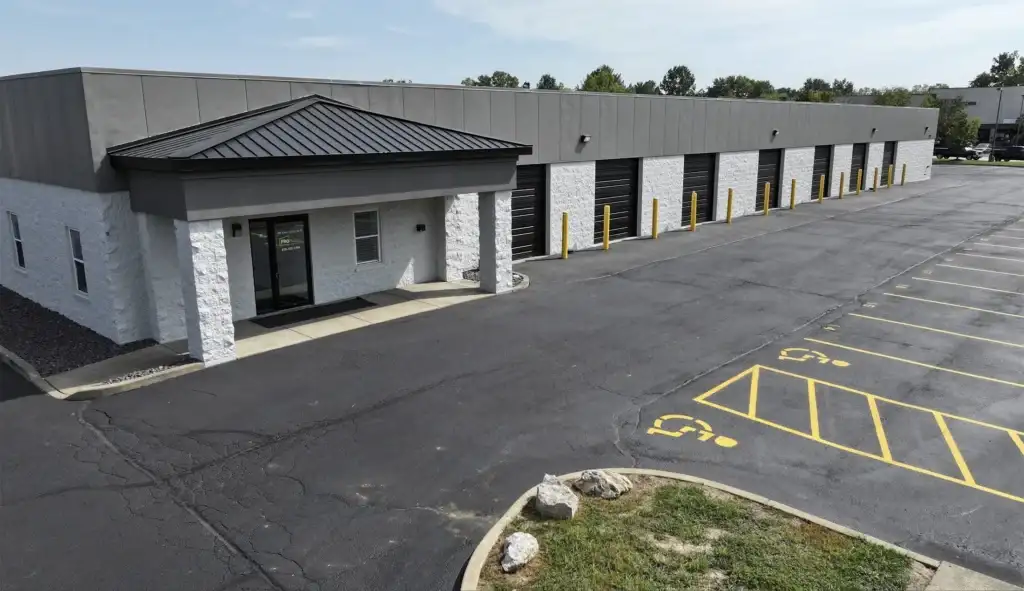
Flex market numbers through September 30, 2026. Loan rates as of early October 2026.
In our last article, Rent or Buy Your Shop on I-35?, we ran the numbers on a 10,000-square-foot shop. Even with loan rates near a 20-year high, a 10%-down SBA loan came in at about the same monthly cost as rent.
Many small businesses don’t need 10,000 feet. They need 2,000 to 5,000, with an office, a roll-up door and a place to park the trailer.
That is small-bay flex. It is the space many trade businesses in the corridor use, and it works differently from the big warehouses behind the averages in our last article. This article runs the same rent-or-buy test on a typical small-bay unit on the New Braunfels side and the San Marcos side.
TL;DR
- Small-bay flex is a different market from big warehouses. On the New Braunfels side, about 8.5% of flex space was empty in September 2026, compared with roughly 12% for industrial space overall. On the San Marcos side, flex was about 20% empty (market data through September 30, 2026).
- It rents for more per square foot. Typical asking rents run about $16 a square foot per year in Comal County and about $18 in Hays County, before taxes, insurance and upkeep.
- Short leases cut both ways. Most small-bay leases run one to three years. That gives you room to grow, but it also means your rent can reset often.
- There is a simple test for buying. On the New Braunfels side, if you can buy a unit for about $205 a square foot or less, the loan payment should come in at or below the rent. On the San Marcos side, the number is about $230.
- Around San Marcos, renters have leverage right now. With about one-fifth of flex space empty, a business shopping for space may have room to negotiate.
What we mean by small-bay flex
Our earlier guide, Small-Bay and Flex Space in Texas, covers the building type in detail. The short version:
- Small-bay describes the size. A building is split into units, usually 1,000 to 10,000 square feet each.
- Flex describes the layout. A finished office or showroom faces the customer, with a shop or warehouse behind it.
- Many buildings are both. Each unit has a front door, an office or two, a restroom and a roll-up door big enough for a work truck.
The tenants are the businesses that follow new rooftops. Plumbers, electricians, HVAC and pool companies, cabinet shops, sign makers, small distributors, gyms. If your trucks leave a yard every morning to work on new subdivisions along I-35, this is probably your kind of building.
The two markets for small space
Our flex numbers are reported by county, the same as in our last article. The New Braunfels side means Comal County. The San Marcos side means Hays County, which also takes in Kyle and Buda. We include Guadalupe County, where Seguin and part of New Braunfels sit, for comparison.
| Flex space | Empty, Sept. 2026 | Empty, end of 2025 | Typical asking rent per year |
|---|---|---|---|
| Comal County (New Braunfels side) | 8.5% | 4.6% | about $16 / SF |
| Hays County (San Marcos side) | 20.2% | 15.8% | about $18 / SF |
| Guadalupe County (Seguin) | 9.7% | 4.4% | about $14 / SF |
Market data through September 30, 2026. Rents are asking rents before taxes, insurance and maintenance charges, rounded.
On the New Braunfels side, small space is still tighter than big space. About 8.5% of flex space is empty. Industrial space as a whole is about 12% empty. A business looking for 3,000 feet has fewer choices than one looking for 30,000.
That said, flex vacancy nearly doubled this year, from under 5% at the end of 2025. One likely reason is size. Comal County has only about 800,000 square feet of flex space in total. One new 40,000-square-foot building adds 5% to the whole market at once. When a project like that opens, the vacancy rate can jump even if demand has not changed much. As those new units lease up, the rate can fall just as fast.
On the San Marcos side, small space is loose too. About 20% of flex space is empty, even more than the 18% for industrial space overall. Hays County built a lot of industrial space over the last few years.
What that means for you. If you need a unit on the New Braunfels side, you will have some choices, but not many. On the San Marcos side, you can shop.
Why short leases change the math
In our last article, we compared a 10,000-square-foot lease against a 25-year loan. With small-bay space, the lease side looks different.
Small-bay leases usually run one to three years. Short terms let rents adjust more often. Many small business tenants like them because they don’t want to commit to five or ten years.
The catch is that every renewal is a new negotiation. If your area tightens up, a three-year lease can come back with a large increase. And if the landlord sells the building, the new owner may have different plans for your unit.
For a business that has been in the same unit for five or ten years, with equipment installed, a phone number customers know and trucks staged out front, moving is expensive. That cost is real, even though it never shows up on a rent bill. It is one of the strongest arguments for owning your space.
The test: what price makes buying work?
Prices for individual small-bay units vary a lot from building to building, and our market data does not track them at the unit level. So instead of guessing at a price, we turned the question around: at what price does a loan payment equal the rent?
If you can buy a unit at or below that price, owning costs no more each month than renting. Above it, you are paying extra for ownership. That may still be worth it, but you should know how much extra.
We used the same loan assumptions as our last article:
- SBA 504 structure: 10% down from you, about 50% from a bank and about 40% from the SBA program.
- A blended rate of about 7.2%, based on SBA 504 rates near 6.97% for 25-year terms in October 2026 and bank rates in the 6.4% to 7.5% range.
- A 25-year payoff schedule.
For a 3,000-square-foot unit:
| 3,000 SF unit | New Braunfels side | San Marcos side | Seguin |
|---|---|---|---|
| Rent per month (typical asking rent) | about $4,000 | about $4,500 | about $3,500 |
| Break-even purchase price | about $620,000 | about $695,000 | about $540,000 |
| Break-even price per square foot | about $205 | about $230 | about $180 |
| Your cash down at that price (10%) | about $62,000 | about $69,000 | about $54,000 |
| Loan paid down in year one | about $8,000 | about $9,000 | about $7,000 |
Rents: market data through September 30, 2026. Loan math: our estimate using early-October 2026 rate quotes. These are examples, not quotes on any real property.
How to use this table. When you see a unit for sale, divide the asking price by its square feet. On the New Braunfels side, a unit priced well under $205 a foot looks good against renting. A unit priced well over it means you will pay more each month to own, at least at first.
A note on the extras. Renters usually pay their share of the building’s taxes, insurance and common upkeep on top of rent. Owners of a unit in a multi-unit building usually pay the same costs through property taxes and association dues. Since you pay them either way, we left them out of both sides. Before you compare a real unit, get last year’s actual numbers for both.
The cash question
As with the larger shop, the hardest part of buying is not the rate. It is the down payment.
At the break-even prices above, 10% down is roughly $54,000 to $69,000, plus SBA and bank fees, an appraisal and closing costs. For a five-truck service company, that might be most of the cash reserve. The money also has a cost. If it could earn 5% elsewhere, for example, $62,000 gives up about $3,100 a year, or about $260 a month.
On the other side, a long-term loan payment is more predictable than a small-bay lease, which resets every one to three years. And each year, part of the loan payment pays down what you owe, about $8,000 in year one on the New Braunfels example, and more every year after.
Three ways to own small space
Owner-users in small-bay space usually end up in one of three places.
1. Buy a single unit. Some newer small-bay projects sell units individually, like condos for businesses. You own your unit, and an owners’ association handles the shared roof, parking and landscaping. This is often the easiest way in, because the price is lower and you only buy the space you use. Read the association rules closely. They can limit outside storage, signs, hours and the kind of work allowed.
2. Buy a small building and rent out the rest. Some owners buy a building with several units, use some, and lease the others. The rent from the other units helps cover the loan. The trade-off is that you become a landlord. SBA 504 loans generally require your business to use at least 51% of an existing building, so in a building of four equal units you would usually need to use three yourself, or find a different kind of loan.
3. Build your own. If you can’t find the right building, you can build one on a pad site or a small tract. You get exactly the power, doors and yard you want. It is also the slowest and riskiest path. Our earlier guide walks through what to check first: zoning, utilities, road access and a real contractor bid. If you are looking at land in Comal County, our guide to Comal County zoning is a good place to start.
Where renting still wins
Buying is not for everyone, and right now there are good reasons to rent, especially around San Marcos.
With about 20% of flex space empty in Hays County, landlords there have more reason to compete for tenants. It is a good time to ask for:
- Free rent for the first few months.
- Build-out help. Money from the landlord for offices, power or a bigger door.
- A longer lease at a fixed rate. In a soft market, a landlord may trade a lower rent for a five-year commitment. That gives you the stable cost of owning without the down payment.
- A right to buy. Some landlords will give you the first chance to buy the unit or building later.
Even one of those changes the math. Three months of free rent on a three-year lease takes about 8% off what you pay over the term.
Renting also makes sense if:
- You might grow quickly. A business that will need twice the space in two years should keep the option to move.
- Your cash is tight. A building does not help a business that cannot cover payroll in a slow month.
- You are not sure about the location. If your customers or crews are shifting, a short lease keeps your options open.
On the New Braunfels side, renters have less room to negotiate. With less space open, landlords are less likely to offer much. That is part of why buying looks stronger there, the same as with larger shops.
How to decide
Most small business owners can sort themselves with four questions.
1. How long will you be there? If you expect to stay five to seven years or more, buying deserves a hard look. Every renewal you skip is a rent increase you avoid.
2. What is your space worth to your business? If you have a lift, a spray booth, heavy power or a yard set up the way you need it, moving costs real money. Owning protects that.
3. Can you spare the cash? If the down payment would leave you thin, renting may fit better for now, with another look at buying in a year or two.
4. Does the price pass the test? Divide the asking price by the square feet and compare it with the break-even numbers above. Then add what it costs to set up the space for your work.
How it shakes out for most owners:
- Settled business, solid cash, New Braunfels side: buying a unit may be worth pricing seriously. Space is tighter and leases reset often.
- Settled business, solid cash, San Marcos side: buying can still work, and some sellers may be open on price. But get a landlord’s best offer first and compare.
- Growing fast or short on cash: renting usually fits better, and the soft market around San Marcos may help you lock in good terms.
- Middle path: sign a longer lease at a fixed rate with a right to buy. You get stable costs now and a path to owning later.
Common questions
Can I use an SBA loan to buy a single small-bay unit?
In many cases, yes. SBA 504 loans can be used for owner-occupied commercial condos as well as whole buildings. The lender will look at the association’s rules and finances as well as your business. Talk to a lender who does SBA loans regularly. Our guide to commercial property loans covers the main options.
Why did flex vacancy jump so much in Comal County this year?
Mostly because the market is small. About 800,000 square feet of flex space means one new building can move the rate several points at once. That does not mean demand dropped. Watch how fast the new units lease over the next few quarters.
Is small-bay space a better buy than a big warehouse?
For an owner-user, it depends on what you need. Small-bay has been less empty than big space on the New Braunfels side, and it rents for more per square foot. But a single unit in a shared building comes with association rules and less control. The right answer is the space that fits your business.
Do flex rents include taxes and insurance?
Usually not. The rents in this article are asking rents before taxes, insurance and maintenance charges. Ask any landlord what those charges were last year.
Will flex space keep loosening?
It could in the short term, as newly built units come on the market. Over the longer term, as our earlier guide explains, small-bay projects face real hurdles: land near homes costs more, and the permits and engineering for a small building are not much less than for a large one. That tends to limit how much new small space gets built.
Terms used
- Flex space: Buildings that mix office or showroom space in front with shop or warehouse space behind.
- Small-bay: A building split into small units, usually 1,000 to 10,000 square feet each.
- Vacancy rate: The share of space that has no tenant.
- Asking rent: The rent owners are asking for space that is open now.
- Break-even price: In this article, the purchase price at which a loan payment equals the rent.
- SBA 504 loan: A federal loan program for small businesses buying or building the property they use.
- Amortization: Paying off a loan over time with regular payments, part interest and part principal.
- Free rent: Months at the start of a lease with no rent due.
- Tenant improvements: Work done to fit a space to a tenant’s business, often paid for in part by the landlord.
- Owners’ association: The group of unit owners in a multi-unit building that manages and pays for shared areas.
Talk it through
If you are weighing whether to rent or buy your next unit, on either side of the county line, talk to Rex. For more background, read our small-bay and flex guide, our investor’s look at Texas flex space, or the first article in this series, Rent or Buy Your Shop on I-35? You can also see how we help with tenant representation and buyer representation.
Flex market figures: market data through September 30, 2026, rounded. Rate sources (early October 2026): SBA 504 rates from SomerCor and Success Capital; commercial mortgage ranges from Northmarq and CommercialLoanDirect. Rates change monthly; check with a lender before relying on any figure. This article is general information. It is not investment, legal, tax or financial advice.



