
Last checked: November 5, 2026. Contract references are to the July 2022 Texas Realtors commercial forms. Your contract may differ.
If you own a small shopping center around here, you’re holding something buyers want. In our Q3 2026 market reports, retail vacancy was 4.0% in the San Antonio metro and 2.4% in Comal County. Retail sales in the San Antonio metro reached about $269 million over the past 12 months, up from about $169 million the year before. Nationally, Green Street reported strip center values rising about 2% in the first quarter of 2026.
That’s a good backdrop for a sale. It also tends to bring out buyers who do their homework. We recently published a guide for first-time buyers that teaches them to set the seller’s income number aside and work out what they’d keep in a bad year.
Run that same test on our made-up center, and $240,000 of income becomes $159,208. At a 7.5% return, that’s the difference between a $3.2 million price and about $2.12 million. A buyer may not push for all of that gap, but every line in it can come up in the negotiation, and it can come up after you’ve taken your center off the market.
The good news is that you can run the test first. You know your tenants, your leases and your building better than any buyer ever will. This guide shows what a careful buyer will look for, which fixes can pay for themselves, and how to keep a deal together once you’re under contract.
The buyer’s math, on your center
We’ll use the same center from our buyer’s guide. It’s invented, so your numbers will differ. It has 12,000 square feet and five spaces, and it’s priced at $3.2 million on $240,000 of income, which is 12,000 feet at $20. Expenses run $8 a foot. Space C is on an old gross lease, Space B has a cap on its common-area charges, and Space E, in the back corner, is empty or about to be.
A careful buyer will rebuild that income lease by lease and raise the property tax bill to reflect the purchase price:
| Per year | |
|---|---|
| Seller’s income number | $240,000 |
| Lost rent on Space E | -$40,000 |
| Space E’s share of expenses | -$16,000 |
| Space C’s share of expenses (gross lease) | -$12,000 |
| Cost above Space B’s cap | -$375 |
| Money set aside for roof, parking lot, HVAC | -$6,000 |
| Owner’s share of a higher tax bill | -$6,417 |
| Buyer’s bad-year number | $159,208 |
Each $1,000 of income is worth about $13,333 of price at a 7.5% return. That’s why small lines get so much attention. The $375 above Space B’s cap looks like nothing, but in that math it’s about $5,000.
Two lines deserve a closer look. The first is taxes. Texas appraises at market value as of January 1, and a buyer will likely assume the value moves toward the price. You can’t change that, but you can show your last few tax bills and any protest results, since buyers commonly ask for them. Our guide to commercial property tax in Comal County covers local rates.
The second is your tenants’ ability to carry that tax increase. A buyer may add it to each tenant’s bill and compare the total with sales, using a measure called occupancy cost. If you have sales reports, and the numbers are good, they can answer that question for you.
Fix what you can before you list
Some of the gap is fixable. This table shows what two changes could do to our example, using the same 7.5%:
| Buyer’s income number | At a 7.5% return | |
|---|---|---|
| Starting point | $159,208 | about $2,123,000 |
| Space E leased at $20 NNN | $218,875 | about $2,918,000 |
| Space C also moved to $12 NNN | $221,625 | about $2,955,000 |
Please treat that as an upper limit. A buyer will likely discount a brand-new lease, especially with a weak tenant, an untested business or free rent still running. A buyer may also use a different return for a center with short leases. We don’t have a reliable number for how large that discount runs, so ask a broker who knows your market to price your particular case. Even so, the direction is clear: an empty space is costing you income today and may be costing you far more in price.
Fill the empty space, if it can be filled
Leasing Space E brings in $40,000 of rent and moves about $19,667 of expenses and new taxes to a tenant. In our buyer’s guide, re-leasing that space cost from $74,667 to $136,000, using assumptions about months empty, free rent and commission. Compare that with the table above, and leasing often looks like the better bet.
There are two catches. The first is time. Our guide assumed 6 to 12 months empty, and a space with poor visibility can take longer. The second is that some spaces won’t lease at a price that helps you. If you’ve tried and it’s still empty, it may be better to price the center around that space and let the buyer take on the job. Some buyers go looking for exactly that kind of work.
Renew your best tenants early
Buyers look hard at how many leases end soon after they close, especially when the largest tenant is involved. In our example, Space A is a third of the rent.
Renewals also cost far less than new deals. Whitestone REIT, which owns centers in Texas and Arizona, reported 2025 costs of $3.85 a foot on renewals, compared with $25.09 on new leases. Phillips Edison reported $0.98 against $40.97 for small shops in the second quarter of 2026. Those are large public owners, and a small center may not match them, but the gap is wide enough to be worth acting on. A tenant with five years left is also a better story than one with five months left.
Watch what you give up, though. A long, fixed-rent renewal option can look like security to you and like a ceiling on income to a buyer.
Clean up old gross leases when they come due
Space C pays $30,000 a year with everything included. Moving it to $12 NNN at renewal keeps its bill at $30,000, so your income today stays the same. What changes is who carries the next increase. In our example, that’s $2,750 of new taxes, or about $36,700 of price at 7.5%. Keep the tenant’s total cost at market when you do this. Losing a happy tenant to gain that isn’t a good trade.
Reconcile your expenses
Buyers often ask for tenant reconciliation statements, and those show whether you’ve billed everyone correctly. Look for tenants you never billed, caps you missed, and square footage that doesn’t match the lease. Old errors are easier to fix with a tenant you know than in front of a buyer.
Handle the deferred items
Get a roofer and an HVAC contractor to look at the property, and clear any code items you know about. You don’t have to replace everything. But a buyer’s inspector will put a dollar figure on the roof either way, and it helps to have your own number and your repair records on hand.
Get your papers in order
Late papers can cost you time. In its April 2026 checklist, law firm Thompson Coburn says it often recommends that buyers start the due diligence clock only after the seller delivers the last item. If that language is in your contract, a missing report can stretch the whole schedule.
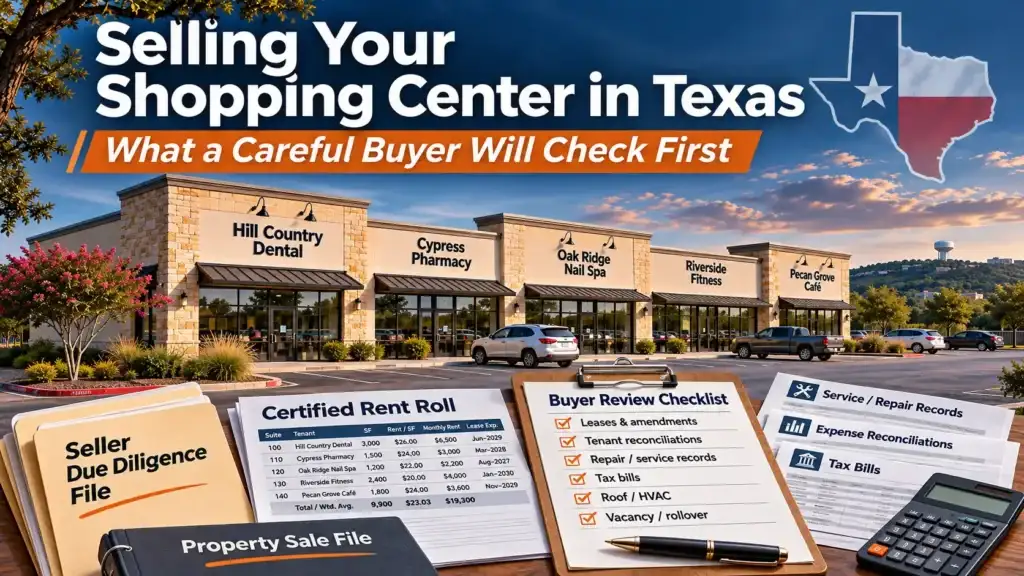
The Texas Realtors commercial contract for improved property, form TXR-1801, shows what buyers expect. The parties choose which items apply, and you deliver only what you have. Build one folder now with:
- Leases and rents. Every lease with all amendments, guaranties and side agreements. A certified rent roll. Commission agreements.
- Money. Income and expense statements, 24 months of utility and repair invoices, tax bills and protest results, and tenant reconciliation statements.
- The property. As-built plans, plat, survey, title policy, warranties, and any environmental or engineering reports.
- Operations. Service, management and utility contracts, insurance policies and any claims, and water and sewer capacity letters.
- Problems. Lawsuits, code notices and condemnation letters, if there are any.
Now read your rent roll against every lease. Rent, square footage, dates, deposits and options should all match. Under that form, you certify a rent roll as true and correct at closing, and often when you deliver it too, so any difference is your problem to fix first. Look for handshake deals too, such as a tenant you’ve let pay late or a rent cut you agreed to by text. A tenant may bring those up on an estoppel if you don’t.
Read your leases for sale traps
Your own leases can slow a sale or scare off a buyer. Read them the way a buyer’s attorney will:
- First-refusal rights. A right of first refusal lets a tenant match a buyer’s offer. A tenant holding one may also get the buyer’s diligence period, which can tie up your property for weeks before the tenant walks away. If the wording is unclear, the right may come back with each new offer. Have your attorney read any such clause before you list.
- Co-tenancy clauses. A buyer will ask what happens to rent if one store closes.
- Exclusive-use clauses. These limit who you, and the next owner, can lease to.
- Go-dark and termination rights. A 10-year lease with a right to leave after three isn’t really a 10-year lease.
- Landlord promises. Unfinished build-outs, unpaid allowances and promised repairs can become a credit against your price.
- Guaranties. Find out which ones have expired or shrunk. A personal guarantee that burned off years ago changes how a buyer sees that lease.
Under TXR-1801, you must also tell the buyer in writing about lease problems. That includes your own failures under a lease, anything that lets a tenant leave or claim an offset, a tenant who isn’t occupying its space, prepaid rent, and any free rent or similar concessions.
Once you’re under contract
Most of what you can fix, you should fix before you sign. Under TXR-1801, once a contract is in place, you can’t sign a new lease or change an existing one without the buyer’s written consent. You also have to keep running the property as you have been. After the feasibility period ends, other contracts that affect operations need the buyer’s approval too.
So if a good prospect is close on Space E, it’s usually worth finishing that lease before you accept an offer. If it can’t wait, write into the contract how a pending lease will be handled.
The feasibility period is the other thing to plan around. Under that form, a buyer can walk away for any reason during that window, so a surprise in those weeks can end the deal, or turn into a request for a lower price.
Estoppels are where deals can stumble
An estoppel certificate is a tenant’s signed statement confirming the facts of its lease. It stops the tenant from later claiming something different, which is why buyers and lenders want one.
TXR-1801 calls for one from each tenant, on or matching the Texas Realtors estoppel form, signed no earlier than a date the parties fill in. If you can’t deliver them on time, through no fault of your own, the buyer can get the earnest money back or extend by up to 15 days. That’s a lot to manage with five small tenants.
A few things help:
- Read your leases now. Many leases require tenants to respond, often within 10 to 30 days, according to law firm DarrowEverett. A lease that says nothing gives you less to work with.
- Clear disputes first. An estoppel request is when an old complaint about the roof or the parking lot lands in writing.
- Negotiate who has to sign. In multi-tenant properties, the requirement is sometimes limited to major tenants, according to law firm Blakes. Ask for that if you can, and allow enough time, since certificates often need to be recent.
- Ask about a seller certificate. Some buyers will accept your signed statement for a tenant who won’t respond. It doesn’t bind the tenant, and you’re liable if it’s wrong, so read every line.
- Call your tenants yourself. When it’s time to ask, a friendly call from you beats a form from a stranger.
What Texas law and the forms expect of you
Texas courts generally enforce as-is clauses on commercial sales. In Prudential v. Jefferson Associates, the Texas Supreme Court held that a buyer who took an Austin office building as-is couldn’t recover from the seller over asbestos found later. But the protection has limits. According to the Texas Real Estate Research Center, an as-is clause won’t protect a seller who lies about the property, hides known defects or blocks an inspection.
Texas requires a set disclosure notice on many home sales. We didn’t find an equivalent rule for commercial property, but the contract usually asks anyway. In TXR-1801, you choose between stating what you aren’t aware of, from a long list of items, or attaching a Commercial Property Condition Statement, form TXR-1408. That statement asks what you know about environmental conditions, drainage, flood history and flood claims, building systems, notices of violations, and planned roads that could hurt access or visibility.
It reports what you know, and it isn’t a warranty. That makes it simple to fill out well: tell the truth, and put down what you know. A known roof leak on the form is a negotiating point. The same leak left off the form can become a lawsuit. If a buyer asks you a direct question, answer it fully, and ask your attorney about anything you’re unsure of.
Security deposits have their own Texas rule. Under Property Code section 93.007, the buyer becomes responsible for deposits when it takes title, but you stay liable until the buyer gives the tenant a signed statement with the exact dollar amount. TXR-1801 requires the buyer to send that statement at closing. Ask for copies and keep them.
Closing, and what you keep
Under TXR-1801, taxes, rents and tenant reimbursements are split through the closing date. If this year’s tax bill isn’t out yet, the split uses last year’s, and the parties adjust when the real one arrives. Be sure to think past closing, too. The form doesn’t spell out who runs the year-end expense reconciliation with tenants, or who gets any refund from a pending tax protest. Commercial contracts often handle these with an estimate at closing and a later adjustment, so write yours down. Tenants may have a claim on part of any refund, depending on their leases.
Look at your loan early as well. A prepayment penalty can take a real bite out of your proceeds. If you have a CMBS loan, you may face defeasance or yield maintenance, which can be costly and take time to arrange. Get a payoff estimate from your lender before you set a price.
Then talk with your CPA before you sign a contract. According to the IRS, the part of your gain that comes from depreciation can be taxed at up to 25%, which can surprise a long-time owner. A 1031 exchange can defer the tax, though it doesn’t erase it. The timing is strict: you have 45 days after the sale to identify replacement property, and you must receive it within 180 days or by your tax return’s due date, including extensions, if that comes first. TXR-1801 has a paragraph for an exchange, but the planning has to start before closing.
What we’d do
If you asked us how to get a center ready to sell, we’d follow this order. Start as early as you can, since leasing is the slowest part.
- Run the buyer’s math. Fill in the table above with your own leases and a tax bill based on your likely price.
- Pick your fixes. For each one, compare the cost and time with what it might add to the price. Fill Space E if you can, and renew your best tenants first.
- Get a value. Ask for an opinion of value based on your cleaned-up numbers and on the numbers as they stand today.
- Build the folder. Match your rent roll to every lease, and fix what doesn’t match.
- Read your leases for traps. Have your attorney look at any first-refusal right, and at your estoppel clauses.
- Check your loan and your taxes. Get a payoff estimate, and talk with your CPA about what you’d keep.
- Fill out the condition statement. Do this early, so you know what you’ll need to disclose.
- Finish your leasing, then list. Show a buyer the same numbers that buyer’s own math will find.
A center that holds up under a buyer’s test gives you a stronger position in the negotiation, and it can spare you a price cut in the last weeks of a deal. In a market this tight, a well-prepared owner has a lot going for them.
The seller’s stress test on one page
All figures are from our made-up center.
| Question | Example answer | Where to find yours |
|---|---|---|
| Your stated income | $240,000 | Your rent roll |
| Income a careful buyer finds | $159,208 | Your lease-by-lease rebuild |
| Price gap at a 7.5% return | About $1.08 million | Your market’s return, from a broker |
| What filling the worst space adds to income | $59,667 | Your rent and expense share |
| Cost of filling it | $74,667 to $136,000 | Local leasing broker |
| Largest lease ending soon | Space A, a third of the rent | Your lease calendar |
| Estoppels needed | Five, unless negotiated | Your contract |
| Prepayment cost | Ask your lender | Your loan documents |
| Tax on depreciation | Up to 25% | Your CPA |
Common questions
Do I have to disclose problems when I sell a commercial property in Texas?
You can’t lie about the property or hide known defects, even with an as-is clause. Your contract will probably also ask what you know, through its own list or a condition statement. Answer truthfully, and ask your attorney about anything you’re unsure of.
What is an estoppel certificate, and do my tenants have to sign one?
It’s a tenant’s signed statement confirming its lease facts. Many leases require tenants to provide one on request, often within 10 to 30 days. Check each lease, because the terms vary.
Should I fill my empty space before selling?
Often, if it can be filled at a fair rent in a reasonable time. Income from a signed lease can add much more to the price than the leasing cost, though buyers may discount a new or weak tenant. If the space has resisted leasing for a long time, pricing around it may make more sense.
Can I sign a new lease after I accept an offer?
Under the Texas Realtors commercial contract, not without the buyer’s written consent. Other contracts may differ, so read yours.
What cap rate will my center sell at?
It depends on your tenants, your lease terms and your location. Average retail cap rates in our Q3 2026 reports ran from about 6.3% in Comal County to 6.8% in Guadalupe County, but those averages cover all retail. A small center with short leases can trade at a higher rate, which means a lower price. Ask for an opinion of value on your own property.
Who gets my tenants’ security deposits at closing?
They go to the buyer. Under Texas law, you remain liable until the buyer gives each tenant a signed statement with the exact amount, so keep copies.
Can I avoid taxes with a 1031 exchange?
You can defer them if you follow the rules. The deadlines are strict, so talk with your CPA and a qualified intermediary before closing.
Glossary terms used
- Cap rate: Income divided by price. The return used to turn income into a value.
- Co-tenancy clause: A lease term that lets a tenant pay less or leave if key neighbors close.
- Defeasance: Paying off a CMBS loan early by swapping in bonds that cover the remaining payments.
- Estoppel certificate: A tenant’s signed statement confirming lease facts for a buyer or lender.
- Exclusive-use clause: A tenant’s right to be the only one in the center selling a certain thing.
- Feasibility period: The window when a buyer can inspect and, under many contracts, walk away.
- Go dark: A tenant closing its doors while still under lease.
- Gross lease: One rent amount that includes expenses.
- NNN (triple net) lease: Rent plus a share of taxes, insurance and common-area costs.
- Occupancy cost: A tenant’s rent plus charges, as a percentage of sales.
- Personal guarantee: An individual’s promise to pay if the business doesn’t.
- Right of first refusal: A right to match another buyer’s offer.
- Yield maintenance: A charge for paying off a loan early, based on the interest the lender loses.
Sources
Market figures: Blue Collar Commercial Group Q3 2026 retail market reports, from brokerage market data through September 30, 2026.
Contract references: Texas Realtors forms TXR-1801, Commercial Contract – Improved Property, and TXR-1408, Commercial Property Condition Statement (both July 2022).
- Due Diligence Checklist for Commercial Real Estate Acquisitions, Thompson Coburn
- Tenant Estoppel Certificates: Navigating Risks, Responses and Leverage, DarrowEverett in New England Real Estate Journal
- Locking in the Lease: Key Considerations for Tenant Estoppel Certificates, Blakes
- A Clause for Concern? What Does As-Is Mean in Real Estate?, Texas Real Estate Research Center
- Texas Property Code section 93.007
- Valuing Property, Texas Comptroller
- Preemptive Rights and Wrongs: First-Refusal and First-Offer Rights, The Florida Bar Journal
- Clearly Limit First Refusal to a One-Time Right, The Habitat Group
- Whitestone REIT 2025 Form 10-K
- Phillips Edison Q2 2026 Form 10-Q
- Strip Centers, Senior Housing Lead CRE’s Cap Rate Compression, CRE Daily, reporting Green Street data
- Topic 409, Capital Gains and Losses, IRS
- Instructions for Form 8824, Like-Kind Exchanges, IRS
- Like-Kind Exchanges Under IRC Section 1031, IRS
This guide is general information, not legal, tax, lending or investment advice. The example center is made up, and your results will differ. Talk to your own attorney, CPA, lender and broker about any specific sale.