

There’s a rose growing on a grave in New Braunfels that has no business still being alive. A widow planted it in 1866, before she left for home in Germany, on the grave of a Union soldier who had come to Texas to cure his tuberculosis and lasted three months. She died six years later. The rose stayed. When a survey crew inventorying the town’s headstones came across it in 1985, it turned out to be a rare antique variety, and when a local historian drove out to look for it in 2022, there it was, still growing, 156 years on.
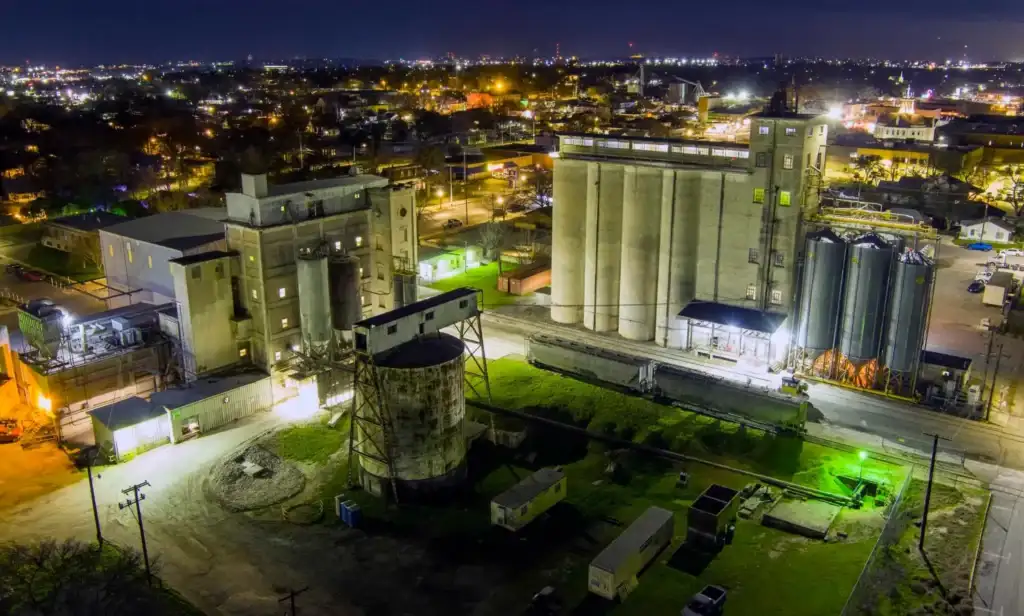
That soldier was Nicolaus Dittlinger. Ten years after he died, his orphaned son came to pay his respects and never left. And if you’ve ever been to downtown New Braunfels, you’ve seen what the son built, whether you knew it or not. It’s the silos at the east end of San Antonio Street, right beside the river.
I used to live on the corner of Napoleon Street and South Market Avenue, a few blocks east of Main Plaza and Naegelin’s German Bakery, and a short walk from Napoleon to the old Dittlinger mill. That mill was part of nearly every walk I took. I passed it on the way to the Tube Chute, on the way to Prince Solms Park, and on the way to one of the many downtown restaurants for dinner or a drink. I grew up in this part of the world, in Bulverde and Bergheim and the hallways of Boerne High, and for the last 30 years Comal County has been home. I can tell you that a big old working building in a small Texas town does something funny to you after a while. You stop seeing it. It was a place you walked past on your way to somewhere else, and for 137 years that was its job. It made flour, and the town went around it.
Now the people who built the Pearl in San Antonio own that ground, and they want it to be a place you walk to. On paper, at least, there’s a boutique hotel inside the mill, a bar on top of the silos, movies flickering across the concrete on summer nights, and trails along the prettiest water in the state. People are already calling it the next Pearl, which is the kind of thing people in this town have heard before.
It raises a question that goes well past one old building. For as long as anyone can remember, before it started growing to the east and west, New Braunfels was really two towns: the one around the plaza and the one on the river, a few blocks and a whole world apart, with a flour mill sitting in between. What happens when the thing that has always stood between them turns into the thing that’s supposed to bring them together? And who, exactly, does the new place get built for?
The Night Watchman
To understand the mill, you have to understand how little Hippolyt Dittlinger had when he got here.
He landed in Texas in April 1876 on borrowed money. He’d graduated from school in Germany, an orphan, and crossed the ocean to check on what his father had owned back in Cape Girardeau, Missouri, only to find the war had wrecked all of it. So he came to New Braunfels to see the grave. Mr. Schmitz, who owned the hotel where his father had died, gave the young man a place to stay. The Hill Country was doing what it does in April, and Hippolyt decided he wasn’t going anywhere.
He went to work at Scherff’s Store on the plaza, and the job description was everything. He slept in the store at night as the watchman. He got up and fed and groomed the horses. He loaded beer barrels, swept the floors, waited on customers, and after closing, sat down and kept the books. From there he moved to Tips, Clemens and Faust, a general mercantile, and worked his way up to partner. The store grew a grist mill and a cotton gin. In 1886, with Peter Faust, another name this town knows well, he founded what would become Dittlinger Mills.
Then they did something I’ve been thinking about ever since I read it. The power they needed was at Clemens Dam, on the far side of the river. So in 1887 Dittlinger and the Fausts went to the city council and asked to run a cable across. What they built was a metal rope drive, a moving loop about 1,500 feet long, running from the north end of the dam, over the Comal, to the mill on the south side. According to the Sophienburg’s history, it was one of the longest known in the United States.
I love that rope: a long loop of moving metal over the river, carrying the Comal’s own muscle into the mill. It went to diesel in 1914 and later to electricity, the way everything did, but for those first years the town’s biggest industry was physically tied to its river. It’s worth remembering, the next time somebody tells you the mill and the water have nothing to do with each other.
Hippolyt bought out Faust in 1901 and kept going. On a family trip to Germany in 1904, he stood looking at Roman buildings that had been up for 2,000 years, got to thinking about the lime mortar holding them together, and came home determined to build a lime plant like the one his father had built in Missouri. It opened in 1907 southwest of town. He hired laborers from Mexico and gave them work year-round, and the company replaced their tents and shacks with small houses, a church that doubled as a school, two stores and a dance hall. People called it Dittlinger Village, or La Calera. By 1930 he’d bought the retired Landa mill, on what’s now the Wurstfest grounds, and retooled it for feed.
When he died in 1946, at 87, New Braunfels was calling him its father of industry. The night watchman at Scherff’s lived in a grand house by then, and when the Dittlingers were handed a portrait of Prince Carl in 1925 to hang in a museum the town didn’t have yet, they kept it safe until one went up across the street in 1933. Later his children gave $80,000 for a library in the family’s name.
A Debt of Water
The part of the story I didn’t know until I went looking is my favorite. The land itself came with a string attached.
The parcel where the mill stands, 4.3 acres, goes back to an 1881 deed. When the city sold it, it wrote in a condition: whoever owned this ground had to give the fire department water from the Comal River. If an owner ever failed to keep the deed’s terms, the land would go back to the city.
Think about what that meant. For more than 140 years, through two world wars and every owner since, the most industrial block in a very German town owed the town water, and the town could in theory take the block back. As far as I can tell, that clause just sat there until May 2024, when Archer Daniels Midland, by then the owner, had the mill under contract to sell. A year earlier, in March 2023, ADM had shut the place down, ending 137 years of milling. The parties asked the city to clear up the old language, and the council waived both the water and the forfeiture. It was a small vote on a dusty clause, and with it, the last formal tie between the mill and the town dissolved.
The night watchman was long gone. So were the rope and the flour. What was left was a silent mill and its silos at the edge of a historic downtown, on a river that Oxbow Development’s Omar Gonzalez has called “the prettiest in Texas.” I walked past it every day, and I won’t argue.
Two Towns, One July
You can’t understand what’s about to happen on that block without understanding what New Braunfels has become, and I can give you the numbers or I can tell you about my street. I’ll do both.
The city had about 90,000 people in the 2020 census and about 122,000 by the middle of 2025. A recent study for the local tourism industry counted nearly six million visitors a year, which by my math comes to about 49 guests for every person who lives here. Hospitality accounts for 16,475 jobs, $376.3 million in wages and 32% of the city’s employment. Those are big numbers. From the front porch, they looked like this.
During spring break and all summer, I would open my door and see cars I didn’t know driving up and down my normally quiet street, looking for a parking place in front of my house. On Friday and Saturday nights, I’d stay in and skip the walk to hear a local band at the Pour Haus, knowing I could always catch a band on Thursday night. Then I’d wait until Sunday evening, after the tourists were gone, to meander over to the Lone Star Lounge and bother Chase, who I could always count on for an entertaining recap of the weekend.
Everybody who lives near the river has a version of that calendar. You learn the rhythm of the place the way people on the coast learn the tides. It’s a good life, and I’m not complaining about the folks who come here, since they pay for a lot of it. But a family from Houston and a family from Mill Street can stand a short walk apart on the same July afternoon and be in two different towns. The Texas band Jason Boland & the Stragglers put a name to that feeling in “Comal County Blue,” and anybody who’s lived here for long knows just what they mean. In season, parking at Prince Solms Park runs $20 a car. That’s a fair price for a day on the water, and it’s also a pretty clear signal about who the park is for between May and Labor Day.
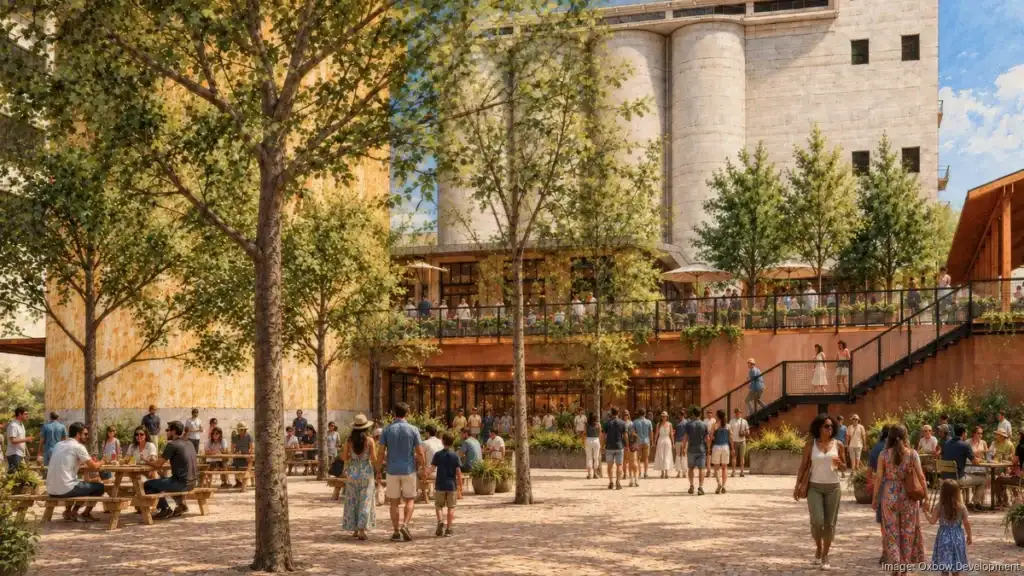
That’s why one of Oxbow’s stated goals caught my eye. The company says it wants to give people a reason to come down to the river with no swimsuit required. Gonzalez has said what made Pearl work is that it was built for locals, and that Oxbow is taking the same approach here. If they mean that, it’s the most interesting idea in the whole plan, because the river stopped feeling like ours a long time ago.
When Oxbow held its first listening session, on August 25 at the Civic & Convention Center, the locals showed up and told them what they wanted. They wanted a place for families and for grown-ups. They wanted the history and the views protected. They wanted a trail along the old train tracks, a Prince Solms Park they could actually use, a splash pad for the kids, and the silos lit up at night. Some wanted upscale shops that would pull in sales tax from visitors. Others wanted it kept affordable, so they wouldn’t get priced out of their own downtown. And they said, pretty clearly, that they wanted it to be more than a bar scene.
Seven weeks later, the new renderings had a bar on top of the silos.
To be fair to Oxbow, the same drawings added Silo Square, a gathering place with movie nights, and a plan to turn the floodplain into trails. One bar with a view doesn’t make a bar scene, and I’d probably go. But that small comedy is the whole tension in one image: a project that says it’s for the people who live here, drawn by people who know what the people who visit will pay for. It’s going to need both, because neither crowd can carry it alone through a Comal County winter.
Everybody’s Next Pearl
Locals have been through this before. When the first plans surfaced in 2024, a commenter quoted by MySA pointed out that this was the third New Braunfels project to claim it would be the next Pearl, and that the line was getting old. Some also complained that “Dittlinger Mill” was a terrible name, which, after what I’ve learned about the man, I’ll have to disagree with.
You can walk to one of the earlier promises. The Co-Op Marketplace on Castell Avenue got the Pearl-style label and approval for $4.5 million in incentives, none of it paid so far. This October, the city’s economic development corporation gave the developers five more years, to the end of 2031, after they cited rising costs, tenant trouble and redesigns. So far, the work hasn’t gone past initial demolition. I don’t say that to pile on. Building something new in an old downtown is hard, and there’s no better local evidence of how hard.
Oxbow has one thing nobody else who’s made that promise could claim: it actually built the Pearl. So it’s worth looking closely at how that happened, because the real story is slower and stranger than the one people tell.
The Pearl brewery closed in 2001, and Kit Goldsbury’s Silver Ventures bought the roughly 22 acres soon after. Then it waited. It spent years working with the city, adding a restaurant here, a farmers market there, a culinary school, some apartments. Hotel Emma, the thing everybody pictures, didn’t open until late 2015, about 13 years in. And in 2009, right in the middle of all that patience, the Museum Reach extension of the River Walk opened past the Pearl’s front door, a public project of about $71 million that handed it a river frontage it never had to pay for. Land values along that stretch climbed more than 270%, according to the San Antonio Report, and more than 3,500 housing units followed. Gonzalez has said he hopes for something like the partnership Oxbow had back then with the city, Bexar County and the river authority.
New Braunfels has no river project like that on the way, and it doesn’t have San Antonio’s million and a half people to lean on through a slow January. Oxbow seems to know it. At that August meeting, its team said flatly that there would never be another Pearl, and that New Braunfels would get something of its own. It said it wants to tell the Dittlinger story the way it told Emma and Otto Koehler’s at the brewery, and bring the place back to something Hippolyt would be proud of.
I believe them, and I reckon it’s good news. This town already has what San Antonio spent decades and a fortune trying to build: a clear, spring-fed river, a historic downtown you can walk, and six million people who already know how to find it. And the silos are a landmark nobody has to invent. With a story like that night watchman’s to tell, I wouldn’t need a Pearl either.
The Least Photogenic Building on the Block
Every big dream in a Texas town eventually comes down to something boring, and in New Braunfels, the boring thing is parking.
Downtown has been sore about it for a while. In July 2025, about a third of the on-street spaces went to paid parking, first hour free and $2 an hour after that. Some merchants say turnover got better, and the city has put the money back into downtown. Chip Lyons, who owned the Tavern on Castell, told reporters his sales fell about 35%, and he blamed fewer locals coming down. The tavern closed for good that next January, after two years. I don’t know how much parking had to do with it, and I won’t guess. But anybody who’s ever hunted for a spot near the plaza knows that argument is alive, and it’s about the same people Oxbow says it’s building for.
The garage in Oxbow’s plans has been a moving target. It was 400 spaces in 2024 and more than 500 this spring, wrapped in shops so you’d see a storefront instead of a parking deck. By October, reports had the project itself needing 200 to 250 spaces, with people at the meetings strongly in favor of a public share. A 2023 city study had already found that a 400-space garage would be hard to pay for on its own. So this may be the most realistic way downtown gets a public parking garage this decade.
It won’t ever make the postcard. But stand on the corner and think about it two ways, because I think this garage is what decides which town we get.
In one version, the hotel faces San Antonio Street, the way it was described to the council. The garage is open to everybody. The trails tie into Prince Solms. You park once, eat at the mill, stroll up East San Antonio to the plaza, and wander back along the water, and for the first time in 140 years, the plaza and the river feel like one place. The block I used to walk past becomes the middle of downtown.
In the other, the garage holds about what the project needs, the doors face inward, and the trails loop back to the hotel. Visitors park, spend their money and leave without ever seeing the courthouse. On a Saturday in July, the overflow lands on the same streets that are already full, ~~including mine.~~ Somebody will be standing on Napoleon Street looking at a car they don’t know.
The drawings could go either way. What separates them is a deal that hasn’t been made. Oxbow says it wants to bring the city a framework for a public-private partnership by the end of this year, covering parking, open space, drainage and other infrastructure. It’s targeting 2028 to start building and 2030 at the earliest to open. There’s no hotel operator yet and no announced cost.
That deal could run through a little-known piece of city plumbing called Downtown TIRZ #3, a zone where a share of any growth in property taxes gets spent back inside downtown. So far it’s barely had anything to spend. By my estimate, it’s taking in only about $35,000 a year, and the mill itself paid about $10,000 in property tax in 2025. A finished Dittlinger could become nearly all of the zone’s money. That could build the garage and the trails downtown has wanted for years, or it could mostly go back to the developer, leaving not much for anybody else. Neither one would be a scandal. Developers ask for partners, and cities have good reasons to say yes. But if you care how this story comes out, that’s the chapter to read.
The River Gets a Vote
The Comal has its own opinion about all this, and anybody who was here in 1998 will tell you it isn’t shy.
The river gauge just upstream of the San Antonio Street bridge, right next to the mill, has a major flood stage of 23 feet. In October 1998, it crested at 39.28. In June 2010, it hit 28.64. A lot has been built since then to hold the water back, including a flood dam on the Dry Comal, but about a quarter of the Dittlinger site still sits in the floodplain.
Oxbow’s answer is about the smartest thing in the plan. It wants to give that land over to trails and open space, so the part nobody can safely build on becomes the part everybody gets to use. There’s something fitting about it. The men who built this mill looked at that river and saw power. The people rebuilding it are looking at the same water and seeing a reason to linger. Either way, it’s the Comal that decides how much of those 11 acres can ever hold a building.
Meanwhile, downtown isn’t sitting around waiting. The Faust Hotel, which I wrote about last year when it was still a shell behind a construction fence, reopened in May. The Neue, 43 condos on West San Antonio Street, broke ground in September. The Mainzer, a hotel planned for the plaza, has been aiming to break ground next summer. By the time the first guest checks into a room at the mill, this will be a very different downtown, and the mill will have to earn its place in it.
What the Rose Knows
I don’t live on Napoleon Street anymore, so I can’t tell you whether the people on those streets in 2031 will love what gets built there, or whether they’ll go on doing what most locals do with a tourist attraction, which is give directions to it and avoid it in July.
I can tell you what I’d want. I’d want a kid on Napoleon Street, with a dog on a leash and nowhere special to be, to have a reason to cut through that block on an ordinary Tuesday in February. I’d want a coffee shop open and a place to sit by the water. I’d want somebody behind the bar on a Sunday night who can give you the recap of the weekend, with a local musician on an acoustic guitar singing covers of local legends like Cody Canada and Ray Wylie Hubbard. And I’d want some small sign, somewhere on that site, telling the story of a teenager who slept in a store on the plaza and a long metal rope that once ran across the Comal.
Hippolyt Dittlinger’s mother planted that rose and went home, and as of the last time anyone wrote it down, it was still growing in this same town. Things last in this town longer than anybody plans on. The mill lasted 137 years. The debt of water lasted 143. Whatever gets built on that block is going to be standing long after the people arguing about it today are gone, so it’s worth getting the argument right.
Somebody ran a rope across that river once, because a mill on one bank needed what was on the other. New Braunfels has spent the 140 years since then on both sides of it. Now somebody’s going to have to run another one.
The Mill: A Timeline
- 1866: Nicolaus Dittlinger dies in New Braunfels, and his widow plants a wild rose on his grave
- 1876: His son Hippolyt arrives from Germany and goes to work at Scherff’s Store on the plaza
- 1881: The deed on the mill’s 4.3-acre parcel requires river water for the fire department
- 1886: Hippolyt Dittlinger and Peter Faust establish what becomes Dittlinger Mills
- 1887: Dittlinger and the Fausts ask the city to run a cable from Clemens Dam to the mill
- 1901: Dittlinger buys out Faust
- 1907: Dittlinger’s lime plant opens southwest of town, along with the company community of La Calera
- 1914: The mill changes to diesel power, and later to electric
- 1946: Hippolyt Dittlinger dies at 87
- 1998: The Comal crests at 39.28 feet at the gauge beside the mill
- 2023: ADM closes the mill after 137 years
- 2024: The city waives the old deed terms, and the first rezoning passes
- 2026: The rezoning is expanded, and Oxbow shows its plans at public meetings
- 2028: Oxbow’s target to start construction
- 2030: Oxbow’s earliest target to open
Sources: Sophienburg Museum & Archives, “The Dittlinger Legacy” (Tara V. Kohlenberg, 2022). Handbook of Texas Online, “Dittlinger, TX.” New Braunfels Herald-Zeitung on the deed, rezoning and listening sessions (2024, 2026) and the hospitality study (2026). San Antonio Express-News, CultureMap San Antonio, The Real Deal and the San Antonio Business Journal on Oxbow’s plans (2026). Community Impact on the Co-Op Marketplace and paid parking (2025, 2026). MySA on local reaction and the Tavern on Castell. City of New Braunfels on parking and the downtown reinvestment zone. San Antonio Report and the Urban Land Institute on the Pearl. Texas State University and the Guadalupe-Blanco River Authority on flood records. U.S. Census Bureau. Visitor and tax estimates are the author’s math from published figures. Plans and dates can change, and this article is general information.



