

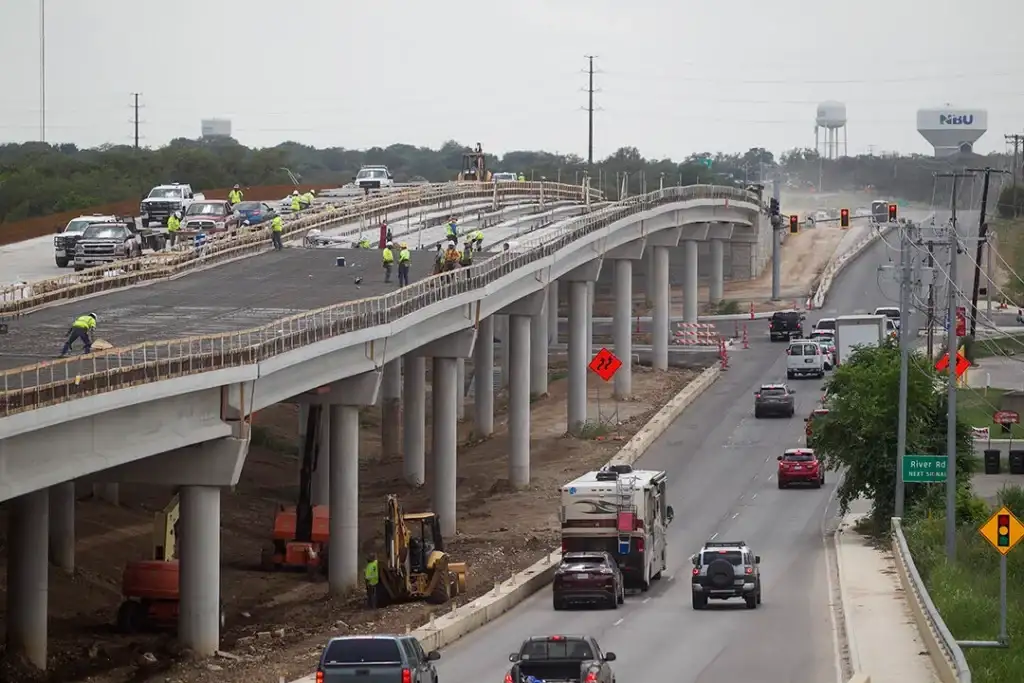
New highways get the headlines. The street out front getting rebuilt gets almost no attention, even though it can change what a property is worth. Here’s what the research says, and how to tell when road work is likely to help or hurt.
The short version
- Does road construction hurt nearby businesses? Often, especially small, local, single-location shops and restaurants.
- Does the value come back afterward? Often, but not always, and it can take years.
- Which road fixes matter? Fixing real problems like flooding and poor access shows the most promise. Repaving alone hasn’t shown a measurable effect on property values.
- Can you buy before the value goes up? Sometimes. But on big projects, prices can start to move once the project is funded and certain, and nobody has studied the timing for ordinary street repairs.
- Where do you find these projects early? City bond lists, TxDOT project plans, regional planning lists, federal grant awards and city council agendas.
Living with orange barrels
If you live or work in Comal County, you know the feeling. You plan your drive around the cones.
Out in Bulverde and western Comal County, State Highway 46 spent years being rebuilt from two lanes into six, with raised medians and a sidewalk. The $59 million project started in late 2022 and is now finished. For years, the shops, the school and the H-E-B along the way lived with the construction.
In New Braunfels, the work at I-35 and FM 725 was supposed to be a simpler fix: new turnarounds, signals and sidewalks for about $5.1 million. Work started in January 2022 and was supposed to finish in September 2023. A redesigned retaining wall, a change of contractor and material delays stretched it past three years, according to Community Impact.
And I-35 itself? Between the interchanges and frontage roads, it can feel like it’s never not under construction.
Here’s the question most people never ask: what does all that road work do to the value of the property next to it?
When people talk about roads and real estate, they usually mean a brand-new highway. But most of the road work that touches a property owner’s life is smaller and closer to home. An old street gets widened. Drainage gets rebuilt so the road stops flooding. Sidewalks, turn lanes and traffic lights go in. The potholes finally get fixed.
For a business on that street, those construction years can be rough. Customers find another way to go, and some businesses don’t survive.
For a buyer, the same years can be an opportunity.
At Blue Collar Commercial Group, we have a name for it: a “someone else added the value” deal. The city or the state pays to fix the road. When the work is done, nearby property can be worth more, and the owner didn’t pay for the improvement directly. It doesn’t always work out that way, which is why we use the test below.
That’s the idea. Here’s what the research says about when it works, when it doesn’t, and how to tell the difference.
What happens to a street during road work?
Road projects usually go through three stages.
1. Before: something is wrong. The street floods when it rains, the drainage has failed, or turning in and out is hard. That’s usually why the project gets funded in the first place.
2. During: the hard part. Lanes close, detours go up, and drivers build new habits. A University of Minnesota study for the state transportation department looked at highway projects around Minneapolis and St. Paul. Across all businesses, it found few significant effects overall. But small, single-location businesses in the city took real losses and closed more often. Restaurants and other food businesses were hit hardest. Chains and businesses with several locations came through much better.
There’s Texas evidence too. A study of U.S. 183 in Austin tracked commercial property values for 18 years while the highway was expanded. Values dipped during the years when land was being bought for the road and while construction was underway.
And there are local voices. During the rebuild of Broadway in San Antonio, a restaurant owner told the city council that developers were “buying up properties at pennies on the dollar,” according to the San Antonio Report.
3. After: often a recovery, not always. On U.S. 183, finishing the road cancelled out the losses from the construction years, and values then rose along with the rest of the market. The study also cites earlier research suggesting values took about five years after completion to get back to where they were before construction started. But the Minnesota study found some small city businesses kept losing even after the work was done. Both studies looked at highway projects, so treat them as a guide for city streets, not a rule.
What it means for you: The pain during construction is real, and a recovery often follows, but not for everyone. The big question is who owns the property while it happens, and who can afford to wait.
Which road fixes actually add value?
Not all road work is the same. Here’s what the research shows.
Fixing flooding and drainage: promising. Flood risk clearly lowers property values. Most of that research is on homes, not commercial property. But removing a real flooding problem is one of the more promising ways a public project can help. Check whether a project actually reduces flooding for the property you care about.
Walkability: real, but modest. One national study of office, retail and apartment properties found that a 10-point increase in a property’s Walk Score (a 0–100 rating of how walkable a location is) was linked to roughly 1 to 9 percent higher value. It found no effect for industrial property. New sidewalks and safer crossings can raise a Walk Score.
Repaving and pothole repair alone: no measured effect. The one study we found that tested pavement condition directly found the effect on property values was small and usually too small to tell apart from chance. Smooth new asphalt is nice. On its own, it hasn’t been shown to change what a property is worth.
Medians, closed driveways and lane changes: watch the specific property. Even when a project helps a street overall, these changes can hurt one particular property, for example if customers can no longer turn left into the parking lot.
Traffic counts: not the whole story. It’s common to assume more cars driving by means more value. The research doesn’t prove that. We found no U.S. study showing that more car traffic raises commercial rents. What does show up is foot traffic. In a study of Dutch shopping streets, 10 percent more people walking past was linked to at least about 2.5 percent more rental income for shops. Cars passing by don’t pay rent. Customers who stop do.
What it means for you: Look for road work that removes a real problem, like flooding, failed drainage or bad access. Fresh asphalt alone isn’t a reason to expect higher value.
The 6-question test
Here’s how we’d size up any road project near a property you own or are thinking about buying.
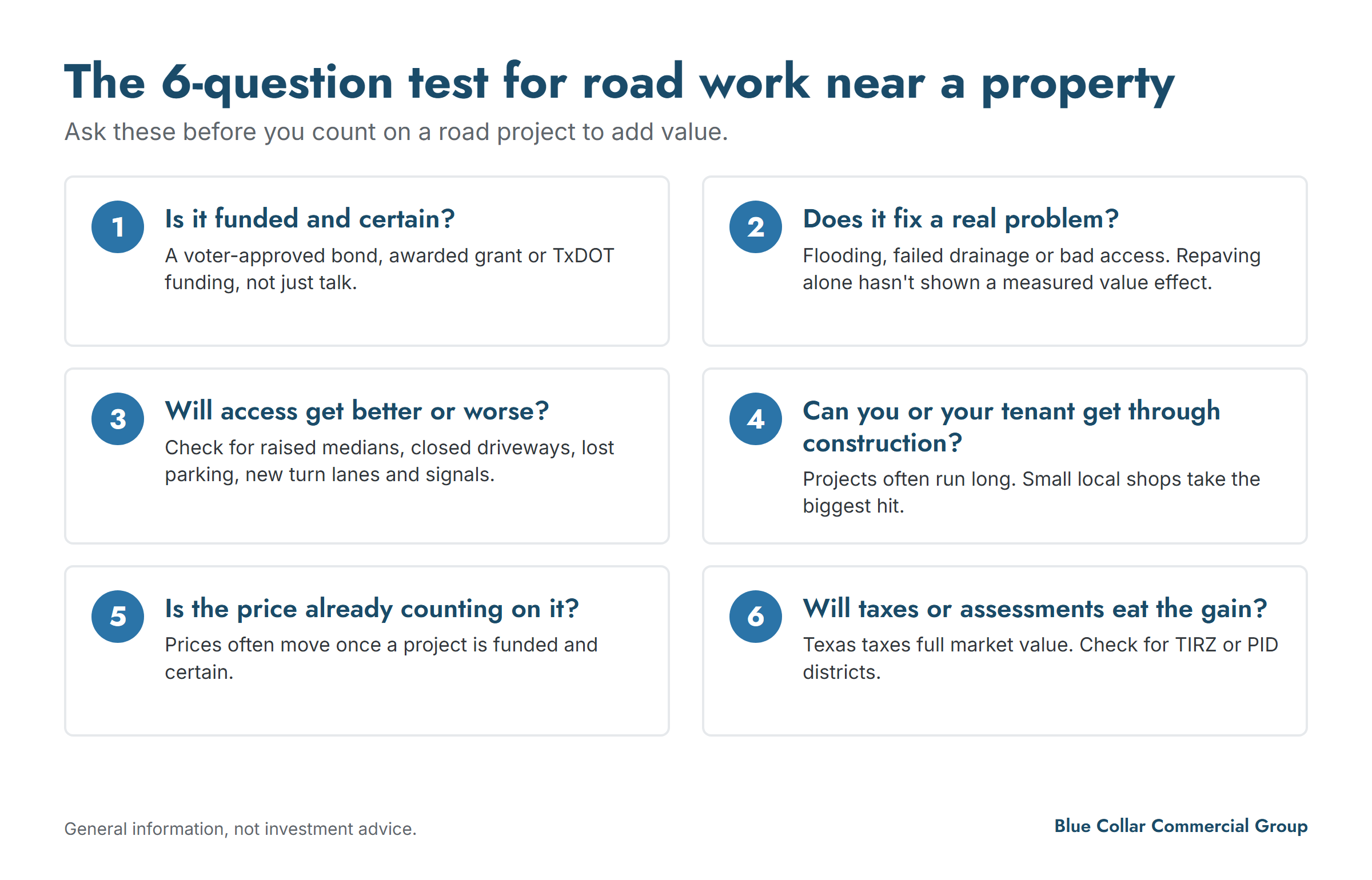
1. Is the project funded and certain?
A project that has been talked about for years is not the same as one with money behind it. Look for a voter-approved bond, an awarded grant, a TxDOT project with funding, or a construction contract. Until then, it’s a maybe.
2. Does it fix a real problem?
Flooding, failed drainage, dangerous or difficult access, or a missing turn lane are real problems. Fixing them is where value tends to come from. A cosmetic refresh alone is less likely to change what a property is worth.
3. Will access to this property get better or worse?
Pull up the project plans. Look for new raised medians, closed or moved driveways, lost parking, new turn lanes and new traffic signals. The same project can help one property and hurt the one across the street.
4. How long will construction last, and can you or your tenant get through it?
Road projects often run longer than planned. Ask whether you, or your tenant, can handle reduced customer traffic for a year or more. A small restaurant and a national chain face very different risks.
5. Is the price already counting on the improvement?
Studies of big new projects, like new highways and rail lines, show prices sometimes start to move once a project is funded and certain, years before it opens. Nobody has studied this for ordinary street repairs. If a seller is already pricing in the finished road, the “someone else added the value” part may already be gone.
6. Will taxes or assessments eat the gain?
Texas appraises property at market value, so a higher value usually means a higher tax bill over time. For now, a temporary rule limits how fast the appraised value of many non-homestead properties worth up to about $5.3 million can rise: 20 percent a year. That limit is set to expire at the end of 2026 unless the Legislature extends it. Some areas also have special districts. A TIRZ (a tax increment district) sends the extra tax from rising values to projects inside the zone. A PID (a public improvement district) charges property owners an extra assessment to pay for improvements. Check whether the property sits in one.
Where to find these projects before everyone else
Road projects don’t appear overnight. They show up in public documents long before the orange barrels do.
City bond programs and capital improvement plans. A bond program is a package of projects voters approve borrowing for. A capital improvement plan is the city’s list of big projects for the next several years. Both name the streets a city plans to fix and what each will cost. New Braunfels voters approved a bond in 2023 that pays for street and drainage projects, including South Kowald Lane and Solms Road. San Antonio is planning its next bond for 2027, and KSAT reported in September 2026 that the city estimates it may only have room for about $442 million because of falling property values, compared with $1.2 billion approved in 2022. Fewer dollars means fewer projects, which makes it more important to know which ones get funded.
TxDOT’s project tracker and statewide plan. The Texas Department of Transportation publishes its planned and active projects, with maps, costs and schedules.
Regional planning lists. Federal road money in our area flows through two regional planning agencies: the Alamo Area Metropolitan Planning Organization (AAMPO) for the San Antonio area, and the Capital Area Metropolitan Planning Organization (CAMPO) for the Austin area, including Hays County. Their lists show which projects are getting funded and when.
Federal grant awards. Cities apply for federal transportation grants. When a grant is awarded, a project often moves from “maybe” to “funded.”
City council agendas. Contracts, designs and schedules show up on council agendas before construction begins.
At Blue Collar Commercial Group, we track these sources across the Austin–San Antonio area for our clients.
Two local projects, run through the test
Here’s how we’d think through two real projects in our area. This isn’t a prediction about any property, and it isn’t advice to buy anything. It’s a way to practice the test.
South Kowald Lane, New Braunfels
What’s planned: The city plans to add sidewalks and a center lane, improve drainage, and add turn lanes and traffic signals at major intersections, including I-35.
Cost and funding: About $10.74 million from the voter-approved 2023 bond.
Timing: In October 2025, Community Impact reported construction was expected to begin by the end of 2026 and finish by mid-2028. Schedules change, so check the city’s latest update.
How we’d think it through:
1. Is it funded? Yes. It’s a voter-approved bond project, though the schedule could still slip.
2. Does it fix a real problem? Yes. It targets drainage and access.
3. Will access get better or worse? Turn lanes and signals often help, but each property’s driveways should be checked against the final plans.
4. How long is construction? About a year and a half, if it stays on schedule.
5. Is it already priced in? Look at whether recent nearby sale prices already reflect the project.
6. What about taxes? If values rise, tax bills usually follow.
East Main Street, Buda
What’s planned: East Main Street between I-35 and Firecracker Drive would become a four-lane road with a raised median and left-turn lanes, a 10-foot shared path for walking and biking on both sides, and upgraded stormwater drainage.
Cost and funding: $10.48 million in federal money awarded through CAMPO, plus $2.62 million from the city, for a $13.1 million project.
Timing: The federal money becomes available in 2029, according to Community Impact (July 2026).
How we’d think it through:
1. Is it funded? Yes, but the money isn’t available until 2029, so it’s years away.
2. Does it fix a real problem? It upgrades drainage and widens the main road into the Sunfield community, which has more than 5,800 planned home lots.
3. Will access get better or worse? This is the key question. A raised median changes who can turn left into which properties. Some properties may gain, and some may lose.
4. How long is construction? It hasn’t been scheduled yet.
5. Is it already priced in? With the money years away, it’s worth asking how much the market has already counted on it.
6. What about taxes? As with any project, rising values usually mean rising tax bills.
The lesson: Even a well-funded project that fixes real problems can help one property and hurt another. The details of each parcel matter.
If you already own or rent on a street that’s about to be torn up
In the Minnesota study, small, single-location city businesses were the ones that took losses during construction. If that’s you, here’s what can help.
Before construction starts:
– Ask the city for the schedule and how the work will be phased.
– Ask how your driveway and parking will stay open.
– Find out who to call when something goes wrong.
During construction:
– Make it obvious you’re open, with signs, social media and word of mouth.
– Ask whether the city offers help. San Antonio, for example, has offered grants to small businesses hurt by construction.
If you’re a landlord:
– Talk with your tenants early. If a tenant closes during construction, you lose the rent and may have to find a new tenant while the street is torn up.
If you’re thinking about selling during construction:
– Keep in mind that the buyer may be counting on a recovery. Recoveries aren’t guaranteed, but it’s worth weighing what the property could be worth after the work is done, not just how things feel in the middle of it. Talk to a professional before you decide.
When the “someone else added the value” deal goes wrong
This idea doesn’t always work. It can go wrong when:
- The project is delayed or cancelled.
- Construction drags on much longer than planned.
- Access gets worse because of a new median, a lost driveway or lost parking.
- The price already reflected the improvement, so there was nothing left to gain.
- The tenant closes before the work is done.
- Taxes or special assessments take a big share of the gain.
That’s why the 6-question test matters. It won’t guarantee a result, but it helps separate the real opportunities from the wishful ones.
Frequently asked questions
Does road construction lower property values?
It can, temporarily. A study of U.S. 183 in Austin found commercial property values dipped during land acquisition and construction, then recovered after the road was finished.
How long does it take for property values to recover after road construction?
It varies. Earlier research cited in the U.S. 183 study suggested values took about five years after completion to reach pre-construction levels.
Does road construction hurt small businesses?
Often, yes. A University of Minnesota study found small, single-location businesses in city areas lost sales and closed more often, with restaurants hit hardest. Chains came through better.
Does repaving a road increase property value?
The one study we found that tested pavement condition directly found little or no measurable effect. Fixing real problems, like flooding or poor access, shows more promise.
Does more traffic increase commercial property value?
Not necessarily. We found no U.S. study proving that more car traffic raises commercial rents. Foot traffic, meaning customers who actually stop, has a clearer link to shop rents.
How can I find out about road projects near my property?
Check your city’s bond program and capital improvement plan, TxDOT’s project tracker, the regional planning agency’s project list (AAMPO for the San Antonio area, CAMPO for the Austin area), federal grant announcements, and city council agendas.
What is a “someone else added the value” deal?
It’s our name for buying property near a public road or drainage project that could raise nearby values once it’s finished. The government pays for the improvement, and the property owner may benefit. It doesn’t always work, which is why we use a 6-question test.
The bottom line
Road work is easy to ignore until it’s out front. For owners and tenants, it can mean a hard year or two. For buyers, it can be an opportunity, but it’s most promising when the project fixes a real problem, access doesn’t get worse, and the price doesn’t already count on the result. Even then, there are no guarantees.
At Blue Collar Commercial Group, we track city bonds, TxDOT projects and grant awards across the Austin–San Antonio area. If road work is coming to your street, or you want to know which streets are next, contact our team.
Information is current as of October 7, 2026, except where an older date is noted. Sources include the University of Minnesota Center for Transportation Studies (for the Minnesota Department of Transportation), ten Siethoff and Kockelman (University of Texas at Austin, Transportation Research Record, 2002), Seo, Salon, Shilling and Kuby (Public Works Management & Policy, 2018), Koster, Pasidis and van Ommeren (Journal of Urban Economics, 2019), Pivo and Fisher (Real Estate Economics, 2011), the San Antonio Report, KSAT, Community Impact, and Texas appraisal district guidance on the non-homestead appraisal limit. This article is for general information only and is not investment, legal or financial advice.



