

Last checked: October 11, 2026. Road plans change. Dates and dollar figures here come from the Texas Department of Transportation and local news as of that day.
The short version
- There is no single “281 expansion.” Highway 281 has more than a dozen separate projects between San Antonio and Hamilton. Each one is at a different stage.
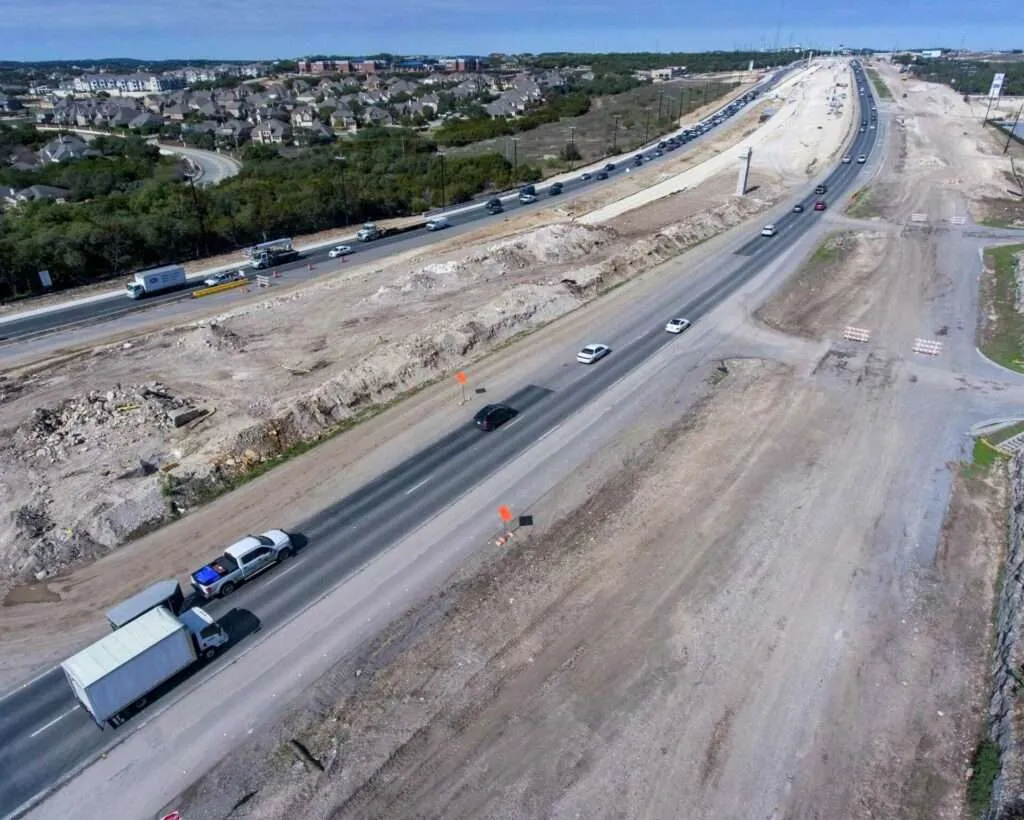
- A few are real construction right now: the Loop 410 and 281 interchange in San Antonio, Highway 46 at 281 in Bulverde, and the rebuild on the south side of Lampasas.
- The biggest ones are planned, not started: the freeway through Bulverde and Spring Branch, the new interchange at Highway 71 near Marble Falls, the Blanco County widening, the Lampasas to Evant widening, and the Hamilton truck route. Most of these are years away. Some have no construction money yet.
- The Blanco bypass is a finished study with no funding. Nobody is building it.
- For a property owner, the lane count is not the main thing. What matters is how a customer turns into your driveway after the road changes, and whether the state needs a piece of your land.
One highway, a lot of rumors
If you own property on Highway 281, you have heard some version of this: “They’re widening 281. It’s going to be a freeway. Values are going through the roof.”
Part of that is true. Most of it is a mix-up.
Highway 281 runs the full height of Texas, from the Rio Grande Valley to the Oklahoma line. The state does not have one plan for it. It has a long list of separate jobs, and each job has its own budget, its own schedule and its own problems. A few are under construction. Several are drawings on a table. A couple are studies that may never turn into a road.
People mix them up all the time. Someone hears “the state is buying land in Hamilton” and assumes a road is coming next year. Someone sees a dollar figure in a state plan and assumes the money is in the bank. Someone sees a date on a website and assumes that date is a promise.
This article sorts it out. We put every major project from San Antonio to Hamilton into one of three groups: being built now, planned but years away, and still just an idea. Then we explain what each one can mean for the people who own, rent or want to buy property next to it.
We are not going to tell you a road will make your land worth more. No one can honestly promise that. Some properties come out ahead when a highway changes. Some come out behind. The difference is usually in the details, and the details are what this article is about.
First: how a highway actually gets built
You need one piece of background before the list makes sense.
The Texas Department of Transportation, called TxDOT, is the state highway department. TxDOT takes a road project through four steps:
- Study. Is there a problem, and what could fix it? Lines get drawn on maps. Nothing is decided.
- Design and environmental review. Engineers draw a real plan. The state checks what the plan would do to homes, businesses, water, wildlife and historic places. The public gets to comment.
- Final plans, buying land and moving utilities. The state finishes the drawings, buys the land it needs, and moves power lines and pipes out of the way.
- Construction. A contractor is hired and the work starts.
A project can sit at any step for years. TxDOT says it plainly on its own Blanco County handout: moving to the next step depends on how the last step went, “as well as funding availability.”
Here is where people get fooled. Several things sound like “it’s happening” when they are not:
- “It’s in the state’s 10-year plan.” Texas keeps a 10-year list of road projects it expects to pay for. Being on the list is a good sign. It is not a contract. The list is rewritten every year, and projects move later or change cost all the time.
- “The state is buying land.” The state can buy land for a road long before it has the money to build the road. TxDOT says exactly that about the Hamilton truck route.
- “It passed environmental review.” That means the state is allowed to build it. It does not mean the state has decided to build it, or has the money.
- “Bids are expected in 2029.” An expected date is a target. A target that has passed does not mean the thing happened.
The only solid proof a road is being built is a signed construction contract and crews on the ground.
Keep those four steps in mind. They are the whole key to reading the rest of this.
Group 1: Being built now
These jobs have contractors and real work under way, or work that is almost done.
San Antonio: Loop 410 at Highway 281 and San Pedro
What it is. A $156 million rebuild of the ramps and side roads where Loop 410, Highway 281 and San Pedro Avenue come together, near the airport and North Star Mall. It covers about four miles of Loop 410 and almost three miles of 281.
Where it stands. TxDOT’s August update said construction was scheduled to begin in September 2026 and run into 2029.
The detail that matters. This job does not add main lanes to 281. It changes how you get on and off. TxDOT says seven ramps will be removed and replaced with new access points.
What it means for you. If your business depends on a certain exit, find out whether that exit is one of the seven. A customer who used to get off right at your door may soon get off a half mile earlier. And three years of ramp closures is a long time for a shop or a restaurant.
Bulverde and Spring Branch: Highway 46 at 281
What it is. Highway 46 on both sides of 281 is going from two lanes to six, with raised center dividers and a center left-turn lane.
Where it stands. Final paving and cleanup. TxDOT lists the finish as winter 2026.
What it means for you. This is the busiest commercial corner in that part of Comal County. A raised center divider means some driveways that allowed a left turn in and a left turn out will now be right turn only. The road is nearly done, so you can go look at the real thing instead of a drawing.
Lampasas: the south side rebuild on Key Avenue
What it is. A rebuild of 281 on the south side of Lampasas, from Sulphur Creek to the Burnet County line. It adds a center turn lane, curbs, sidewalks and lighting. It also reworks the intersection with Highway 190 at Plum Street.
Where it stands. Almost finished. Work began in early 2024. The local paper reported in August 2026 that final paving was done. State contract records from early October showed the job about 94 percent complete and not yet signed off.
What it means for you. What you see on the ground is very close to the final layout. If you own or lease on that stretch, now is the time to check your driveway, your drainage and your sign.
Already finished: north San Antonio to the Comal County line
One project is done, and it is worth knowing about because it shows what the next one will look like.
The stretch of 281 from Loop 1604 north to Borgfeld Drive was rebuilt into a full freeway. It has main lanes in the middle, a carpool and bus lane each way, and one-way side roads along the edges. TxDOT says the first half opened in 2021 and the second half in 2022.
That is why 281 feels like a freeway until you reach the county line, and then turns back into a four-lane highway with stoplights. It is also a preview. The state’s plan for Bulverde uses the same basic design.
A quick word on South Texas
The most active construction on all of 281 is not in the Hill Country. It is in the Rio Grande Valley.
North of Edinburg, the state is turning 281 into a future interstate, which will be called I-69C. A contract of about $165 million was awarded in January 2025 for the first seven miles, and work started that summer. In Alice, a separate job is turning about nine miles of 281 into a freeway.
Even there, the pattern is the same. The state is building it one short piece at a time. TxDOT says there is no dedicated funding to build the whole interstate at once. Several of the next pieces have slipped to the 2030s.
Group 2: Planned, but years away
These are the projects people talk about most. All of them are real plans. None of them has a construction contract. Read the “where it stands” line on each one with care.
Bulverde and Spring Branch: the freeway plan
This is the one to watch right now.
What it is. TxDOT wants to turn about 6.7 miles of 281, from Borgfeld Drive at the county line up to Highway 46, into a freeway. Today it is a four-lane divided highway with stoplights and driveways. The plan is six main lanes, new carpool lanes, on-ramps and off-ramps, bridges over the cross streets, one-way side roads on each side, and paths for walking and biking.
What it takes. The state says it needs about 104.5 acres of new land. The strip of land the road sits on would grow from roughly 225 to 315 feet wide today to roughly 238 to 460 feet wide. TxDOT’s notice says the project could displace nine businesses, depending on the final design.
Where it stands. Step 2, design and environmental review. The public hearing was first set for October 6. It was moved to Tuesday, November 10, 2026, from 5 to 7 p.m., at Bulverde Methodist Church, 28300 US 281. Written comments are due November 25, 2026.
The money. The state’s transportation commission approved land negotiations for this project in August 2024. That is not construction money. We did not find this project on the state’s current 10-year funding list. The state’s public project database shows a placeholder bid date in 2037. Treat that as a rough marker, not a schedule.
One more thing. The plan changed. In 2021 the state showed a four-lane freeway. The 2026 plan is six lanes plus carpool lanes and takes more land. If someone shows you an old map, it is out of date.
What it means for you. This is the project most likely to change how individual properties work.
- If your driveway opens right onto 281 today, it would likely open onto a one-way side road instead.
- A customer coming from the other direction could not just turn left. They would have to exit, go to a cross street or a U-turn, and come back.
- Where the main lanes rise up over a cross street, drivers on the freeway may not see your building or your sign the way they do now.
- Nine businesses may have to move. Many more could lose a strip of frontage, some parking, or a sign location.
None of that is certain for any one property until you look at the state’s drawing for that exact parcel. The drawing exists. You can ask for it. If you plan to build on that stretch, our guide to zoning and building rules in Bulverde covers the city side.
Marble Falls: the Highway 71 interchange
What it is. The old cloverleaf where 281 meets Highway 71, south of Marble Falls, would be torn out and replaced. The new design is called a turbine interchange. In plain terms: the tight loop ramps go away. In their place are longer, wider ramps that sweep around the center on bridges, so drivers do not have to slow to a crawl or weave across each other. The plan also adds side roads to separate local traffic from fast through traffic, plus walking and biking paths.
What it takes. About 96 acres, counting land the state would use only during construction. One house would be displaced. TxDOT estimates construction at about $243 million.
Where it stands. Step 2. The public hearing was held April 9, 2026. TxDOT’s page says environmental approval is “estimated fall 2026.” We found no proof that approval has been given yet. For construction, the page says one word: “TBD.”
The money. The state’s 10-year plan lists this project at $277 million, in the 2031 to 2036 window. The two dollar figures are probably measuring different things. One is likely building cost alone and the other likely includes more. Either way, this is the best-funded Hill Country project on 281, and it is still years from a contract.
What it means for you. New side roads can change which road your property actually faces and how a driver reaches you after leaving the highway. When the ramps move, the “easy corner” can move too. And when it does start, expect years of construction at the busiest crossroads in the Highland Lakes. If you are signing a long lease near that interchange, the construction years belong in the conversation.
Marble Falls: the corner at RM 1431
What it is. A much smaller job at the busiest intersection in town. The plan adds a right-turn lane on northbound 281 and double left-turn lanes in both directions.
Where it stands. This is the closest of the Hill Country projects to starting. Two corner businesses were already torn down in 2025 to make room. A TxDOT engineer told the Marble Falls chamber in August 2026 that work should begin in mid-2027. The state’s project database lists it as ready for bids, with a target of December 2026.
What it means for you. Start dates on this job have already moved more than once, so hold the date loosely. If your driveway is close to that corner, ask TxDOT whether it stays as it is, becomes right turn only, or closes.
Blanco County: widening 281
What it is. A plan to improve 19 miles of 281 in Blanco County, from Highway 290 near Johnson City south to FM 306. Most of that road is two lanes with passing lanes today. The plan is four lanes with a center divider, and a rebuilt interchange at Highway 290.
What it skips. The city of Blanco. TxDOT’s handout says the project limits “do not include the existing four-lane segment through the City of Blanco.” The road through town stays as it is under this plan.
Why the state wants it. TxDOT says crashes on this stretch rose 79 percent between 2020 and 2024. It expects traffic to reach 35,000 vehicles a day by 2045. That second number is a forecast, not a count.
Where it stands. Step 2 of 4. The latest public meeting was July 30, 2026. The state’s 10-year plan carries it in two pieces, about $380 million in total, in the 2031 to 2036 window. Last year’s plan showed a higher cost and an earlier window. So the numbers have already moved once.
What it means for you. The road the state owns out there is about 120 feet wide today. The plan calls for about 300 feet. That extra width comes from the land on either side. A center divider also means you can only turn left where the state leaves a gap. If you own land on this stretch, the two questions are simple: how much of my frontage does the state need, and where is the nearest gap in the divider?
Lampasas to Evant: 28 miles of widening
What it is. A plan to take 281 from two lanes to four between Lampasas and Evant, about 28 miles. A grass strip would separate the two directions. Paved crossovers would let drivers get from one side to the other.
Where it stands. Design. TxDOT has split it into two parts and gives these expected dates:
- Evant to Adamsville: contract in 2028, work starting summer 2028.
- Lampasas to Adamsville: contract in 2030, work starting summer 2030.
Those are TxDOT’s expected dates, not signed contracts. The state says it will need more land along the road and that the amount is not final.
What it means for you. On a rural highway today, you can turn left into almost any gate or driveway. With a grass divider, you can only cross at a crossover. TxDOT says the exact crossover locations “have not yet been determined.” If you run trucks, haul trailers or own a business that depends on drivers from both directions, the location of the nearest crossover is the single most important fact about this project. It is also still open to public input.
Hamilton: the truck route
What it is. A brand new road, about 16.7 miles long, that would carry trucks around Hamilton instead of through the courthouse square. It would be four lanes with a divider, with side roads in some places and ramps at the major cross streets.
Why the state wants it. Anyone who has sat on the Hamilton square behind a long truck trying to make the turn knows why.
Where it stands. Step 2. A public hearing was held February 12, 2026. TxDOT lists an expected bid date of December 2029. Then it adds this, in its own words:
“The project is currently unfunded for construction and cannot let until funding is identified.”
TxDOT also says buying the land can go ahead even without construction money. The total cost is listed as “to be determined.”
What it means for you. Hamilton is the clearest example in Texas of why “the state is buying land” does not mean “a road is coming soon.” If you own land on the proposed route, you may hear from the state about your property years before anyone knows when, or if, the road gets built. If you own a business on the square that lives on truck traffic, such as fuel or quick food, a bypass could one day take some of that traffic away. If your business is a place people drive to on purpose, fewer trucks on the square could help. Nobody can tell you today which way it goes.
Group 3: Still just an idea
These are studies. A study asks “should we, and where?” It does not build anything.
The Blanco bypass
This is the one that causes the most confusion, because it gets blended together with the Blanco County widening above. They are two separate things.
The city of Blanco asked the state to study a route around town. The study ran from 2022 to 2026, with five public workshops. More than 40 route ideas from the community were narrowed down to one. The final report, dated July 2026, recommends a bypass on the east side of Blanco.
The study projects that this route would cut large truck traffic through downtown by nearly 70 percent, cut delays at the town’s traffic lights by more than 60 percent, and cut crashes on the existing road through town by more than 15 percent. Those are computer projections, not measured results.
Now the key sentence from the report. The route would move to the next step “if the project moves forward, and if funding and resources become available.”
There is no money set aside. There is no construction project. There is a line on a map and a recommendation.
What it means for you. Be very careful with any land pitched as “on the future bypass.” The route can still shift, and it may be many years before anything is built, if it ever is.
Other studies along the corridor
- A relief route around Lampasas. A study only. No route chosen, no money.
- Widening from Evant through Hamilton to Hico. About 37 miles. In early design. The state’s database shows target dates in the mid-2030s or later.
- Spring Branch north to the Blanco County line. The same freeway idea as Bulverde, continued north. The state’s database shows a placeholder in the 2040s.
- Burnet County, north of Marble Falls. A possible widening between Park Road 4 and RM 1855. Proposal stage.
Treat every one of these as “maybe someday.”
What all this means for your property
Here is the part that matters if you own, lease or are thinking about buying on 281. For the wider question of what road work does to prices, read Does Road Construction Affect Property Value?
Being seen is not the same as being reached
This is the biggest idea in the whole article.
Today, on most of 281 in the Hill Country, a driver sees your sign, slows down and turns in. Simple.
When a highway becomes a freeway, that changes. The driver sees your sign from the main lanes at 70 miles an hour. To reach you, they have to take the right exit, which may be a mile before your building. Then they drive a one-way side road. If they were going the other direction, they have to exit, cross under or over the freeway, and come back.
Your building did not move. Your traffic count may even go up. But the trip to your door got longer and more confusing. For a gas station, a drive-through or a convenience store, that can matter a lot. For a business that customers plan a trip to, such as a feed store, a contractor’s yard or a medical office, it usually matters less.
So before you look at how many cars pass a property, look at where the ramps are.
Center dividers change left turns
Several of these plans add a divider down the middle: a raised curb in town, a grass strip in the country. Dividers make a road safer. They also end the “turn left anywhere” habit. After a divider goes in, drivers can cross only where the state leaves an opening.
A property right at an opening keeps full access. A property halfway between two openings becomes right in, right out. Same road. Very different result.
The state may need a piece of your land
Wider roads need more land. Most of the time the state does not take a whole property. It takes a strip along the front. That strip can hold your sign, your front row of parking, your septic field or your driveway slope.
If the state needs part of your land, it has to pay for it, and you have rights in that process. The state publishes a Landowner’s Bill of Rights. Read it early, well before anyone knocks on your door.
Construction is its own problem
Even a project that helps you in the end can hurt for two or three years while it is being built. Lanes close. Driveways move. Customers avoid the mess.
If you are a landlord or a tenant near one of these projects, talk about the construction years before you sign a lease. Do not wait until the orange barrels show up.
A bypass cuts both ways
When trucks and through traffic move to a new road around town, the old road gets quieter. Some businesses lose customers who were only passing through. Others gain, because the downtown is easier to walk, park and shop in. Which way it goes for a given town is honestly not known ahead of time. Anyone who tells you a bypass will “kill” or “save” a downtown is guessing.
What nobody can promise
A road project does not come with a guaranteed result for the land next to it. Some parcels gain. Some lose a turn, a strip of land or a clear view from the road. We will not tell you which until we have looked at the state’s drawing for that exact property, and neither should anyone else.
Eight questions to ask before you buy, sell or lease on 281
Take this list with you. For raw land, pair it with The Texas Land Investor’s Checklist.
- Which exact project is next to this property? Blanco has two. Lampasas has three. Hamilton has two. Get the right one.
- Which of the four steps is it on? A study, a design, final plans, or construction.
- Is there a signed construction contract? If not, every date you hear is a target.
- Have I seen the newest drawing? Ask TxDOT for the latest one, with a date on it. Old drawings are common and often wrong.
- Does the new edge of the road cross this property? If so, how much land, and what sits on it now?
- After the project, how does a customer get in from each direction? Trace it on the drawing. Count the turns.
- Where is the nearest ramp, crossover or gap in the divider? That often matters more than the traffic count.
- What happens during the construction years? Ask where the temporary driveways go and how long each stage lasts.
If you cannot answer most of these, you do not yet know what the road will do to the property.
How to have your say
Public comments do change these plans. The Bulverde freeway design, the Blanco bypass route and the Lampasas to Evant crossovers were all shaped by what people said.
The next big chance is the Bulverde and Spring Branch freeway hearing on Tuesday, November 10, 2026, 5 to 7 p.m., at Bulverde Methodist Church Community Center, 28300 US 281. There is also an online version. Written comments are due November 25.
If you own property on that stretch, go. Find your parcel on the drawings. Ask the engineers about your driveway.
The bottom line
Highway 281 is changing, but not all at once and not all for certain.
A few jobs are real and under way. The big Hill Country projects are real plans that are still years out, and some have no construction money. The Blanco bypass is a recommendation on paper.
For a property owner, the smart move is the same in every town. Find the exact project. Find out which step it is on. Get the newest drawing. Then look at how a customer reaches your door, not at how many lanes are going in.
At Blue Collar Commercial Group, we help owners, buyers and investors read what the state has planned next to their property. Contact our team to talk it through.
Related reading
- Does Road Construction Affect Property Value? What New Braunfels and Comal County Owners Should Know
- Texas Hill Country Water in 2026: What Property Owners, Buyers and Developers Need to Know
- The Texas Land Investor’s Checklist: 7 Critical Factors
- Navigating Zoning and Building Requirements in Bulverde, Texas
Common questions
Is Highway 281 being widened through the Hill Country?
In pieces, and mostly not yet. Short sections near Lampasas and at Highway 46 are under construction or nearly done. The large projects in Comal, Blanco, Burnet, Lampasas and Hamilton counties are still in design or study.
When will 281 become a freeway through Bulverde and Spring Branch?
There is no construction date. The plan is in design and environmental review. The public hearing is November 10, 2026. We did not find the project on the state’s current 10-year funding list.
Is the Blanco bypass going to be built?
Nobody knows. A state study finished in July 2026 recommends a route on the east side of town. There is no funding and no construction project.
Will the Blanco County widening change downtown Blanco?
No. TxDOT says that project does not include the existing four-lane road through the city.
The state contacted me about buying part of my land. Does that mean construction is close?
Not always. The state can buy land years before it has money to build. TxDOT says so directly about the Hamilton truck route.
Will a highway project make my property worth more?
It might. It might not. It depends on what happens to your access, your frontage and your view from the road. Anyone who promises a result without looking at the state’s drawing for your parcel is guessing.
Where do I find the official drawings?
On TxDOT’s website. Search the project name, such as “US 281 South Comal” or “US 281 Blanco County.” Each project page lists a contact person. You can also ask for the drawing that covers your property.
Glossary terms used
- TxDOT: The Texas Department of Transportation. The state highway department.
- Freeway: A road with no stoplights and no driveways. You get on and off only by ramps.
- Frontage road (side road): A smaller road that runs next to a freeway. Driveways connect to it instead of to the freeway.
- Interchange: The set of ramps and bridges where two highways meet.
- Turbine interchange: An interchange with long, sweeping ramps instead of tight loops.
- Center divider (median): A raised curb or grass strip between the two directions of traffic.
- Crossover: A paved gap in the divider where drivers can turn across.
- Right of way: The strip of land the state owns for a road.
- Displacement: When a home or business has to move because the state needs the land.
- Relief route (bypass): A new road that carries through traffic around a town.
- Environmental review: The state’s check of what a road would do to people, water, wildlife and historic places.
- 10-year plan: The state’s yearly list of road projects it expects to fund over the next ten years. The official name is the Unified Transportation Program.
- Bid date (letting): The date the state expects to take bids from contractors.
- HOV lane: A lane for carpools and buses.
Sources
Texas Department of Transportation project pages, hearing notices and handouts for: US 281 South Comal (hearing notice for November 10, 2026); US 281 at SH 71 Interchange; US 281 Blanco County Project (July 30, 2026 fact sheet); US 281 Blanco Relief Route Study (report dated July 2026); US 281 at SH 46; I-410 at US 281 and San Pedro; US 281 Loop 1604 to Borgfeld Drive; US 281 Lampasas County; US 281 Lampasas to Evant; US 281 Hamilton Truck/Relief Route; US 281 Future I-69C. TxDOT 2027 Unified Transportation Program and TxDOT Project Tracker. Texas Transportation Commission records. DailyTrib.com (August 17, 2026). Lampasas Dispatch Record (August 3, 2026).
This article is general information. It is not legal, engineering or investment advice. Check current plans with TxDOT before you make a decision about a specific property.



