

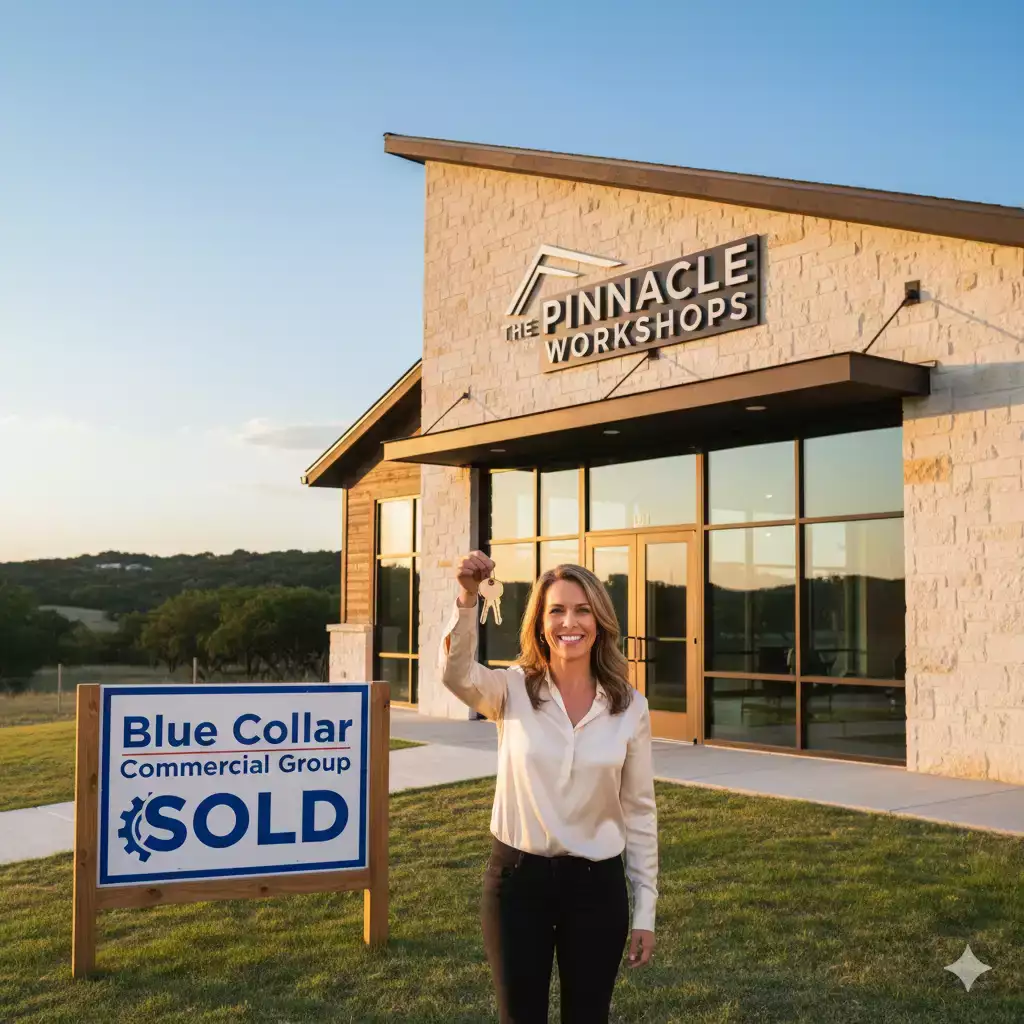
Updated October 2026. This guide is for Comal County business owners who rent the space they work in and are weighing whether to buy a building. It walks through the steps from first conversation to closing day, the team you need, the loan choices, and what the local market looks like as of September 2026.
The quick answers
- Who is this for? An owner-user: a contractor, supplier, small manufacturer, medical practice or professional office that rents today and would use the building it buys.
- Where do I start? With your goals and a short list of advisors, then with the building you already rent. Ask your landlord whether they would sell.
- How is it paid for? Usually a loan. The two common government-backed choices are the SBA 504 and SBA 7(a). The other main choices are a bank loan or a deal where the seller carries part of the financing.
- What does the market look like in Comal County? As of September 2026, about 12 percent of industrial space and about 8.5 percent of flex space was empty. Only about 2.4 percent of retail space and about 3.9 percent of office space was empty.
- What can go wrong? A building can need a new roof, sit in a floodplain, or not allow your type of business. Each of these is found during due diligence, before you are committed.
- Does buying always beat renting? No. It depends on the price, the loan, your cash and how long you will stay. Two companion articles on this site work through that math.
What changed in this update
This version uses Comal County market figures through September 30, 2026 and loan information from October 2026. It is written for the business owner who would occupy the building, not for the investor who would rent it out. The rent-versus-buy math now lives in two companion articles, linked below.
Why owner-users look at buying
Owners buy for two reasons. They want control of the space, and they want a payment that stops moving with the landlord’s decisions. Neither reason makes a better result certain, so it helps to see both sides.
What owning gives you
- Control. You can add a bay door, move a wall, put in a lift or build out exam rooms without asking permission. You still need city permits, but the landlord’s approval is no longer part of it.
- A steadier payment. A fixed-rate loan holds the principal-and-interest payment in place. Property taxes, insurance and repairs still change, so the total cost of the building does not stand still.
- Staying put. You do not lose the location because a landlord sells, redevelops or leases the space to someone else.
- Equity. Each loan payment pays down what you owe. Whether the building is worth more or less when you sell depends on the market, so treat any gain as possible, not promised.
- Rent from an unused part. If the building is larger than you need, another business can rent the rest. That rent helps with the payment, but you take on the job of being a landlord.
What owning asks of you
- Cash up front. A down payment, closing costs, inspection and appraisal fees, and money for any work the building needs on day one.
- Every repair. The roof, the air conditioning, the parking lot and the plumbing become your bills. Some leases already pass part of these to the tenant, so read what you pay today.
- Taxes and insurance. Both are yours to pay, and both can change from year to year.
- Less flexibility. To move, you sell or rent out a building. That takes longer than letting a lease run out.
- Cash tied up in a building. Money in the property is money that is not in equipment, trucks, inventory or hiring.
What it means for you. Buying is a decision about how long you will stay and how much control the business needs. If you may outgrow the space in two or three years, renting may fit better. If you plan to be at the same address for a decade, owning deserves a hard look.
Ask your CPA how loan interest, property taxes and depreciation would apply to your business.
Where Comal County stands as of September 2026
Your building type decides which numbers matter. All figures here are for Comal County from brokerage market data through September 30, 2026. Rents are asking rents, the price a landlord is advertising, per square foot per month. Multiply by 12 for a yearly figure. See asking rent for what the term does and does not tell you.
The county itself
From mid-2024 to mid-2025, Comal County grew from about 201,486 to about 209,166 residents, according to the Census Bureau. That is a gain of about 7,680 people, or about 3.81 percent. The country as a whole grew about 0.5 percent. That figure does not tell you what any single building is worth.
Retail
About 2.42 percent of retail space was empty in September 2026, compared with about 2.58 percent a year earlier. Asking rent was about $2.11 per square foot per month, or about $25.32 a year, up about 4.61 percent over twelve months. Little empty space means fewer buildings to choose from, and an owner-user may wait for the right one. The Comal County retail report has the full set of figures.
Office
About 3.89 percent of office space was empty in September 2026, down from about 4.7 percent a year earlier. Asking rent was about $2.95 per square foot per month, about $35.40 a year, up about 0.76 percent. About 233,028 square feet of new office space was under construction, against a county total of about 3.4 million square feet. Medical and professional offices can read more in the Comal County office report, and medical practices should also read our guide to medical office space in Comal County.
Industrial
About 12 percent of industrial space was empty in September 2026, compared with about 12.53 percent a year earlier. Asking rent was about $0.91 per square foot per month, about $10.92 a year, up about 2.4 percent. About 773,141 square feet of industrial space was under construction. As of September 2026, about 12 percent was empty and about 773,141 square feet was under construction. More buildings to compare does not mean any one of them is a bargain. The Comal County industrial report has the detail.
Small-bay and flex
Smaller units suit many trades and service businesses. In Comal County, about 796,726 square feet is flex space, and about 8.5 percent of it was empty in September 2026, up from about 4.6 percent at the end of 2025. Asking rent was about $1.35 per square foot per month, about $16.20 a year. These figures compare September 2026 with the end of 2025, not with a year earlier. If you work out of a small unit, read Small-Bay Flex on I-35: Rent a Unit or Buy One? for break-even prices.
What it means for you. The county is not the same for every owner-user. As of September 2026, retail and office space was harder to find, and industrial and flex space had more empty room. Look at the figures for your building type before you set a budget or a deadline.
Step 1: Settle your reasons and build your team
Write down why you want to own. Control of the building, a payment you can plan around, room to grow and a long-term home are all reasonable answers, and each leads to a different kind of building. Then think about the next five to ten years of the business. How many people will you employ? Will you add equipment, trucks or exam rooms? Does the building have room for it?
Buying a building is a team effort. A mistake on any one piece can cost more than the advice would have.
- A commercial real estate advisor. Someone who knows which buildings exist in the county, what they have sold for, and which sellers might consider an offer. Our team works with owner-users through buyer representation.
- A real estate attorney. The attorney reads the contract, the title work and the survey, and protects you if something turns up.
- A CPA. Your accountant tests how the loan payment, taxes and building costs fit your cash flow and explains the tax side.
- A commercial lender. Talk to a lender early. Call one before you tour buildings. A lender can tell you how much the business can borrow and what paperwork is needed.
- A general contractor or building inspector. Someone who can look at the roof, the air conditioning, the electrical service and the slab and put a price on repairs.
Step 2: Start with the building you rent
If you like your location, the first question to ask is whether you can buy it. You are already there, you know the building, and a sale to you saves the landlord the cost and wait of putting the property on the market.
Ask the landlord
Make the request in a short conversation, and present it as a sign that you plan to stay. Some landlords are happy to sell. Others hold the building as part of a larger portfolio or have a lender who would need to approve. A no costs you nothing, and a yes gives you a head start. Ask what price they have in mind and what they would want to see from you.
Do not assume the landlord will sell at a price that matches your rent. A landlord who thinks of the building as an investment will look at what it earns. An owner-user looks at what it costs to occupy. Those two views can be far apart, so have an appraisal or an advisor’s opinion of value ready.
The right of first refusal
A right of first refusal, often shortened to ROFR, is a lease clause that gives you the first chance to buy if the landlord decides to sell. If the landlord gets an outside offer they want to accept, they must show it to you, and you have a set time to match it. The best time to ask for one is when you sign or renew a lease. Spell out four things:
- How the price is set, whether it is a match of an outside offer or a figure you both agreed to ahead of time.
- How many days you have to answer once the landlord gives notice.
- What financing time you get; ask your lender how long a loan takes.
- Whether the right passes to a new owner if the building is sold to someone else.
Have your attorney draft this clause. A vague ROFR can lead to arguments at the worst moment.
Lease with an option, or a lease-purchase
A lease can be tied to a future purchase. An option gives you the right, but not the duty, to buy at an agreed price within a set period. A lease-purchase binds you to buy at the end of the term. Get any rent credit in writing, and ask your attorney what you lose if you decide not to buy.
Watch your lease dates
The best time to raise a purchase is well before your lease ends. A loan takes time to arrange, so a purchase raised in the last months of a lease leaves little room. If your lease ends within a year or two, start your lender and CPA conversations now, and ask your advisor whether a short extension makes sense.
What it means for you. Buying the building you already use is often the lowest-friction path. If the landlord says no, you have lost only a conversation, and you still learned what the building might be worth.
Step 3: Find a building that fits the business
If the building you rent is not for sale, or the price does not work, widen the search. Your advisor knows which properties are openly for sale and often hears about owners who would sell for the right buyer. Start by writing down the needs of the business.
- Size and layout. Square footage, ceiling height, number and size of bay doors, office share, and loading space for a contractor or supplier. For a medical or professional office, think about reception, exam rooms, parking and accessibility.
- Location. Your customers, your employees’ commutes, and your access to New Braunfels, the I-35 corridor or the US 281 and SH 46 roads. Our Highway 281 construction guide covers what is being built and what is only planned.
- Zoning. The city or county must allow your business at that address. Parking requirements and outdoor storage rules vary by site, so confirm them in writing before you make an offer you cannot walk back.
- Utilities. Power, water and sewer or septic. Water supply and service limits differ across the county. Our Hill Country water guide explains what to ask.
- Flood risk. Check whether any part of the property sits in a floodplain or a floodway, because that affects what you can build and what insurance you need.
Consider a commercial condominium
If you need a smaller space, a commercial condominium lets you own a unit and share common areas with other owners through an association. Ask for its rules, budget and reserves before you commit.
Compare the cost of owning with what you pay now
Before you fall for a building, run the cost against your current rent. Rent or Buy Your Shop on I-35? New Braunfels vs. San Marcos in 2026 shows a 10,000 square foot shop where a loan payment with 10 percent down on an SBA 504 loan lands about equal to the rent. Small-Bay Flex on I-35: Rent a Unit or Buy One? gives break-even prices for a 3,000 square foot unit of about $205 a square foot on the New Braunfels side, $230 on the San Marcos side and $180 in Seguin. See both.
Step 4: Paying for it
Most owner-users finance a purchase. The loan you pick shapes your down payment, your monthly cost and how much cash stays in the business. The rates below are examples as of October 2026. A lender’s quote for your deal is the only number that counts.
The SBA 504 loan
The SBA 504 loan is built for buying buildings and other large fixed assets that the business will occupy and use. The usual structure splits the cost three ways. A bank or credit union provides about 50 percent, a nonprofit certified development company provides about 40 percent as a second loan backed by the SBA, and the business owner puts in about 10 percent. The down payment can be higher for newer businesses or special-purpose buildings. In general, the business must occupy most of the building.
The development company’s portion carries a fixed rate for the life of that loan. As of October 8, 2026, one certified development company posted rates of about 6.97 percent for 20-year and 25-year terms and about 6.59 percent for 10 years, including servicing fees. Those rates are for the SBA portion only, not the blended rate for the whole package.
The SBA 7(a) loan
The SBA 7(a) loan is a general-purpose business loan from a single lender, with the SBA standing behind part of it. It can buy a building and also fund working capital or equipment in the same loan. The normal maximum loan amount is $5 million. Variable rates are tied to a benchmark. Bank prime was 7.00 percent on October 9, 2026, and for variable 7(a) loans over $350,000 the SBA allows a spread of up to 3 percentage points over the base rate. That works out to a ceiling of 10.00 percent when prime is the base. This is the most a lender may charge, not what borrowers typically pay.
A conventional bank loan
A conventional loan comes from a bank with no SBA backing. Banks want to see a track record of profit, solid credit and cash reserves, and they set their own down payment requirements; ask your lender. The rate may be fixed for only the first several years and then reset, and some loans have a balloon payment, where the remaining balance comes due at the end of a shorter term. We do not have a representative conventional rate for small commercial properties that we can stand behind. Ask lenders for written quotes that state the rate, the term, how long the rate is fixed, the down payment and the fees.
Seller financing
In seller financing, the owner acts as the lender. You pay a down payment and then monthly payments to the seller. It can be faster and more flexible than a bank, and it sometimes helps a business that does not fit a bank’s rules. The cost is that terms are negotiated one deal at a time, the rate may be higher than a bank’s, and there are risks if the seller owes money on the building. Your attorney should check whether the seller’s own loan allows the sale, since many loans can be called due when a property changes hands. In Texas this kind of deal is usually written with a promissory note and a deed of trust, among other documents. Have an attorney draft them.
What it means for you. The loan with the lowest down payment is not always the cheapest overall. Ask each lender for the full cost over the years you expect to hold the building, and ask your CPA how each option affects cash flow. SBA programs have eligibility rules about business size, so confirm yours early.
Step 5: Offer, due diligence and closing
Once you pick a building, the work moves from searching to checking. The sequence below is typical, though the order and the dates are negotiated in every deal.
The letter of intent and the contract
Many deals start with a letter of intent, a short, non-binding outline of price, timing and main conditions. After both sides agree, your attorney drafts or reviews the purchase contract, which is binding. Almost every point can be negotiated, including the price, the closing date, who pays which closing costs, and repairs the seller will make. Make sure your contract ties the purchase to your financing, so you are not forced to close on a building you cannot get a loan for.
The due diligence period
Due diligence is a window, set in the contract, when you can investigate the property and back out if the findings are not acceptable. Its length is negotiated. Use all of it. Your checklist:
- Physical inspection. Roof, structure, air conditioning, plumbing, electrical service, slab, doors and parking. Ask for repair estimates, not only a list of problems.
- Environmental review. An environmental site assessment looks for past uses that could mean contamination. Lenders often require one, and an owner can be responsible for problems left by earlier users.
- Zoning and permits. Written confirmation that your business is allowed, plus any open permits or code issues on the property.
- Title and survey. A title company confirms who owns the property and whether there are liens, easements or other claims. A survey shows the boundaries and whether anything crosses them. Our article on why title companies matter covers this step.
- Appraisal. The lender orders one, and it can come in below the contract price. Your contract should say what happens if it does.
- Leases and finances, if there are other tenants. Read every lease and the building’s recent income and expense records. A tenant with a short lease changes the picture.
- Utilities, access and flood. Confirm water and sewer or septic, power capacity, driveway access and the flood status.
Closing
At closing, the title company collects the loan funds, your down payment and the closing costs, the documents are signed, and ownership transfers to you. Before that day, line up your business insurance, your utilities in the business’s name, and a plan for any repairs or improvements. If you rent the space now, give the landlord the notice your lease requires and agree on the move-in date so you are not paying for two places for long.
What owning costs after closing
The loan payment is the number most people focus on. The other costs deserve the same attention, because they are yours to pay.
Property taxes
Each taxing unit sets its own rate, and your bill is the sum of the units that cover your property. For 2026, Comal County’s county rate and lateral road rate add up to about $0.305015 per $100 of taxable value. A property inside a city, school district or other unit pays those rates as well. The 2026 schedule lists, for example, New Braunfels city at $0.415613, Comal ISD at $1.0748 and New Braunfels ISD at $1.0377 per $100. Not every parcel pays every one. Ask for the full list of rates that apply to the specific address.
Texas also limits how fast the appraised value of qualifying non-homestead property can rise, to 20 percent a year plus new improvements, for property below a value threshold. That limit is not a cap on the tax bill. The law behind it is set to expire on December 31, 2026, unless the legislature acts. Buyers should ask their attorney and the appraisal district how a change in ownership affects any limit on the property they are buying.
Insurance
Premiums depend on the building’s age, construction, location and claims history. Most commercial property policies exclude flood damage, so a property near a river, creek, lake or drainage path may need separate flood coverage. Get quotes before the due diligence period ends, not after, and give the insurer the same address and details you give the lender.
Repairs and reserves
Set aside money for the roof, the air conditioning and the parking surface, even in a year when nothing breaks. The inspection report will help you estimate the timing. If your landlord covers these items today, your costs after buying will be higher than the rent you pay now.
What it means for you. Add up loan payment, taxes, insurance, a repair reserve and utilities, and compare the total with what you pay in rent today. That is the real comparison.
Common questions
Should I ask my landlord about buying before I look elsewhere?
Yes, in most cases. You know the building, and the landlord may like a sale with no marketing cost. If the answer is no, you have learned the owner’s position and can search with a clearer view of price.
How much cash do I need?
It depends on the loan. The loan sets the down payment. You also need money for closing costs, inspections, insurance and early repairs. Your lender can give you a number for your deal.
Can I buy a unit instead of a whole building?
Often, yes. A commercial condominium lets you own a unit and share the common areas. Read the association’s rules and budget before you commit.
How long does a purchase take?
It varies with the building, the loan and the people involved. Your contract sets the dates for due diligence and closing, and your lender can tell you how long the loan will take.
What if I find a problem during due diligence?
You can ask the seller to fix it, ask for a lower price, or end the deal within the period your contract allows. That is the reason to negotiate a due diligence window before you sign.
The bottom line
Moving from tenant to owner is a series of small decisions made in order. Why you want to own, who is on your team, whether the building you rent can be yours, how you will pay for it, and what the property turns up when you check it.
The Comal County figures as of September 2026 show a mixed picture. Retail and office space was scarce, while industrial and flex space had more empty room. Owning gives you control and a steadier loan payment, and it also brings repairs, taxes and a larger up-front check. The decision is sound when the numbers fit your business, not when the neighbors are buying.
At Blue Collar Commercial Group, we help local business owners decide whether to buy, find the right building and work through the deal. Contact our team to talk it through.
First published September 2025. Rewritten October 2026. Property figures come from brokerage market data through September 30, 2026, and are rounded. Population figures come from the U.S. Census Bureau (Vintage 2025 estimates). Loan and tax information comes from public sources dated October 2026. This article is general information. It is not investment, legal, tax or financial advice. Ask your attorney, CPA and lender about your own situation.



