

Last checked: October 24, 2026. Dates and dollar figures come from the City of New Braunfels and local news as of that day, and they can change as the work moves along.
The short answer
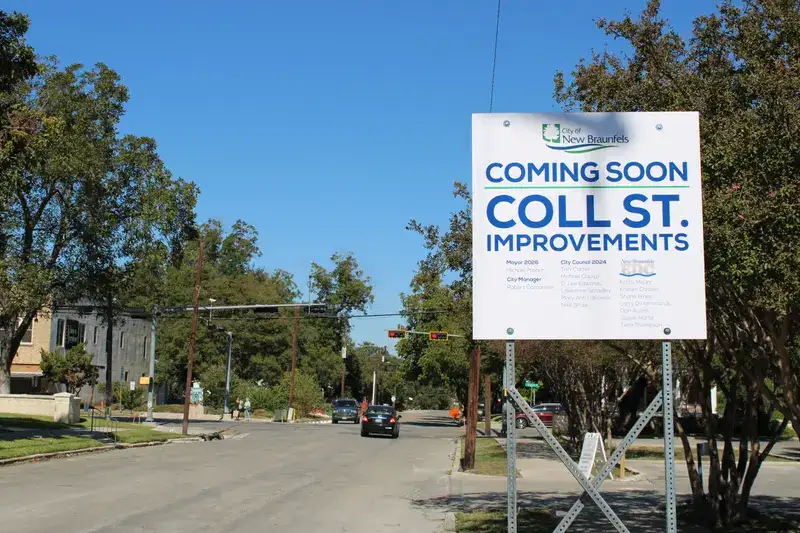
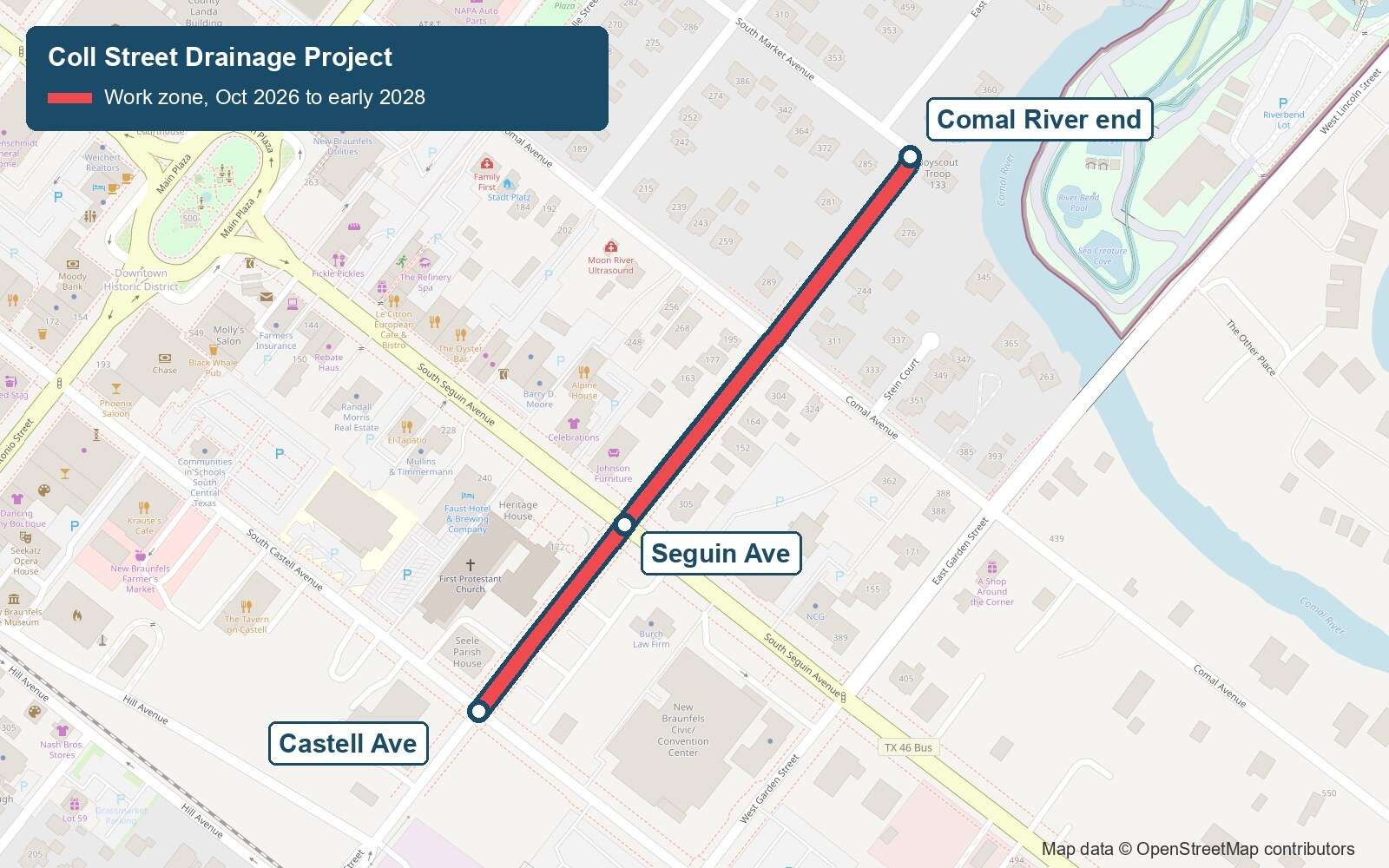
For the next year and a half, Coll Street between the Comal River and Castell Avenue will be a work zone. The city started a $9.6 million drainage and street rebuild on October 19, 2026, and expects to finish in early 2028. Crews will close Coll one block at a time, work Monday through Saturday, and keep two-way traffic open on Seguin Avenue by working on half the intersection at a time.
If you lease space on or near Coll, read your lease now and talk to your landlord before your block closes. If you own a building there, get ahead of your tenants’ questions. If you’re thinking about buying, the construction belongs in your due diligence, and it may also open a door with sellers who are tired of the noise.
When the work is done, that stretch of downtown gets new storm drains, new sidewalks, buried power lines, street lights and trees. It’s also the first piece of the city’s long-range plan for South Castell Avenue.
What the city is building
Most of the money is going underground. The centerpiece is a set of box culverts, which are large concrete channels buried beneath the street to move stormwater out fast. New Braunfels Utilities is replacing water and sewer lines in the same trench, so the street only gets torn up once.
On top of that, the city is rebuilding the road, putting in new sidewalks, and moving the overhead power and phone lines underground. The finished street will have new lighting, trees and landscaping.
Drainage has been on the city’s list for years. When the 2023 bond committee reviewed the South Castell area back in 2022, its chair pointed to drainage as an issue hurting downtown businesses. The city’s engineers then named Coll Street, from Castell to the river, as the first phase of the larger South Castell plan, and the New Braunfels Economic Development Corporation ranked it as its top project.
Who’s paying, and why the number grew
It’s a joint contract between the city and New Braunfels Utilities. The city’s share, roughly $8.2 million, comes from the New Braunfels Economic Development Corporation (NBEDC), which is funded by 3/8 of a cent of the city’s sales tax and invests it in projects meant to help business grow.
The budget has moved since the first vote. In February 2024 the NBEDC and City Council set aside $7.2 million, based on drawings that were about 60% complete. City staff warned then that the cost would probably rise. When four contractors bid on April 2, 2026, the best-value bid came in $2.4 million higher. The NBEDC approved the extra money on June 18, and Council followed on July 13. Pesado Construction won the job.
For a downtown business owner, that history says something useful. Two boards voted on this project several times over two-plus years, then voted again to cover a bigger bill. The city is going to finish it.
How the work will roll out
Because the project mixes utilities, drainage, roadwork and paving, the city is doing it in stages and has only announced the early ones so far.
Crews will work Monday through Saturday, 7 a.m. to 6 p.m. That Saturday schedule matters, since it’s one of the busiest days of the week for downtown shops and restaurants.
The box culvert stage requires a full closure of Coll Street to through traffic. Crews start at the Comal River and work toward Castell Avenue a block at a time, so the closure travels. A given business may have a few hard weeks while its block is open, and then the trouble moves down the street.
Seguin Avenue won’t close. When the work reaches the Coll and Seguin intersection, crews will take one half at a time and leave two-way traffic running the whole way through.
The city also says to expect detours, heavy equipment, and “occasional impacts to driveway access.” Some days, a driveway or loading area may be blocked or shifted.
You can get closure alerts by email or text at newbraunfels.gov/trafficalerts. If your business is anywhere near Coll, sign up now so you can warn customers and staff a few days ahead instead of the morning of.
Keep a little room in your plans on timing, too. The city’s project web page still lists the end of 2027, while the newer press release says early 2028. Budget for the later date.
If you lease space nearby
Start with your lease. Look for language about access, construction, or interruption of business. A lot of commercial leases don’t provide rent relief when the city works on a public street, and some only cover work the landlord does on the property. You won’t know where you stand until you read yours, and if the wording is unclear, a real estate attorney can tell you in an hour.
Then call your landlord, ideally before your block closes. Most landlords would rather work something out with a tenant who pays on time than chase a new one in a torn-up street. It’s fair to ask about a temporary rent adjustment or a delay on a scheduled increase, help paying for temporary signs, and where customers and delivery trucks should park during the closure.
Lease timing deserves some thought. If your term ends in the middle of construction, you may have leverage to negotiate better terms while the block looks rough. On the other hand, a longer renewal now could lock in today’s rent before the finished street draws more interest. Which way to go depends on your business and how long you plan to stay.
Customers will keep coming if they know how to reach you. Put the detour on your website and social pages, tell people which side street or lot to use, and put a sign out that says you’re open. Suppliers need the same heads-up, along with a backup spot for deliveries.
If you own a building nearby
Your tenants will have questions, and it’s better if you answer them before they ask. A short letter with what the city has announced, when you expect the work to reach your block, and who to call goes over well with people who are worried about their sales.
It also helps to decide ahead of time what, if anything, you’d offer on rent. You don’t have to offer anything. But a tenant who leaves over a hard year can leave you with an empty space during the worst possible time to show it.
Ask the city and New Braunfels Utilities how your building’s own service connections will be handled when the lines move underground and the new water and sewer pipes go in. Ask whether there will be planned shutoffs, and who pays for any changes on your side of the property line. Get the answers in writing.
If you have space to fill or a sale in mind, timing matters. A vacancy is harder to lease when customers can’t park out front. Depending on your situation, it can make sense to sign a tenant before your block closes or to hold off and go to market when the new street is finished. A commercial advisor who works downtown can help you weigh that.
If you’re looking to buy
Plenty of buyers will skip a property with a closed street in front of it. That leaves room for the ones who do their homework.
Some owners will be more willing to deal now than they will be in 2028, especially if a tenant is already asking for a break. You won’t know until you ask.
Add a few questions to your normal due diligence. When will the construction reach this block, and how long will it stay? Will the driveway or loading area be affected? Does the current lease allow rent relief for street work, and has the tenant asked for it? How will the building’s power, water and sewer hookups be handled?
Then think about what a business would pay to be on that block once the sidewalks, lighting and trees are in. That number, more than this winter’s traffic, is what drives value for a buyer.
Will values go up when it’s finished?
Possibly. Nobody can promise it, and you should be wary of anyone who does.
The city didn’t plan this as a drainage fix alone. Coll Street is Phase 1 of the South Castell Avenue Visioning Plan, adopted in 2018 to turn city-owned land along South Castell into a downtown district with shops, offices and public space. In 2022 the city estimated the full South Castell corridor at about $44 million and described the project as a catalyst that could draw more than $100 million in investment. That’s a city goal from four years ago, not a forecast for any particular building.
Projects like this tend to help a downtown block in a few ways. Storm water drains instead of pooling at the curb. Wider, newer sidewalks bring more foot traffic past more doors. Storefronts look better without wires overhead, and lighting and shade make the street more comfortable at night and in July.
They can also cut the other way. A property can lose ground if parking gets harder, if a driveway or loading zone changes in a way that doesn’t work for the business, or if rents climb faster than the tenants on the block can handle.
We haven’t found a construction date for the later phases of the Castell plan. If you’re buying, value the property on what’s being built now.
Common questions
What part of Coll Street is closed?
The project covers Coll Street from the Comal River to Castell Avenue. During the drain work, the street closes fully one block at a time, starting at the river and moving toward Castell.
Will Seguin Avenue close?
No. Crews will work on half of the Coll and Seguin intersection at a time, and two-way traffic will stay open.
When will construction finish?
The city expects early 2028. Work started October 19, 2026.
What days and hours will crews work?
Monday through Saturday, 7 a.m. to 6 p.m.
How much does the project cost?
$9.6 million in total. The city’s share is about $8.2 million, paid by the New Braunfels Economic Development Corporation, and New Braunfels Utilities shares the contract.
Do tenants get a rent break during construction?
Only if the lease provides one or the landlord agrees to one. Many commercial leases don’t cover city street work, so read yours and talk to your landlord early.
How do I get closure updates?
Sign up for email or text alerts at newbraunfels.gov/trafficalerts. Project details are at newbraunfels.gov/castell.
Is this a bad time to buy on Coll Street?
Not necessarily. Some sellers may be more flexible during construction. Check access, tenant leases and utility hookups, and value the property on what’s being built now.
Glossary terms used
- Box culvert: A large concrete channel buried under a street that carries stormwater away.
- Storm drain system: The pipes and channels under a street that move rainwater away from roads and buildings.
- NBEDC: The New Braunfels Economic Development Corporation, a city-related fund that invests a 3/8-cent share of the city’s sales tax in projects to support business growth.
- New Braunfels Utilities (NBU): The city-owned utility for water, sewer and electric service.
- Streetscape: The sidewalks, lighting, trees, benches and signs that shape how a street looks and feels.
- Underground conversion: Moving power and phone lines off poles and burying them.
- Best-value bid: The bid a city selects based on price and quality together, not price alone.
- Rent relief (rent abatement): A landlord agreeing to lower or pause rent for a set period.
- Visioning plan: A city’s long-range plan for what an area should become. It guides projects but isn’t a construction schedule.
Sources
City of New Braunfels press release, “City of New Braunfels Begins Work on Coll Street Drainage Improvement Project” (October 21, 2026). City of New Braunfels City Council file 26-704 (approved July 13, 2026). New Braunfels Economic Development Corporation file 26-599 (May 21, 2026). City of New Braunfels, NBEDC page. greater:SATX, “Regional Highlight: New Braunfels” (April 2025). New Braunfels Herald-Zeitung (October 22, 2026). Community Impact, “Construction begins on $9.6M drainage project in New Braunfels” (October 22, 2026) and “Downtown reimagined: New Braunfels to invest $44M in Castell Avenue” (November 4, 2022).
This article is general information, not legal, engineering or investment advice. Check current construction plans with the City of New Braunfels, and have an attorney review your lease, before making a decision about a specific property.



