Last checked: November 4, 2026. Property tax rules could change when the Texas Legislature meets in January 2027. We’ll update this guide if they do.
A small shopping center is one of the most appealing first deals in commercial real estate. You can drive past it, walk into the stores and buy a sandwich from your tenant. The offering package usually shows a list of tenants, a line that says “NNN” and an income number that looks like it takes care of itself.
The market makes it look even easier right now. In our Q3 2026 market reports, retail vacancy was 4.0% in the San Antonio metro and 3.6% in the Austin metro. Comal County was at 2.4%, and Guadalupe, Hays and Kendall counties were all under 3%. San Antonio’s vacancy has stayed between 3.3% and 4.8% for ten years.
Those low numbers are exactly what catches first-time buyers. A market average tells you that most space is full. It tells you nothing about the one space in your center with no visibility and a bad parking lot, and that’s the space that can cost you more than three years of its rent to fill. Add a tax bill that follows your purchase price and a loan that tightens when income drops, and a center that looked like a 7.5% return can pay closer to 5% in a bad year.
This guide teaches one habit: set the seller’s income number aside and work out what you’d keep in a bad year. We’ll do that with one made-up center from start to finish, so you can see how the pieces stack up. Then we’ll tell you what we’d do before making an offer.
Meet our example center
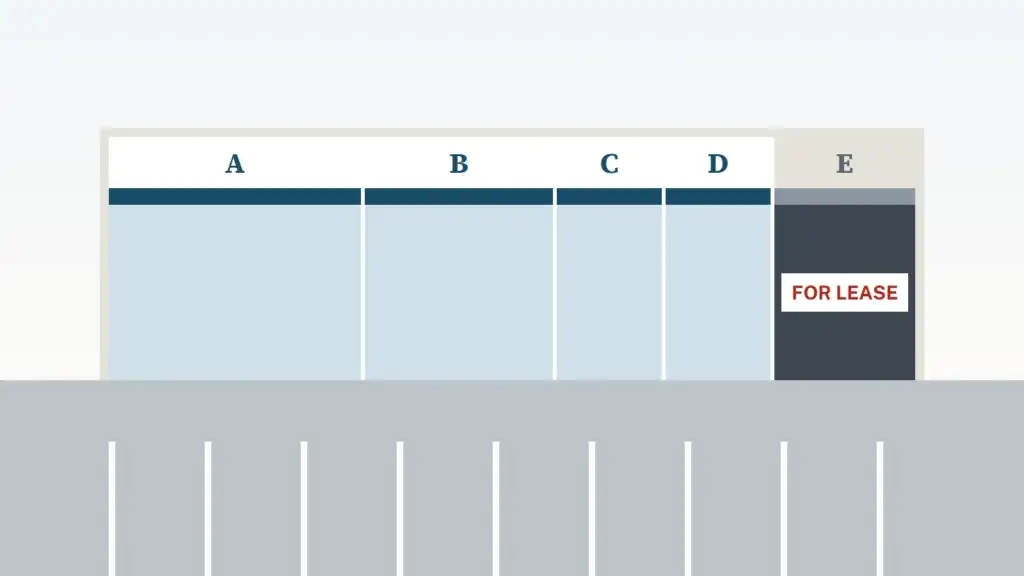
Everything about this center is invented to show the math. Your numbers will be different, and these are not market figures.
It’s a 12,000-square-foot strip with five spaces, priced at $3.2 million. The seller shows $240,000 in income, which is 12,000 square feet at $20 a foot. That’s a 7.5% return on the price, assuming the tenants cover every expense.
| Space | Size | Who’s there |
|---|---|---|
| A | 4,000 sq ft | Largest tenant, a retailer |
| B | 3,000 sq ft | Service business with a cap on its common-area charges |
| C | 1,500 sq ft | Long-time tenant on an old gross lease |
| D | 1,500 sq ft | Restaurant |
| E | 2,000 sq ft | The back corner. Tenant is leaving |
Property taxes, insurance and common-area upkeep total $96,000 a year, or $8 a foot. Keep an eye on Space E.
Part 1: “Tenants pay all expenses” is rarely true
NNN, or triple net, means the tenant pays rent plus a share of property taxes, insurance and upkeep of shared areas like the parking lot. That share is based on the tenant’s portion of the building. On a single-tenant building, that really can mean the tenant pays nearly everything. In a center with several tenants, every lease is its own deal, and the gaps land on you.
The largest gap is vacancy. Nobody pays the share for an empty space, so you do. When Space E goes dark, you lose its $40,000 in rent and pay its $16,000 share of expenses.
The second gap comes from old leases. Space C pays gross rent, meaning one number that covers everything. Its $12,000 share of expenses comes out of your pocket.
The third gap is caps. Many tenants negotiate a limit on how fast their share of controllable costs, like landscaping and parking lot upkeep, can rise each year. Law firm Lowndes describes these caps as running from about 3% to 10% a year. If common-area costs jump 10% in a year when Space B’s cap is 5%, you absorb the difference. On our center that’s only $375, but it repeats every year, and a cap that’s non-cumulative means you may never recover it. Taxes and insurance are usually treated as uncontrollable and sit outside the cap, which matters in Part 2.
People in the business call all of this slippage. Add $6,000 a year to set aside for the roof, parking lot and air conditioning units, and our center’s $240,000 looks like this:
| Per year | |
|---|---|
| Seller’s income number | $240,000 |
| Lost rent on Space E | -$40,000 |
| Space E’s share of expenses | -$16,000 |
| Space C’s share of expenses (gross lease) | -$12,000 |
| Cost above Space B’s cap | -$375 |
| Money set aside for roof, parking lot, HVAC | -$6,000 |
| What’s left | $165,625 |

Moving gross tenants to NNN
A common pitch says you can add value by moving tenants like Space C to NNN when their leases renew. Run it from the tenant’s side first. Space C pays $30,000 a year today. Keep the $20 rent and add $8 in expenses, and the bill becomes $42,000, a 40% jump. Plenty of small operators would look elsewhere, and then you’re paying to re-lease a space that had a happy tenant in it.
Switching to NNN can make sense when the tenant’s total cost stays at market. Moving Space C to $12 NNN keeps the bill at $30,000 and shifts future expense increases to the tenant, which has real value. It just doesn’t raise your income today. We didn’t find reliable data on how often tenants leave over this switch, so budget for the possibility that they will.
Water, and who’s really using it
A restaurant or laundromat can use far more water than the nail salon next door. If water is split by square footage, the salon helps pay for it, and at renewal the salon may notice. A submeter, a small meter on one tenant’s line, lets you bill that tenant for what it actually uses.
Texas has rules here. Under state water rules, a “multiple use facility” includes a commercial park with five or more units rented by the month or longer. Water Code section 13.5031 requires the lease to describe how water costs are divided and bars the owner from charging more than the owner pays for the water. Owners also have to register with the Public Utility Commission. Ask your attorney whether your center falls under these rules before you change how anyone gets billed.
While you’re looking at restaurants, ask about the grease trap. Texas cities set their own rules, and many require regular pumping. Find out who is responsible for it in the lease, and whether the city has any open violations.
Part 2: Your tax bill follows your price
Texas appraises property at market value as of January 1 each year. Texas is also a non-disclosure state, so sale prices don’t appear in the public deed records. Some buyers take comfort in that. We wouldn’t.
Appraisal districts have other ways to find out. They can work backward from loan amounts in recorded documents, buy data from vendors, and ask owners for income and expense information. Retail is usually valued on income, so your rent roll matters too. We didn’t find anything showing that a sale automatically resets your value, and you have a right to protest. But the safe way to underwrite a purchase is to assume your appraised value will move to your price.
In our example, say the center is appraised at $2.2 million and the combined tax rate is about 2.2%, so the tax bill is $48,400. Buy it for $3.2 million and get appraised there, and the bill becomes $70,400. That’s $22,000 more, or $1.83 a foot.
Your tenants pay their shares, but you pay for Space E and Space C. That’s another $6,417, which takes our center from $165,625 down to $159,208. On a $3.2 million price, the 7.5% return has become about 5%.
The 20% cap probably won’t help you
You may hear about the Texas limit that holds yearly appraisal increases to 20% on commercial property. It’s real, but it does little for a new buyer. The value limit for 2026 is $5.32 million, so larger centers aren’t covered. The cap starts only after you’ve owned the property through a full tax year, so it won’t stop the first jump after your purchase. And under current law it expires on December 31, 2026. Bills to extend it were filed in 2025, but we found no sign that any passed. The Legislature meets again in January 2027, so check where this stands before you close. For local rates, see our guide to commercial property tax in Comal County.
Now look at it from the tenant’s side
Taxes usually pass through with no cap, so the increase goes straight to your tenants’ monthly bills. Whether they can carry it is a question you can answer before you buy. Retail people use a measure called occupancy cost: rent plus NNN charges, divided by the tenant’s sales. Published rules of thumb put restaurants around 6% to 10%, though sources count it differently and some concepts run higher.
Say the restaurant in Space D does $600,000 in sales. It pays $42,000 today, which is 7.0%. With the tax increase it pays about $44,750, or 7.5%. That’s fine. If it does $400,000 in sales, the same bill goes from 10.5% to 11.2%, and you may be looking at your next vacancy.
Also compare your new NNN charge to nearby centers. A tenant can’t see your underwriting, but it can see that the center across the street charges $2 less.
Insurance is the other uncapped number
Texas has spent over a decade at the top of the country for hail damage claims, according to the National Insurance Crime Bureau, and insurance usually passes through to tenants with no cap, just like taxes.
Costs here jumped and then started to ease. Texas Department of Insurance reports show statewide premiums for commercial fire and allied coverage up about 23% in 2023 and 6% in 2024, then down 6% in 2025. Those are total dollars written, not the price on any one building, so they also reflect new construction and insurers entering or leaving. Nationally, the market has softened further. A broker survey from The Council of Insurance Agents & Brokers put commercial property premiums down 6.3% in the second quarter of 2026, and Marsh’s index for its own clients showed U.S. property rates down 10% in the third.
We wouldn’t budget on that continuing. The same broker survey showed small accounts down only 0.5% across all lines, and we found no figures specific to Texas retail centers. Get an actual quote during your inspection period, on your building with its actual roof age.
Ask about the wind and hail deductible as well, since some policies set it as a percentage of insured value. The state’s coastal wind pool, for example, uses 1% for commercial property, with 2% and 5% options. Inland terms vary by insurer, so read yours. A 2% deductible on $3 million of insured value is $60,000 out of pocket after a storm. Then read the leases to see who pays that deductible.
Part 3: An empty space costs more than you think
The natural instinct with an empty space is to lower the rent until someone says yes. That works for a good space that’s overpriced. It rarely works for a bad one.
Tenants put far more money into a space than most buyers realize. Cushman & Wakefield’s 2026 guide puts a standard in-line retail store at about $157 a foot nationally, which would be about $314,000 for 2,000 square feet. Restaurants can run much higher. Chipotle reports about $1.5 million to develop and build a new location, with about $0.2 million coming from landlords. Shake Shack reports about $2.3 million, or $1.9 million after allowances. Those are national chains and a local operator will spend less, but the split holds: most of the money is the tenant’s. An operator making that bet needs customers who can see the sign, get into the parking lot and turn in from the right side of the road. Saving $3 a foot in rent, about $6,000 a year, doesn’t change that decision. Some spaces simply sit behind the wrong corner, and the low vacancy numbers we opened with won’t fix that.
When you tour a center, stand in the parking lot and look at each space the way a customer would. Space E, in the back corner of our example, is the one to price as if it will stay empty for a good while.
What turnover really costs
Here are two versions of re-leasing Space E, one easier and one tough. These are illustrations. The months empty, the free rent and the 5% commission are our assumptions, because public filings don’t report them and we found no Texas standard. Ask a local leasing broker to pressure-test yours.
| Cost | Easier space | Tough space |
|---|---|---|
| Months empty | 6 | 12 |
| Lost rent | $20,000 | $40,000 |
| Taxes, insurance and upkeep while empty | $8,000 | $16,000 |
| Free rent to close the deal | $6,667 | $10,000 |
| Leasing commission (5% of a 5-year lease) | $10,000 | $10,000 |
| Money toward the tenant’s build-out | $30,000 | $60,000 |
| Total | $74,667 | $136,000 |
| In years of that space’s rent | 1.9 years | 3.4 years |

The tough column is a downside case, and most spaces won’t get there. You can test the cash portion against what large public shopping center owners report:
| Owner and period | Cost per foot, new lease | Rent per foot | Cost per foot, renewal |
|---|---|---|---|
| Whitestone REIT (Texas and Arizona), 2025. Cost is improvements and incentives | $25.09 | $32.85 | $3.85 |
| Brixmor (national), 2025. Cost is improvements plus outside commissions | $16.02 | $23.32 | not compared |
| Phillips Edison, small shops, Q2 2026. Total cost to execute | $40.97 | $32.21 | $0.98 |
Our two columns work out to $20 and $35 a foot for commission and build-out money, so they sit inside that range. They take more years of rent to pay back only because our rent is lower. Those owners also run larger, stronger centers with their own leasing staff, and a small unanchored strip has less to offer a tenant. Still, these numbers carry two lessons. Good space in a strong market can do much better than either column. And look at that last column: keeping a tenant costs a small fraction of finding a new one. A fair renewal offer made early is usually the best deal in this business.
But you can’t tell from the offering package which space you’ve got, and you have little control over it after you buy. Keep enough cash on hand to survive the second column at least once.
Watch how many leases end at once
A common rule of thumb says not to let more than about 30% of your leases come due in one year. No lender rulebook we could find sets that number, and it’s hard to hit in a small center. In our example, Space A alone is a third of the rent. What the rule points at is real, though. Two tenants leaving in the same year means two sets of the costs above, at the same time.
Build a simple calendar of lease end dates by rent and by square footage. Mark every renewal option and your loan’s maturity date on the same page. The year to worry about most is the one right before you have to refinance, because that’s when your lender will look hardest at who’s staying. As you sign new leases, use their end dates to spread that calendar out.
Read renewal options closely, too. A tenant with a 10-year option at a fixed rent decides whether to stay, and you’ve already agreed to the price.
Part 4: Your loan decides how much room you have
Say you borrow 70% of our $3.2 million price, or $2.24 million, at 6.75% with payments spread over 25 years. That’s about $185,700 a year. Lenders measure safety with debt coverage: income divided by the loan payment.
| Income | Debt coverage | |
|---|---|---|
| Seller’s number | $240,000 | 1.29 |
| Our bad-year number | $159,208 | 0.86 |
At 1.29, the deal looks fine. At 0.86, income doesn’t cover the payment, and you’re writing a check each year of about $26,500 to keep the loan current, before any turnover costs. Whether that’s survivable depends on who your lender is and what you signed.
Why we’d advise a first-time buyer away from CMBS
CMBS stands for commercial mortgage-backed securities. A lender makes your loan and then bundles it with others and sells it to bond investors. A company called a servicer runs it from then on, according to the documents. CMBS loans have real attractions: often a fixed rate, longer payment schedules and no personal liability except for certain bad acts.
For a first shopping center, we’d still look elsewhere, for four reasons.
The first is size. Small loans do get into these pools. One 2025 deal included a $2.7 million loan on Florida apartments and a $3.2 million loan on self storage in Arlington. But in the handful of recent pools reviewed for this guide, we found no Texas strip center under $5 million. That’s a small sample, so ask a lender, but don’t be surprised if your center isn’t a fit.
The second is control of your cash. Holland & Knight’s guide for borrowers says CMBS lenders almost always require a lockbox and cash management system, where rents flow through an account the lender controls. If debt coverage falls below a set level, or a key tenant leaves, your cash can get swept into reserves. Alston & Bird’s sample terms release the trap after debt coverage recovers for two straight quarters, but that language is something you have to negotiate. In real deals, rating agency reports show sweeps that stay in place until the empty space is leased.
The third is leasing. Leases that fall outside your loan’s leasing rules need approval, and the larger ones can go to a special servicer, which adds fees and time. A tenant ready to sign may not wait. And according to Holland & Knight, new money can’t be advanced on the loan after it’s securitized, which is a poor match for a property type where re-leasing takes build-out dollars.
The fourth is getting out. These loans usually can’t simply be paid off early. You typically replace the collateral through defeasance or pay yield maintenance, and tax rules generally bar defeasance during the first two years after the loan goes into its trust.
CMBS can work well for a larger, stable center with long leases. It’s a hard way to learn on a small one with leases coming due.
What a bank does differently
A first-time buyer will likely end up talking to a community bank or credit union. Expect a shorter term, often five years, with payments based on 25 years, so you’ll be refinancing soon. Expect a personal guarantee as well. One credit union we looked at requires unconditional guarantees on all its commercial real estate loans, generally from anyone owning at least 20%. That’s a real risk to your household, so don’t sign it casually.
Banks still have teeth. Lenders commonly review rent rolls and financials, test debt coverage, and may need to approve major leases. Try to limit approval rights to larger leases and ask for language that treats silence as approval after a set time. The difference is that you have a person to call, who can often work with you on a fee, a paydown or a waiver. That flexibility varies by bank, so ask how they’ve handled a covenant miss before you sign. Credit is also tighter right now. In the Federal Reserve’s October 2026 survey, banks reported tightening standards on all categories of commercial real estate loans. Terms vary too much to quote here, so get real term sheets early.
SBA 504 loans, the low-down-payment program, generally won’t apply unless your own business will occupy at least 51% of an existing building. An investor buying a center to lease out wouldn’t normally qualify.
If you ever have to cut rents
Lenders watch income, so a rent cut will get attention, and your next refinance will be underwritten on the lower number. The details matter, though. Cutting Space A by $2 a foot costs you $8,000 a year and gets you nothing new. Filling empty Space E at $15 instead of $20 brings in $30,000 in rent and covers its $16,000 share of expenses, which is a $46,000 improvement that should help your debt coverage. Show your lender that math before you sign, and get any required approval first.
If a CMBS loan does land on the servicer’s watchlist, an early warning list for loans with problems, you’re not stuck there forever. Rating agency reports show loans coming off after debt coverage recovers or tenants renew. Expect more questions and more paperwork until then.
Part 5: Talk to the tenants, then check the paper
If you do only one thing from this guide, talk to every tenant in person, with the seller’s permission and before your inspection period ends. The people who open the doors every morning see things an offering package leaves out.
Ask how the building has treated them. Ask about roof leaks, parking, lighting, air conditioning and how fast problems get fixed. Ask how their sales are going. Ask whether they’d open here again if they had it to do over, and then be quiet and listen. Ask a few more that first-time buyers tend to skip: how long they plan to stay, whether they plan to exercise their option, whether they’re thinking of moving or closing, and whether they’ve seen anything change at nearby centers.
People shade their answers, especially about sales, and tenants know that a new owner may raise rent. So treat the interviews as leads, then go check them against the paper:
- Estoppel certificates. A signed statement from each tenant confirming rent, lease dates, deposits, options and any disputes. Make them a condition of closing, and read each one against the lease.
- Sales reports. Ask for them wherever the lease requires them. Many small tenants won’t have to give them to you, which is worth knowing too.
- Personal guarantees. A 10-year lease signed by an LLC with no assets is worth much less than it appears. Find out who stands behind each lease and whether the guarantee shrinks over time.
- Co-tenancy clauses. These can let a tenant pay less rent or leave if a key neighbor closes. One departure can turn into two.
- Exclusive-use clauses. The coffee shop may have the only right to sell coffee, which limits who you can lease to next. Check for conflicts among current tenants.
- Go-dark and termination rights. Can a tenant close its doors while paying rent? Can it leave early? Does that set off anyone else’s co-tenancy clause?
- The anchor or the store next door. If the grocery store that draws your traffic sits on its own lot, you don’t control it. Read any recorded agreements on parking, signs and use restrictions. Our piece on anchor tenants covers why this matters.
Then look at the property itself. Hire an inspector who knows roofs, parking lots and rooftop air conditioning units, and put a dollar figure and year on each big replacement. Order a Phase I environmental report, and pay particular attention to any current or past dry cleaner, because the chemicals they used can linger in the ground. A Phase I in your own name is also part of qualifying for federal liability protection as a buyer, so don’t rely on the seller’s old one. Have an attorney confirm how that works for your deal. Confirm zoning and certificates of occupancy, and remember that Texas requires registration and an accessibility review for renovation projects of $50,000 or more.
What we’d do
If you asked us how to approach your first center, we’d follow this order, before spending much on inspections.
- Rebuild the income. Read every lease yourself and fill in the slippage table. Use your purchase price for taxes and an actual quote for insurance.
- Pick the likely next vacancy. Stand in the parking lot, then run the tough column of the turnover table on that space.
- Run the bad year against the loan. If debt coverage falls under 1.0, know exactly where that money will come from.
- Stress-test the tenants. Add the new tax number to their bills and compare with nearby centers. Mark who can’t carry it.
- Map the calendar. Put lease ends, options and your loan maturity on one page.
- Price it on what you found. A center can be a good buy at a fair price, even with a bad space and old leases. The goal is to pay for what you’re actually getting, and to go in with enough cash to handle the bad year.
- Then talk to the tenants, and order the reports. Let their answers change your numbers.
Most retail space around here is full, and that’s good news for an owner. Price in the bad year before you buy, and you can enjoy the good ones.
The stress test on one page
All figures are from our made-up center.
| Question | Example answer | Where to find yours |
|---|---|---|
| Seller’s income | $240,000 (7.5% on price) | Offering package |
| Income after vacancy, gross leases, caps and reserves | $165,625 | Your lease-by-lease rebuild |
| Tax bill at your price | $48,400 becomes $70,400 | Appraisal district, tax rate, price |
| Income after tax increase | $159,208 (about 5%) | Your rebuild |
| Annual loan payment | $185,700 | Your lender’s quote |
| Debt coverage, seller’s number vs. bad year | 1.29 vs. 0.86 | Income divided by payment |
| Cost of re-leasing the worst space | $74,667 to $136,000 | Local leasing broker |
| Restaurant’s occupancy cost after tax increase | 7.5% at $600,000 in sales | Sales reports, if available |
| Biggest single-year lease rollover | Space A alone is 33% of rent | Your lease calendar |
Common questions
Is a shopping center a good first commercial investment?
It can be, if you buy it knowing that you’re running a small business with several customers. Multi-tenant retail takes more hands-on work and more cash reserves than a single-tenant building with a long lease. Our steps to a first commercial investment cover the wider process.
How much cash should I keep in reserve?
There’s no standard figure. We’d start with enough to cover the tough-space column for your likeliest vacancy, plus the bad-year shortfall on your loan, and then add your roof and parking lot needs.
Will the appraisal district really find out what I paid?
Texas doesn’t require sale prices to be disclosed publicly, and we found nothing showing an automatic reset after a sale. But districts have ways of estimating, so plan as if they’ll get there.
When can I protest my property value?
Generally by May 15, or 30 days after the district sends your notice, whichever is later. A property tax consultant can tell you which arguments fit your property and what to share.
Does a NNN lease mean I don’t pay expenses?
You pay the share for any empty space, any gross or modified-gross lease, and anything above a tenant’s cap. Your expense exposure depends on the leases, so read each one.
Should I lower rent to fill a vacancy?
If the space is good and overpriced, yes. If visibility, parking or layout are the problem, cheaper rent usually won’t solve it. Check your loan’s leasing rules before you sign.
Can I get off a CMBS watchlist or out of a cash sweep?
Usually yes, once the problem is fixed. How and when depends on your loan documents, so negotiate those terms before you close.
Do I need a personal guarantee?
Many banks and credit unions ask for one on loans of this size. Ask each lender, and have your attorney explain what you’d be on the hook for.
Glossary terms used
- Cap (on expenses): A lease limit on how fast a tenant’s share of certain costs can rise.
- CMBS: Commercial mortgage-backed securities. Loans bundled and sold to bond investors.
- Co-tenancy clause: A lease term that lets a tenant pay less or leave if key neighbors close.
- Debt coverage (DSCR): Income divided by loan payments. Below 1.0, income doesn’t cover the payment.
- Defeasance: Paying off a CMBS loan early by swapping in bonds that cover the remaining payments.
- Estoppel certificate: A tenant’s signed statement confirming lease facts for a buyer or lender.
- Exclusive-use clause: A tenant’s right to be the only one in the center selling a certain thing.
- Go dark: A tenant closing its doors while still under lease.
- Gross lease: One rent amount that includes expenses.
- NNN (triple net) lease: Rent plus a share of taxes, insurance and common-area costs.
- Occupancy cost: A tenant’s rent plus charges, as a percentage of sales.
- Phase I: An environmental review of a property’s history and condition.
- Slippage: Expenses the owner ends up paying despite NNN leases.
- Special servicer: The company that handles CMBS loans with problems or unusual requests.
- Submeter: A small meter measuring one tenant’s use.
- Watchlist: A servicer’s early warning list of CMBS loans to monitor.
Sources
Market figures: Blue Collar Commercial Group Q3 2026 retail market reports, from brokerage market data through September 30, 2026.
- Show Me the Money: Cash Management for CMBS, Alston & Bird
- The Unique Aspects of CMBS Loans, Holland & Knight
- Morningstar DBRS, CMBS rating report showing sweep until re-leasing
- Morningstar DBRS, examples of loans leaving the watchlist
- Beware of Pushing the Defeasance Button Too Soon, Mondaq
- BMO 2025-C12 Annex A, SEC
- October 2026 Senior Loan Officer Survey, Federal Reserve
- Retail Property Loans: Critical Lending Points, Siegfried Rivera
- Commercial Real Estate Loans, Meridian Trust
- SBA 504 Eligibility, CDC New England
- Valuing Property, Texas Comptroller
- Texas Tax Code section 23.231
- Circuit Breaker Limitation, Travis Central Appraisal District
- CAM Expenses: Cumulative Versus Non-Cumulative, Lowndes
- Occupancy cost ratios, Northmarq
- Texas hail claims, National Insurance Crime Bureau
- Texas Department of Insurance, Market Conditions Annual Reports for 2023, 2024 and 2025
- Q2 2026 P&C Market Survey, The Council of Insurance Agents & Brokers
- US Insurance Rates, Marsh
- Texas Windstorm Insurance Association Overview, Texas Department of Insurance
- Texas Water Code section 13.5031
- 16 Tex. Admin. Code section 24.275
- 2026 U.S. Retail Fit Out Cost Guide, Cushman & Wakefield
- Whitestone REIT 2025 Form 10-K
- Brixmor 2025 Form 10-K
- Phillips Edison Q2 2026 Form 10-Q
- Chipotle 2025 Form 10-K
- Shake Shack 2025 Form 10-K
- Understanding the Texas Accessibility Standards, TDLR
This guide is general information, not legal, tax, lending or investment advice. The example center is made up, and your results will differ. Talk to your own attorney, lender, tax consultant and insurance agent about any specific deal.